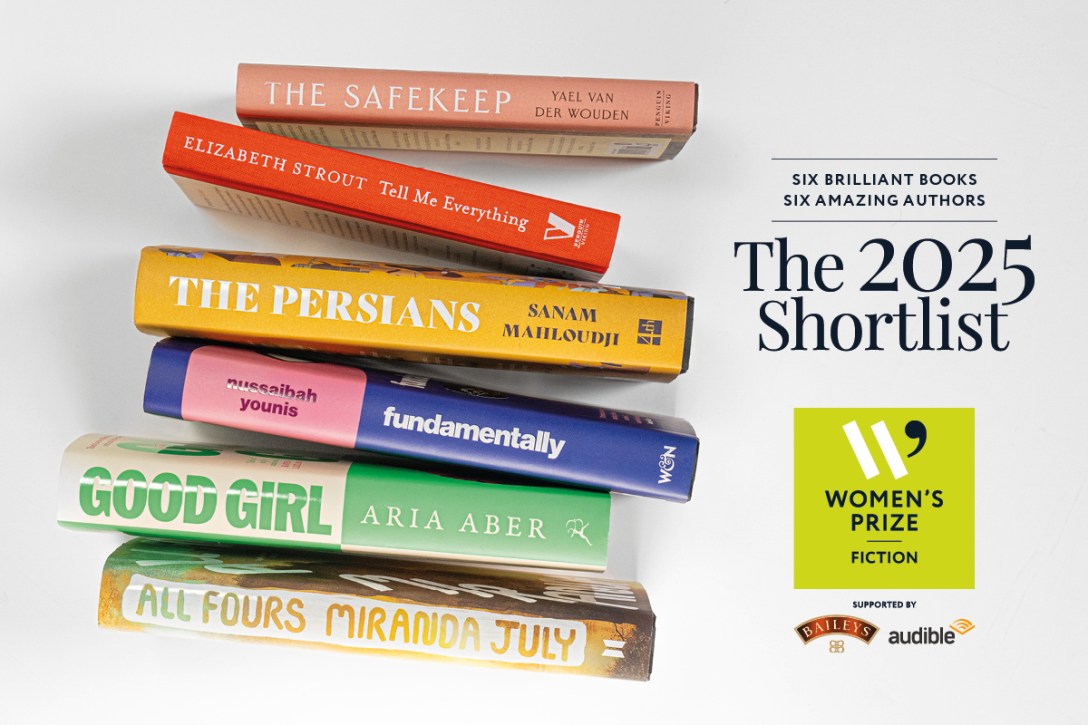
There’s only just over a week until this year’s Women’s Prize for Fiction winner is revealed! My favourite literary prize every year, I always make an effort to read the shortlist before the prize announcement. Many years, I’ve already read one or two of the books before the shortlist is revealed, but this year all six were new to me. This was pretty exciting as I got the chance to add six books to my to-read list (which, according to goodreads, now sits at over 400 books… oops, but also, no regrets). Now I’ve read them all, so here are my thoughts:

All Fours by Miranda July
I, like probably everyone but especially probably women, feel equally excited by and terrified of aging. While the last ten years of my life have been exponentially better on almost every metric than the ten years that preceded them (on a personal level, clearly; on a global level… you know), which I feel bodes well for the next ten years ahead, I can’t help but fear the advent of my late thirties, then the apparently-dreaded “over the hill,” and then, what?
Nobody really talks about what comes after. I guess women just become invisible, even to ourselves. The most chatter I ever hear about menopause is when my early-50s female coworker brings it up to annoy our late-20s male coworker.
Maiden and mother get plenty of airplay, but what about crone? NOT, to be clear, that someone ten years older than me, as is the protagonist of All Fours, is a crone. And she certainly doesn’t act like one either. Rather than withering, she is blossoming — sometimes into heretofore undiscovered alien flora rather than regular flowers, but still!
The protagonist reminds me a little bit of Jane from Danzy Senna’s excellent Colored Television. While they differ in that she has the level of semi-fame and certainly the amount of wealth to which Jane only aspires, they are the same in that I spent their narratives feeling engagingly horrified at the bafflingly bad decisions they make one spiraling from another. In a fun way.
I love the juxtaposition of how much we learn about the protagonist’s interior self versus how little we learn about the daily details of her life. Unless I missed it, I believe there is only even one fleeting reference to her name.
We never learn exactly where her fame and wealth came from — we know she writes, because a line from her work is licensed by a whiskey company, leading to a windfall that drives some of her wildest decisions, and later in the novel she publishes a book. But is she a novelist? A blogger? And there are hints that she works across various mediums, but we aren’t told exactly what they are.
From reading Miranda July’s wikipedia’s “Personal Life” section and seeing the similarities between herself and the protagonist, I imagine she is meant to have created a blend of visual, performing, and written arts like July, but I enjoy the way I felt allowed to create my own exterior vision of her, to compare and contrast with her interiority.
The protagonist falls into one of my favorite categories of characters: difficult to like but easy to love. She is narcissistic, melodramatic, a little bit deranged at times, and would be absolutely exhausting to know. But I couldn’t help but love her.
No matter what you think of her actions, which I won’t even begin to try to recap here because they are both more and less insane in the context of the novel, she is not someone who will allow herself to become invisible, although it seems like she may have been on the precipice of it. And in the protagonist’s journey of self-discovery, she also discovers a dawning era that she has not contemplated, maybe because most of us don’t contemplate it except with trepidation until we are in it.
After the appointment I sat in my car and did a quick round of open-sourcing, sending a group text to all the older women I knew. What’s the best thing about life after bleeding? I asked them. Just let me know when you get a minute! But the first response, from Sam’s old kindergarten teacher, didn’t even take a minute
I’ve never read anything by Miranda July before, but the way she writes about the interconnecting themes in this book — pregnancy and motherhood and menopause, relationships and monogamy and non monogamy and romance and sex and partnership, womanhood and queerness and gender, and more — rewired my brain a little bit.
While some of the protagonist’s experiences are not ones I will or want to have (spending twenty grand to redecorate a motel room, literally everything regarding all of her romantic relationships, although I did love all of her friendships), others are pretty much inevitable for all women as we age, and July perfectly captures the fact that this is beautiful and terrifying and somehow very funny. My favourite of the shortlist, and I hope to see it win on June 12.
Fundamentally by Nussaibah Younis
To be honest, in scrolling through the other reviews on goodreads, it seems like there are a lot of folks who really want this book to be something that it’s not. And I don’t mean that they think the book was trying to be something in particular and didn’t succeed; I mean that some reviewers seem to have made up a different book that they thought Fundamentally should be given the subject matter, and then got annoyed that it wasn’t trying to be.
Yes, it’s satirical, the tone is irreverent, and the protagonist makes a series of insane decisions. Those things are pretty obviously intentional on the author’s part. Have we strayed so far from media literacy’s light? With a decade in peacebuilding work on the deradicalisation of ISIS brides, author Nussaibah Younis could surely have written a serious and academic treatise, if that had been her aim.
For my part, I found the novel extremely successful, and extremely entertaining. For me, the incongruity of the subject (deradicalising ISIS brides) and the tone (more in line with a trashy beach read than a serious academic piece) brought such an interesting element to the novel.
In Fundamentally, protagonist Nadia agrees to take a role at an Iraqi refugee camp, spearheading a deradicalisation program for the UN. She quickly learns that, just as one of her primary motivations in the move was escaping the heartbreak of her girlfriend/flatmate/FWB dumping her, most of the other folks working there aren’t doing so with only the purest of motivations. Younis deftly skewers local and foreign governments and NGOs, aid workers and experts, including, I’m sure, herself.
Even the ISIS brides do not escape a bit of satire, although Younis offers a very empathetic narration here, looking at the complexities of their situations despite the choices that brought them to the refugee camp.
The star of the show is Sara, an English teenager of South Asian descent who had left to join the extremist movement at just 15 (in an obvious parallel to a real-life story). Nadia is immediately drawn to the young woman, seeing in Sara the endpoint of a path she herself could have gone down, had her circumstances been slightly different.
Her fixation drives the plot, and the depth of the two women’s similarities and differences bring a fascinating element to the story. When Sara finally opens up to Nadia around halfway through, it’s powerful and in some ways devastating; likewise when they have a heart-to-heart of sorts toward the end of the book.
Aside from Nadia and Sara’s, my favourite relationship in the book was between Nadia and her mother. Although it is a minor storyline, their rupture when Nadia came out as queer and has a crisis of faith and their gradual return to having each other in their lives felt both realistic and emotional.
The story throughout is about blinders, biases, and how they affect motivations and actions large and small, from top to bottom. The novel also forces us to confront our own preconceived notions, while still being entertaining, rather than lecturing.
My one complaint is that the part of the ending that concludes Sara’s storyline felt both slightly rushed and a too perfectly tied up. However, for me this was the second best of the Women’s Prize shortlist, and a shockingly fun novel and strong satire of a serious subject.
The Persians by Sanam Mahloudji
The Persians took me a little while to get into, but once I did I was hooked. This novel focused on a history and culture that I have to admit I know very little about.
The story is told from the perspective of women from several generations of a formerly-influential Iranian family, some of whom left Iran for the United States, and others who stayed. They no longer have their political power, but they still have their wealth. When one of the women finds herself in trouble with the law, the relatives are drawn together, and as they reconnect, for better or worse, their family history (and its secrets) are revealed.
The characters take some getting used to, being frequently over-the-top in their dramatics and often unlikeable. But Sanam Mahloudji does so beautifully with differentiating each of the women’s voices and offering their perspectives to the story that you come to understand each of them. The multiple POVs worked well for the structuring of the novel, and the later parts where the women spend more time together and interact solidified their distinct personalities and characters.
I feel like this would make a great miniseries, and it’s a strong addition to the Women’s Prize shortlist.
The Safekeep by Yael van der Wouden
“Isn’t that funny? No one ever knows anything in this country. No one knows where they live, who did what, who went where.”
I feel a bit torn about this book.
The writing was stunning, and each individual part of the book was very well plotted (aside from the sex scenes which I felt were, while also well-written, disproportionately long given the length of the novel without actually advancing the plot or revealing much about the participants’ characters, sex for sex’s sake that didn’t compare to the richness of the longing and metaphorical dance that came before).
The twist — I suppose you can call it a twist, although the way it reveals itself is not as a jump scare but as a realization that the horror has been lurking in the room throughout — is fantastic. The diary chapter is brilliant.
But the problem for me was that the “twist” and the shift in the narrative was so interesting that I ended up wondering why we had spent all of this time on the far less interesting narrative that had come before it.
And I found the ending frustrating. I felt that the ultimate resolution did not fully resolve the issue. Its success hinges on the stability of the characters’ relationships (saying what I can without spoilers) and I didn’t feel like that foundation was there, at least not to the level that would adequately lead to closure and happiness to the character who I felt most deserved it.
Whenever I read a debut novel I consider whether I’d read another by the author, even if I didn’t love the first, and in this case the writing was so good that I absolutely would. And as I said, I may return to reevaluate this one as well. But as it stands at the moment, I did feel like the book didn’t fully achieve its goals, but it did do what it could manage in a beautifully-written way.
Good Girl by Aria Aber
There are writers who can make stories about partying and doing drugs interesting and compelling, but there are also a lot of writers whose stories about doing drugs are interesting only to the participants, despite what they think. Unfortunately, this one is definitely the latter.
The element that is meant to save the novel from drowning in cliché is that the protagonist Nilab is the child of Afghan immigrants, but while the book’s only really moments of depth stems from this finding-identity-between-two-worlds narrative, they’re not enough to draw it out of the mire.
Despite being a woman author and even being shortlisted for the Woman’s Prize, and despite the protagonist obviously the protagonist also sharing much of her backstory with the author herself, if you’d told me that the author stand-in was not the protagonist but the douchey white American writerbro she’s in a boringly toxic relationship with, I’d nearly believe you.
There were some good lines in here, and again there were moments as Nilab grapples with her identity and with the expectations of her parents, her cultural background, and her life in an increasingly politicized and anti-immigrant Berlin that did strike me, but as a whole it mostly left me cold.
Tell Me Everything by Elizabeth Strout
This book is not last in my rankings, but separate. I find it hard to evaluate because I don’t think it was meant to be a reader’s first introduction to Elizabeth Strout, as it was for me.
I assumed that, because it was shortlisted for the Women’s Prize (the reason I read it), it would be a standalone novel even if it took place in the same universe as the author’s other works (similar to Marilynne Robinson’s Home, which I had no trouble reading independently despite not having read Gilead, and which won the Women’s Prize in 2009).
While this may technically be true in that the novel is another story in an existing universe rather than a sequel that directly follows the events of a previous book, from the number of reviews exclaiming joyfully about catching up with favorite characters like Olive Kitteridge, Lucy Barton, and Bob Burgess as though they are old friends, it is clear that the novel is far more meaningful to those who have already spent time with them and their town of Crosby.
That said, even without the backstory, there were some things I really loved about the novel. The writing was warm and inviting, not too soft or twee but gentle and genuine. I liked that most of the characters were older, a nice change from most novels being populated by people in their 20s and 30s. I loved how rich in detail the setting and characters both were, obviously bolstered by Strout having written about them many times before. It felt like there was so much going on in the background and the little moments that made it feel like a real place in which real people live, and I can see why readers would be delighted to visit with them again and again.


 thebestpossibletime