We all have them. Those internet rabbit holes you just can’t resist going down. Maybe it’s a topic that fascinates you, or one that infuriates you, or maybe it’s just one you know has enough content online that you can kill a bit of time when things are slow at work. Maybe you have a favourite topic that you check back on frequently in hopes of updates, even if the matter has been dormant for years. Maybe you and your friends share your findings back and forth, like my BFF and I do with bizarre advice column questions from sites like Ask a Manager and Dear Prudie.
Some rabbit holes are quite common: topics like unresolved true crime (who killed JonBenet Ramsey, who was Jack the Ripper) or cryptids (mythological—or potentially not mythological—beings like Bigfoot or the Loch Ness Monster) have always piqued our interest and our imagination. The internet has facilitated others: it’s easy to get lost scrolling through satellite images on Google Earth or idly planning a dream vacation or dinner on Instagram. Wikipedia is the biggest conduit, with its infinite hyper links making it easy to move through a series of innocuous topics until suddenly it’s three hours later and you’re deep into a world of conspiracy theories and oddities. “What is the best internet rabbit hole to get lost down?” is a common question on AskReddit, and Slate has an entire series based around the idea.
As someone who is Extremely Online, I probably go down the rabbit hole more often than most. Let me bring you down a few of my favourites:
Being a woman in a patriarchal society is hard, but it doesn’t make you a feminist.
Let me say it louder for the people in the back.
BEING A WOMAN IN A PATRIARCHAL SOCIETY IS HARD, BUT IT DOESN’T MAKE YOU A FEMINIST.
Feminism is about beliefs and actions aimed at dismantling the patriarchy, the systematic inequality that inhibits people of all genders. Feminism doesn’t mean that everything a woman does is good or feminist, that women can’t be called out (including by other women), that any criticism of a woman is an act of misogyny, that all women must lift up all other women all the time.
I would say it louder for the people in the back but I don’t want you to have to read a whole paragraph of capslock.
I always knew I wanted to be a writer, and I guess I was smart enough as a kid to realise that most fiction writers don’t immediately publish a bestselling novel and turn that into their day job, so I decided I wanted to be a journalist. Linda Ellerbee was my main inspiration for this, between her incredible educational news show Nick News and her Girl Reporter young adult book series.
I stopped wanting to be a journalist sometime in college. Although I loved my classes and my peers, and certain aspects of journalism like copyediting and researching are definitely right up my alley, and I do love the deadline-oriented nature of the job, I just couldn’t see myself doing it as a career. Sometimes I question that, especially when I look at the amazing work somefellowalums are doing, but for the most part I have no desire to step into a newsroom.
Still, I consider both Ellerbee’s work and my time at Ithaca College to have had a huge influence on shaping my life, but between them was something that was even more important: Reality.
I read an interesting article on Buzzfeed yesterday discussing the way youtubers and influencers use the idea of “self care” to sell sponsored content. The article discusses influencers who shill products that allegedly help them when they’re feeling low, as well as influencers who post sponsored (i.e. paid to mention certain brands) videos with a self-care focus. It’s a good article and it got me thinking about the way we use and, yes, commodify self care.
“Self care” is of course not a new concept, but it seems like there’s a definite uptick in talking about it as of late (especially, for obvious reasons, after the 2016 election). From blog posts to YouTube videos talking about “10 things I do for Daily Self-Care,” “My Favourite Beauty-Related Self-Care Products,” and so on. There’s also been a lot of discussion about the concept of self-care in positive and critical ways, ranging from an acceptance for the need for self-care being beneficial in fighting the stigma surrounding mental health to the inequality of “self-care” being limited to those who have the time and resources to achieve it.
The materialism often underlying self-care talk that’s examined in the Buzzfeed article is something that’s come up before, and I think it’s an interesting discussion. Part of this comes from the fact that some youtubers and bloggers who frequently talk about their self-care routines also gain emotional credibility from their audience through their openness about their struggles with mental health. While their efforts to work against the stigma of mental illness is admirable, there’s also a definite backlash against people equating “self-care” with a treatment for mental illness. There’s this whole history of people saying, “Oh you’re depressed? Just do something that makes you happy” that doesn’t acknowledge that mental health treatment often requires medical treatment because it’s a medical condition, not just a bad feeling, so the ire is understandable.
When I was a kid, I found a yoga VHS in the house and gave it a few goes before I got bored of holding a single pose for five minutes. I’m fidgety now—I can only imagine it felt like an eternity of stillness back then. When I was a teenager, I had a set of “yoga cards,” cardboard squares with yoga poses and mantras that were, I suppose, designed to guide your practice. I carried them through several moves, always intending to use them and never quite getting around to it. When I was in college, I took a yoga class. It was at 8 or 9pm on a Sunday, which wasn’t the optimal time for a college student to feel motivated to do anything but lie in bed and watch reruns of The Office. I tried a few more times here and there, but always ended up writing off yoga as one just not for me.
I think it was these cards, or something similar
That changed earlier this summer. When I couldn’t find an ATS bellydance class to pick up learning where I’d left off in Seattle, I signed up for the closest I could find to where I live (I’ve since found an ATS class so I’m happy to be taking that as well). This ended up being a fusion class with a strong yoga focus, so at first I was wary. Then, it began to click.
I still didn’t enjoy doing yoga for its own sake (yet), but I began to understand how the focus on flexibility, opening up joints, and strengthening muscles could translate into more powerful bellydancing. Every time I struggled into a slight backbend, I was making my body wave chewier and more dynamic. Every time I dropped from plank to the floor and into cobra (and, as time went on from plank to chaturanga to upward-facing dog), I was strengthening my core for better isolations.
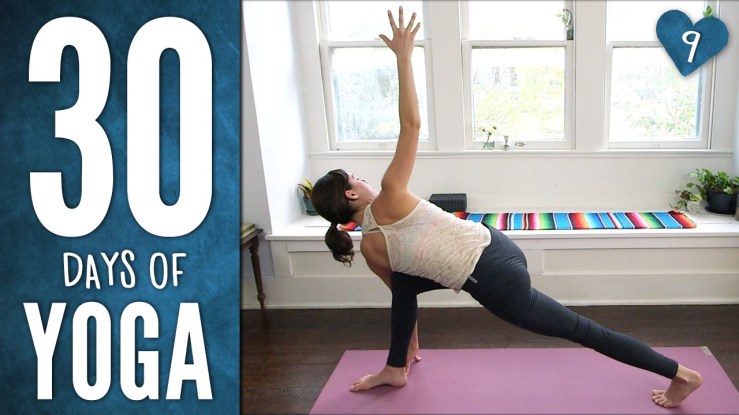
I decided I needed to do yoga more than the once a week in class to really feel the difference, so I asked some friends for recommendations of youtube videos, and that’s when I found Yoga With Adriene. I jumped nearly straight into her “30 Days of Yoga” series, and that’s when things really began to fall in place. Aspects of yoga that had always disinterested me finally began to seem fun and important as I modulated my breathing and let the day slip away. Eight days into the series (as I noted in my bullet journal), I felt savasana. The “corpse pose” had always been a sticking point for me in that college yoga class—why would I lie on the cold gym floor when I could go home and lie in bed? I finally began to appreciate the way it tied together a practice to transition peacefully back into your day.
Not only did I begin to enjoy doing the poses, I began to notice improvements. Today I finished the 30 Days series with a deeper forward fold, lower heels in downward dog, and, again, a smoother vinyasa from plank to chaturanga to upward-facing dog. My attitude toward yoga has changed too. I’ve stopped checking the clock and started checking on my breath, started focusing on my body instead of every external distraction I could find. My yoga journey is just beginning, but it’s one I feel inspired and confident to continue for months, years, and perhaps even a lifetime. Namaste.