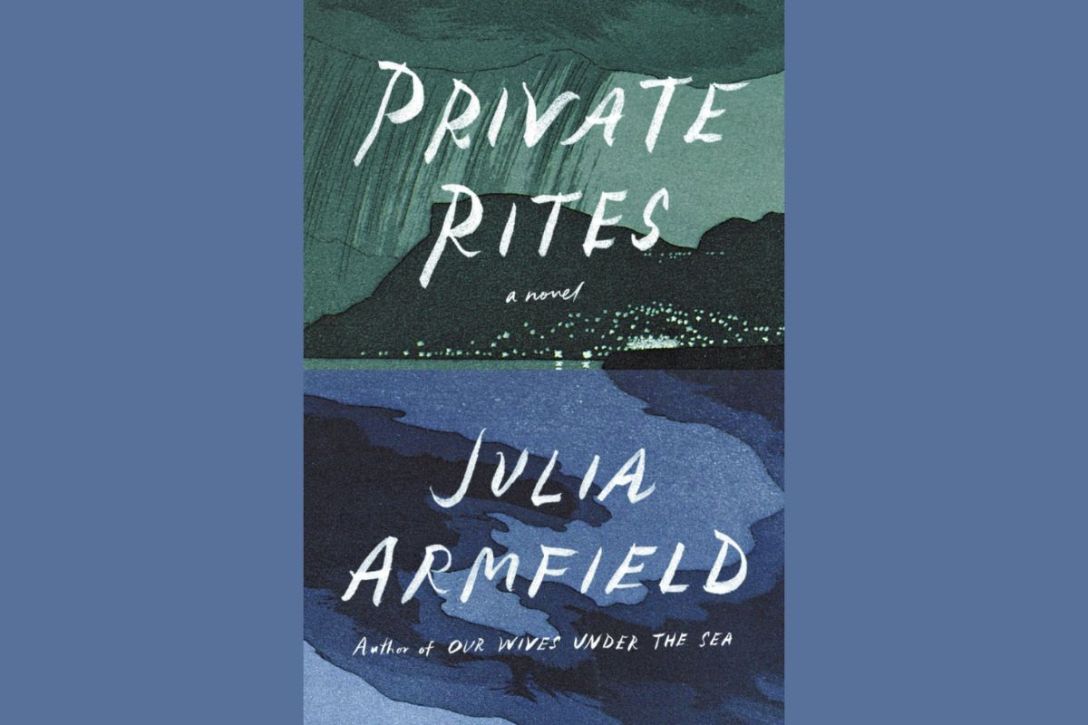
When I read Julia Armfield’s debut novel, Our Wives Under the Sea, I wanted to immediately call her one of my favorite authors, but it seemed silly to do so after only reading one of her books. When I read Salt Slow, the short story collection that preceded it, the feeling only grew. After reading Private Rites I’m completely confident in adding her to my list of favorites.

Did you ever, she once said to Isla, apropos of goodness knows what, read any of the weird shit that actually goes on in Revelations? In the Book of Revelations, I mean. People think it’s just hellfire and brimstone four horsemen and out, but actually the end times go on and on and on.
This is the way the world ends under capitalism, not with a bang but with a routine. When the seas rise so much that most of the population is forced to move to dilapidated urban centres in order to live in the high rises that are the only safe havens (unless you are rich enough to build your home high above the flood waters, of course). When the rain so rarely ceases that workers go about their days in a constant, sodden gloom (but they still go to work).
In the background, there is the creeping growth of uncanniness — strange practices, odd interactions, doomsday cults gaining membership — but for most people there is only the wet rot of monotony and misery as the world decays.
It is in this world— maybe, probably, a future vision of our world— that Private Rites takes place. It’s a serious slow-burner of a book, but with an explosive ending. This is the wrong genre Agnes thinks, but it’s only the wrong genre if you haven’t been paying attention. Like a river rushing up against a dam, the intensity builds and builds, and when the dam breaks, boy does it break.
Drawing inspiration from King Lear, the novel follows three sisters, held together and torn apart by the death of their wealthy but abusive father, as they struggle to find some sort of balance in their relationships and themselves in this world set adrift.
Isla, Irene, and Agnes are my favorite type of character — difficult to like but easy to love. At times, each one is frustrating, infuriating, endearing, enchanting. They live in this world of external and internal trauma that shapes them in some ways so differently and in some ways the same. I think Irene was my favorite of the three, but I loved each of them in their own way. I could have spent a lifetime with them.
The prose is exquisite, rich yet intimate, encompassing the overwhelmingness of the climate crisis as well as as the deeply personal moments between the sisters, their lovers, and the now-deceased patriarch of their family. The story crosses genres from family drama to speculative fiction to outright horror and creates a gradient that offers a full spectrum of everything in between. A truly fantastic novel that just further cements the fact that I’ll be waiting with bated breath on everything that Julia Armfield writes (and in the meantime, recommending her work to everyone who will listen).

 thebestpossibletime