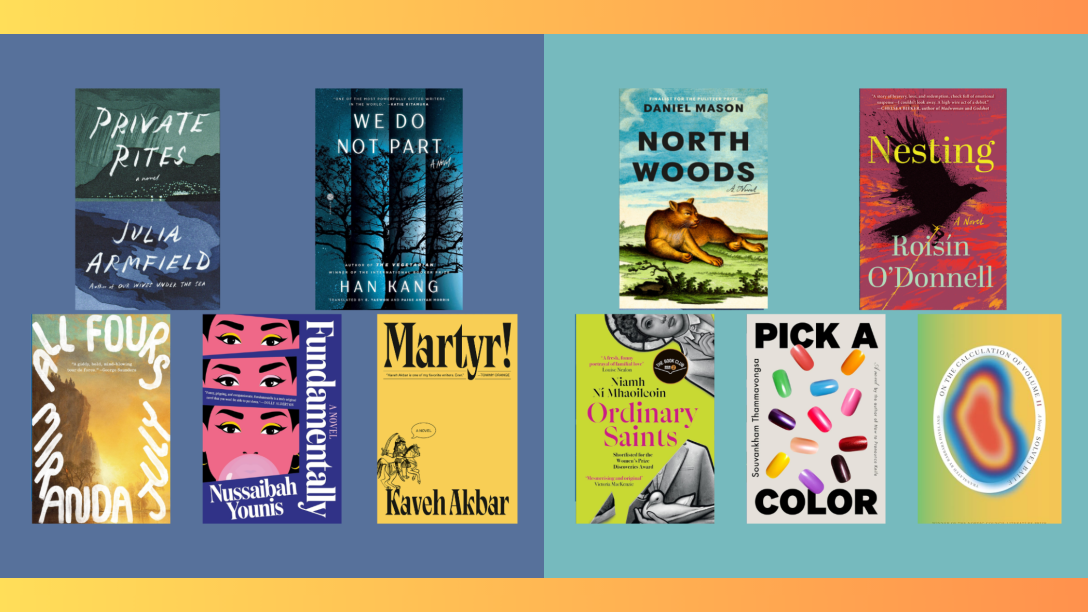
I read so many good books in 2025, it has taken me a few days to narrow down my absolute favourites. While, as I mentioned the other day, I’m hoping to read fewer books in 2026 and spend more time with each story, I definitely can’t complain about the quality of the work I read last year.
I tallied it up and I wrote about 40,000 words worth of book reviews on Goodreads in 2025, so if you want my full rundown on everything I read and loved (or didn’t love!) last year you should follow me there (for now… I’m trialling some non-amazon-owned alternatives to see if I can find a new bookish home in 2026), but here’s an overview of my 2025 fiction (non horror — they’ll get their own post!) faves:
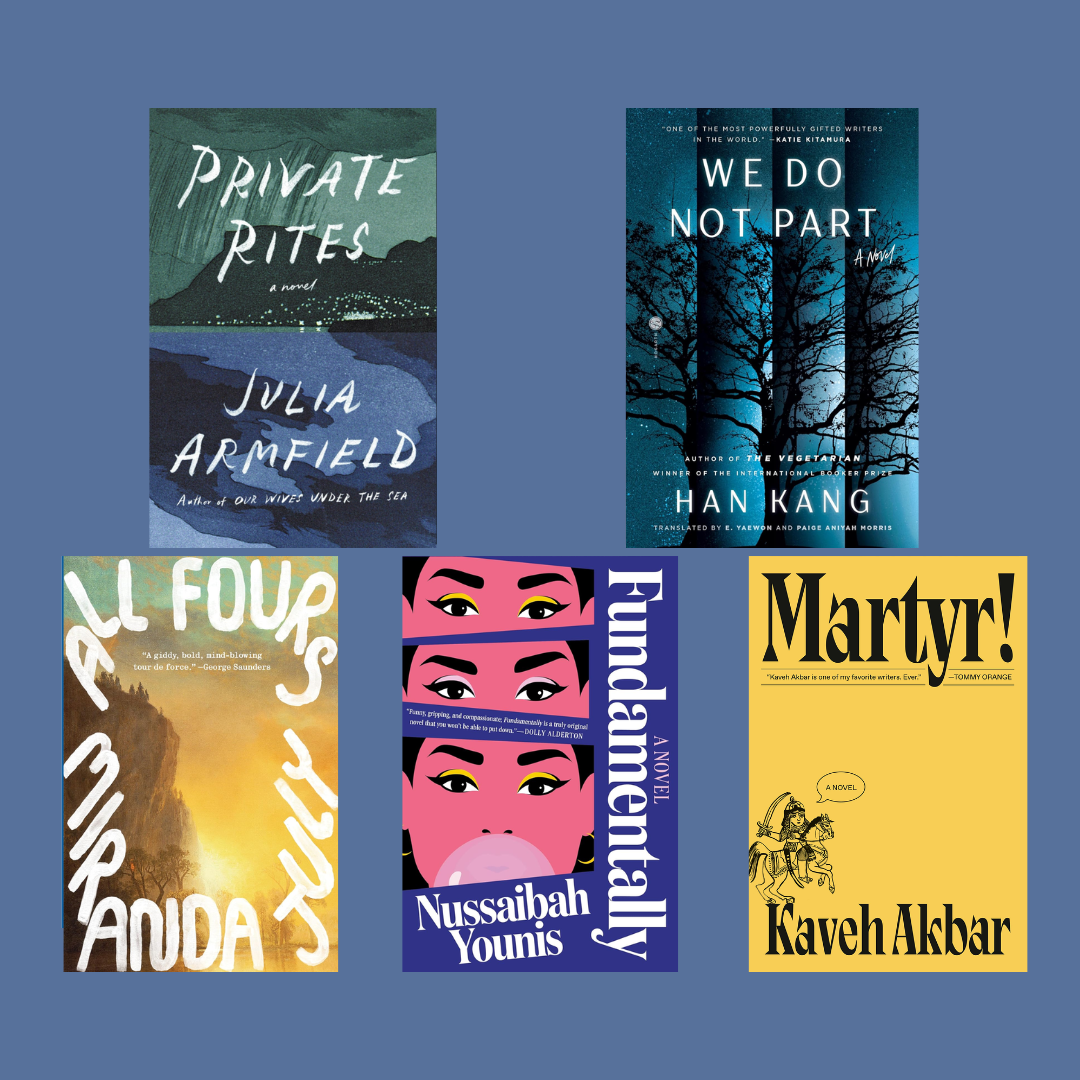
Private Rites by Julia Armfield – Drawing inspiration from King Lear, the novel follows three sisters, held together and torn apart by the death of their wealthy but abusive father, as they struggle to find some sort of balance in their relationships and themselves in a world set adrift. The prose is exquisite, rich yet intimate, encompassing the overwhelmingness of the climate crisis as well as as the deeply personal moments between the sisters, their lovers, and the now-deceased patriarch of their family.
We Do Not Part by Han Kang – We Do Not Part will probably be a lot of folks’ introduction to Han Kang, being that it is her first new release in translation since she won the Nobel Prize for Literature last year. And I think that this haunting novel is a perfectly fitting place to start. We Do Not Part encapsulates all of the things I have come to expect from Han’s writing — gorgeously poetic prose (this time translated from Korean by Emily Yah Won and Paige Aniyah Morris rather than her usual translator Deborah Smith), eeriness bordering on (and sometimes tipping over) the edge of horror, and unflinching references to the darkest parts of Korean history (in this case the 1948-49 Jeju massacre).
All Fours by Miranda July – I’ve never read anything by Miranda July before, but the way she writes about the interconnecting themes in this book — pregnancy and motherhood and menopause, relationships and monogamy and non monogamy and romance and sex and partnership, womanhood and queerness and gender, and more — rewired my brain a little bit. While some of the protagonist’s experiences are not ones I will or want to have (spending twenty grand to redecorate a motel room, literally everything regarding all of her romantic relationships, although I did love all of her friendships), others are pretty much inevitable for all women as we age, and July perfectly captures the fact that this is beautiful and terrifying and somehow very funny.
Fundamentally by Nussaibah Younis – In Fundamentally, protagonist Nadia agrees to take a role at an Iraqi refugee camp, spearheading a deradicalisation program for the UN. She quickly learns that, just as one of her primary motivations in the move was escaping the heartbreak of her girlfriend/flatmate/FWB dumping her, most of the other folks working there aren’t doing so with only the purest of motivations. Yes, it’s satirical, the tone is irreverent, and the protagonist makes a series of insane decisions. Those things are pretty obviously intentional on the author’s part. With a decade in peacebuilding work on the deradicalisation of ISIS brides, author Nussaibah Younis could surely have written a serious and academic treatise, if that had been her aim. For my part, I found the novel extremely successful, and extremely entertaining. For me, the incongruity of the subject (deradicalising ISIS brides) and the tone (more in line with a trashy beach read than a serious academic piece) brought such an interesting element to the novel.
Martyr! by Kaveh Akbar – This book lives up to every single bit of the hype. Everyone I know who has read it has raved about it. Everyone I don’t know who has read it has probably raved about it, too. And now I’m raving about it. Funny, devastating, beautiful. Every word genuine, every sentence poetic. I read it on a plane and while I would cry reading any book on a plane thanks to the heightened emotions that always seem to come with heightened altitudes, I think I would cry reading this book anytime, anywhere. I loved Cyrus. I loved Orkideh. I loved their realness, just slightly blurred by that sheen of unreality that turns interesting characters into interesting fiction.

North Woods by Daniel Mason – North Woods tells the story of a single house and its inhabitants over the course of several centuries. The writing in this novel is stunningly good, rich and full and as deep as the woods that surround the house. I loved the epistolary elements, which not only enriched the story but were creative in a way that went beyond the traditional use of the device. I loved the way it played with genre, and the way it blends classic and modern literary elements. I was completely drawn in and engrossed from the first sentence to the magnificent final pages.
Nesting by Roisín O’Donnell – By around 20 pages into Nesting I started feeling sick to my stomach, and that feeling didn’t abate through my entire fevered reading of the novel. Roisín O’Donnell masterfully takes the reader on a journey through Clara’s circumstances and her efforts to slowly build and rebuild her life with her children and to break free of the mental and emotional hold of her abusive ex. Viscerally real and unflinchingly powerful. The immediate horror of Clara’s situation and the insidious, creeping horror of everything surrounding it, and her abusive partner’s efforts to draw her back into an even worse situation, and the knowledge that there are so many real women for whom these situations — the abuse, the homelessness, the seemingly no-win choice between the two — are real life, all combine into a powerful and gut-wrenching read.
Ordinary Saints by Niamh Ní Mhaoileoin – Niamh Ní Mhaoileoin’s exceptionally good debut novel, Ordinary Saints, follows Jay, a queer, atheist, Irish woman living in London who finds out that the diocese of Dublin has initiated the process of putting up her late brother Ferdia for consideration for canonization. Jay must grapple with the news, with her own potential place in the process (she is asked to testify as to her brother’s saintliness), and with her relationships to her family, the church, the cultural Catholicism of Ireland, and her memory of her brother. The author writes about this push and pull so well, creating complex, sympathetic characters across the board. There are no cartoon villains, no innocent heroes. There’s nothing dogmatic here; everyone admits to doubts, even about their most staunchly-held beliefs, religious and otherwise. It requires an incredibly deft touch, and Ní Mhaoileoin handles it powerfully.
Pick a Color by Souvankham Thammavongsa – This is one of those stories that is so simple — a day at a nail salon, told from the perspective of the salon’s owner — that it requires perfect execution. And Pick a Colour by Souvankham Thammavongsa is exquisitely executed. Short and subtle, with every word feeling carefully chosen to create the atmosphere of the salon and the character of Ning, who in the salon is called Susan by her customers, and her staff, who are also called Susan by their customers. I was really moved by this novel. I found it so poignant and thoughtful, from the power dynamics between the “Susans” and their customers to those between Ning and the rest of her employees. The hints of Ning’s past life as a boxer add depth to the story, and the push and pull between her life in the salon, her self outside of it, and the stories she makes up for banal conversation with the clients are so interesting.
On the Calculation of Volume II by Solvej Balle – I was intrigued by the first volume of this time-loop novel, but this second installment has me absolutely hooked. It builds on the premise that while its protagonist is stuck in time, she is not stagnant in space; wherever she ends one of her seemingly endless November 18ths is where she awakes the next. This allows her to begin a journey of attempting to create a year through a slow migration— moving north to find an approximation of winter and then south in search of a simulacrum of spring. Likewise, certain meaningful items can be carried with her from one November 18th to the next, and certain items she consumes like food, etc. are gone for good even as the day resets. This begins to have an impact on the way she lives her days, and gives the novel an allegorical element in connecting it to climate change and the use of resources. This new depth to the second volume makes it such an addicting and thoughtful read, and has me waiting with bated breath until I can get my hands on the next.

 thebestpossibletime