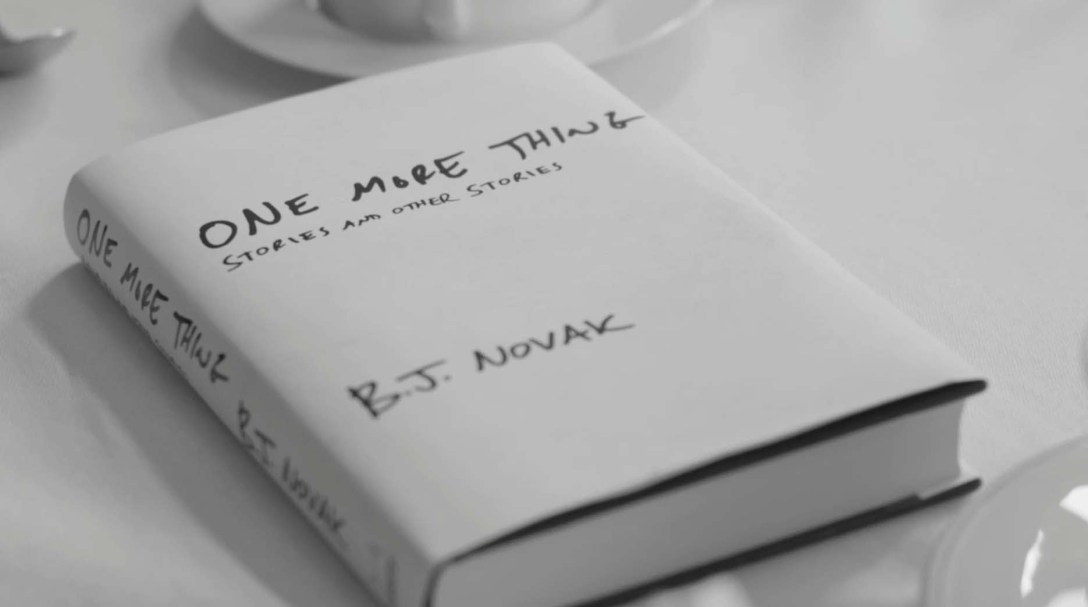
One More Thing by BJ Novak (2014): 4/5 stars

maxresdefault

There’s a video on Youtube of BJ Novak telling the story of “Wikipedia Brown and the Case of the Missing Bicycle.” It’s pretty grainy and the sound quality isn’t that great… and I’ve watched it enough times that when I reached the story in Novak’s first story collection, One More Thing: Stories and Other Stories, I could hear his voice in my head and could probably have recited the story nearly by heart myself.

Maybe that’s a sign I’ve followed BJ Novak’s career too closely, along with the fact that I recognised a few of the collection’s shorter “stories” as originally being from his Twitter account, but ever since I started watching The Office and Ryan Howard became one of my favourite characters on the show even in his most hate-able moments (that blond hair), I’ve been a big fan. So in fairness, this is a pretty biased review, as I already knew his sense of humour and writing style was in my wheelhouse.

Regardless, I loved this book, and stayed up into the wee hours of the morning to finish reading it. Every time I thought “I’ll stop after this story, save the rest for the next day,” I found myself reading another. Some were longer, while others were only a few lines (for example, “The Literalist’s Love Poem”: Roses are rose. Violets are violet. I love you.). The thing that I found most engaging about the collection was the tone.

Continue reading “One More Thing by BJ Novak (2014): 4/5 stars”

This Love is Not for Cowards by Robert Andrew Powell (2012): 4.5/5 stars

tlinfc-coverI don’t know much about the Liga Mx. I follow the English Premier League and the Spanish Liga, and I’ve even started watching a bit of Bundesliga recently (although I’ve yet to find a broadcast with English commentary so the only words I can pick up are things like “Dortmund” and “das fitness coach”), so I hardly have time to watch yet another league anyway, although I sometimes catch a match on Univisión while I’m at the gym. I know a few key words and names in Mexican football, Hérculez Gómez and Chivas and Chicarito and the Azteca, but comparatively, I’m in the dark. Before reading Robert Andrew Powell’s gripping book, This Love is Not for Cowards: Salvation and Soccer in Ciudad Juárez, I had certainly never heard of Los Indios de Ciudad Juárez.

Continue reading “This Love is Not for Cowards by Robert Andrew Powell (2012): 4.5/5 stars”

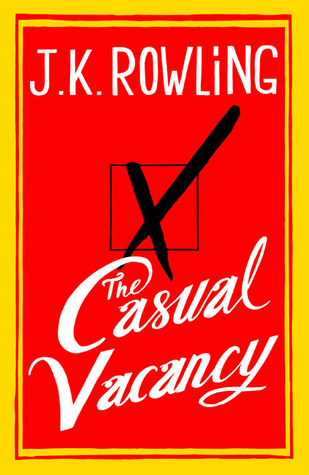
The Casual Vacancy by J.K. Rowling (2012): 4/5 stars

Before I begin this review, I’d like to take a moment and say that I’m sick of reviews referring to The Casual Vacancy as J.K. Rowling’s first novel for adults. While the Harry Potter books certainly originated as a series for children, the themes, particularly in the last three books, are appropriate for those who grew up with the series (I was in elementary school when the first book was released, and high school when Deathly Hallows came out), as well as younger readers and, yes, adults. However, I am alright with reviewers describing The Casual Vacancy as Rowling’s first book marketed toward adults because I do think that’s true—and I don’t think I would advise it be read by anyone under the age of twelve or so, due to the amount of profanity and sexual content (and violence, but then again, Deathly Hallows).

Continue reading “The Casual Vacancy by J.K. Rowling (2012): 4/5 stars”

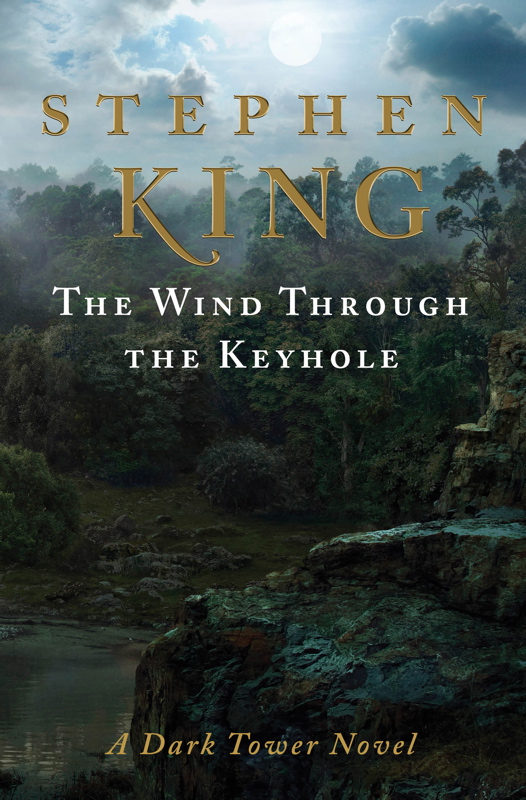
The Wind Through the Keyhole (Dark Tower 4.5) by Stephen King (2012): 3.5/5 stars

The Dark Tower 4.5
The Dark Tower 4.5

It’s no secret that I’m a big Stephen King fan. It’s even less of a secret that I’m a big Dark Tower fan, given that I have the Sigil of Eld tattooed on my wrist (although I suppose one would also have to be a big Dark Tower fan to recognize it as such). Therefore, I was excited when I heard that King would be releasing a new Dark Tower novel this year, if “excited” is a strong enough term. I was even more excited when I found out it was to be set between the fourth and fifth novels (Wizard and Glass and Wolves of the Calla), an excellent place for a little more information about Mid-World and Roland Deschain’s ka-tet.

Continue reading “The Wind Through the Keyhole (Dark Tower 4.5) by Stephen King (2012): 3.5/5 stars”

A Study in Sherlock by Laurie R. King and Leslie S. Klinger, eds. (2011): 3/5 stars

I love any sort of inspired-by-Sherlock Holmes story. Whether it’s an adaptation like the Granada series that stays very true to the book, something more swashbuckling (and “bromantic”) like Guy Ritchie’s films, a modern adaptation like the BBC’s “Sherlock“, or something more subtly connected like “House.” One of my favourite films as a kid was The Great Mouse Detective. I’ve also read several books that were inspired by or written about Sir Arthur Conan Doyle’s detective so when I saw this new anthology of Sherlock Holmes short stories by 15 different authors, I definitely wanted to check it out.

Continue reading “A Study in Sherlock by Laurie R. King and Leslie S. Klinger, eds. (2011): 3/5 stars”

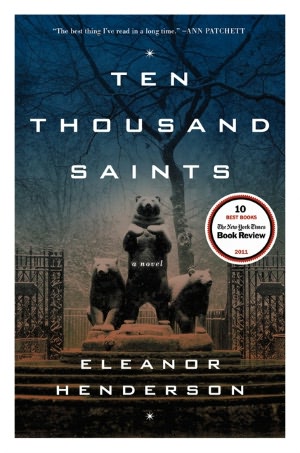
Ten Thousand Saints by Eleanor Henderson (2011): 4.5/5 stars

I first picked up Ten Thousand Saints because I thought it was cool that it was written by an Ithaca College writing professor. That is cool, but the book is even cooler. The novel addresses drugs, sex, pregnancy, AIDS, love, loss, grief, death, and family set against and embedded in the 1980s straight edge scene in New York City.

When fifteen-year-old Teddy McNicholas dies of a drug overdose in a small town in Vermont at the end of 1987, teenage rebel Jude Keffy-Horn, Tedd’ys brother Johnny, and new acquaintance Eliza come together in the city to struggle with holding on and moving forward. Johnny introduces Jude to the hardcore straight edge culture, and Jude’s initiation into the vegan, celibate, drug free world is a sharp contrast to his previous life and the people in it. Meanwhile, all three characters’ lives are changed when Eliza discovers that she is pregnant.

Jude. Johnny. Eliza. Teddy. Les. Rooster. I was absolutely fascinated by every character in this novel, from the protagonists down to those who only had minor roles in a few scenes. Each one had a strong voice and motivations, and the interactions between the characters were honest and powerful. I was especially drawn to Johnny, the tattoo artist and musician who served as Jude’s guide into the scene with simultaneously coping with his own losses and secrets. I was somewhat worried that Eliza would be playing the role of Manic Pixie Dream Girl when she first showed up, brash and beautiful from the big city, ready to change the lives of our heroes, but over the course of the novel I really warmed to her. She had the vulnerability you would expect of someone her age in her situation, but an independence and strong willed personality that let her hold her own against parents, love interests, and her own fears. There are no heroes and no villains (except for maybe death and the beginning of the AIDS epidemic) in this story; each character’s flaws are on full display, but at their hearts they believe they are doing the best they can.

Henderson’s voice is as strong in her setting as it is in her characters. I know very little about the 80s punk, hardcore, or straight edge scenes in New York City. However, I imagine that the atmosphere of the time was full of the same intensity that electrifies this novel. Every page is bursting with description and emotion, so much that sometimes I felt like I didn’t know where to look or what to think. Occasionally this was overwhelming; even more occasionally it seemed unnecessary. But for the most part I was engrossed by this portrayal of a subculture rife with passionate ideals and equally passionate characters. I was fascinated by the politics and the religion, the sexual and sometimes homoerotic undertones of the culture, and the way that the people in it connect and break apart. All of this is relayed with vivid and intense description.

The novel’s “weak” point is in the plot itself, which is sometimes meandering, sometimes jagged, and mostly unresolved. At the same time, I put “weak” in quotation marks because this lack of a single focus or closed ending is fitting with the tone of the book and the characters in it. The novel captures a moment in time, and the characters go on beyond it, profoundly changed by their experiences but not stagnated within them. A more focused conclusion would artificially end their stories, when the realism of the novel dictates that they should go on. Overall, Ten Thousand Saints is a novel full of authentic characters and rich in its description of an intense, emotional era.