Let me start by saying that this is not a definitive guide to Japan, or of the cities I visited there. It is not a guide to secret, off-the-beaten-path, locals only spots, or anything you probably can’t find in another blog post or pinterest page. Obviously this is true of pretty much every travel post I write, but for some reason people seem *really* obsessed with finding the “hidden” Japan in so many travel articles I read, the restaurants that would never deign to have an English menu or the shops whose doors have never been darkened by tourists, so I’m just going to make it clear that this is not that. This is just the places Steve and I went that we really enjoyed, because I have a bunch of friends planning trips to Japan who asked me for recommendations. So here they are. I’ve split the posts up because they’re super long, so today’s post focuses on Tokyo. Check back for my recommendations for Hakone, Osaka, Nara, Kobe, and Kyoto! I’ve bolded my best recommendations for easy reading. And I’m already daydreaming about another trip someday, so please do tell me your favourite things that I missed!
Omoide Yokocho, aka Piss Alley, full of tiny bars and yaktori restaurants
Last night Steve and I landed back in Melbourne after 11 days in Japan for sightseeing around the Rugby World Cup (COYBIG!) and while I have a lot to say about that (I promise, everyone who has asked for recommendations, I have heaps to provide!) I also haven’t even written about our last trip yet. And, well, it was kind of a big deal, so I don’t want to just let it pass by.
So here’s the story about my trip to Queensland with my now-fiancé:
I love to hike in the shoulder season. The temperature is cooler, so you’re not dripping with sweat while you tote around your pack. There are fewer people, so it’s less likely that you’ll be stuck 10 feet behind some asshole who thinks everyone else on the trail wants to listen their shitty EDM playlist. And there’s just something about the misty, transitional weather that accompanies spring and autumn that makes hiking during that time feel like an otherworldly adventure.
Of course, sometimes that adventure is more like a walk through Mordor than a trip into fairyland. A few weeks ago Steve and I went hiking in the Grampians, a national park about three hours’ drive from Melbourne. The weather during the week was decent but as the weekend approached the forecast looked worse and worse. 80%+ chance of rain is never what you want to see when you’re preparing to spend a few days in the great outdoors. Moreover, this would be our first time tent camping during a hike, spoiled as we’ve been with New Zealand’s amazing hut system.
The Seven Summits comprise the highest peak on each of the continents—Mount Everest, obviously, Denali in Alaska, Mount Kilimanjaro, and so on. For many, ascending each of these seven mountains is a lifelong dream. However, not all seven peaks are created equal. Obviously, Everest is the hardest not only for its technical difficulty but also for the tens of thousands of dollars cost of its permit, while Kilimanjaro is a multi-day but non-technical hike that can be accomplished by hikers without mountaineering experience.
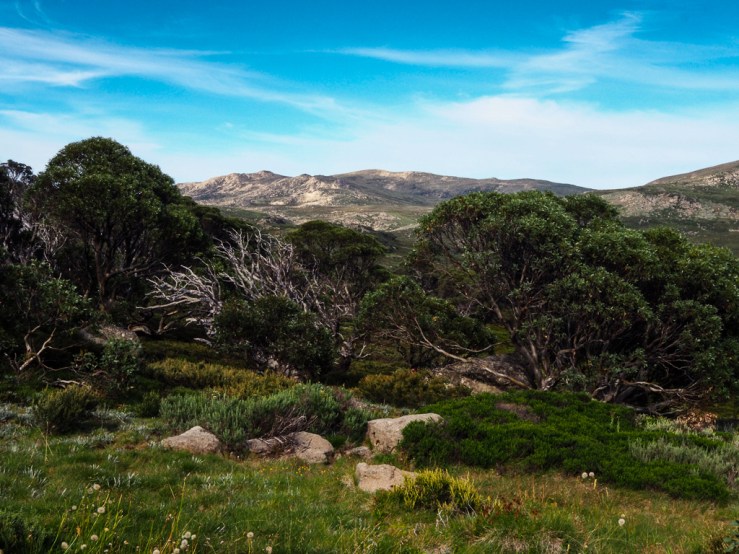
Looking at Kosci from the start of the Main Range Track
Then there’s Mount Kosciuszko. At 2,228 metres, it is only a quarter of the height of Everest, and can be summited in a single day—or less, if you take the route that includes a chairlift ride most of the way to the top. Some rankings of the Seven Summits don’t even include Kosci, replacing it with Puncak Jaya in Indonesia by considering Australasia the continent rather than Australia. But since I don’t have any desire to ascend all seven summits (I’d like to do Kilimanjaro in a few years, but I don’t see myself ever tackling the others), I’m happy to consider Kosci among the peaks.
Steve and me at the start of the hike
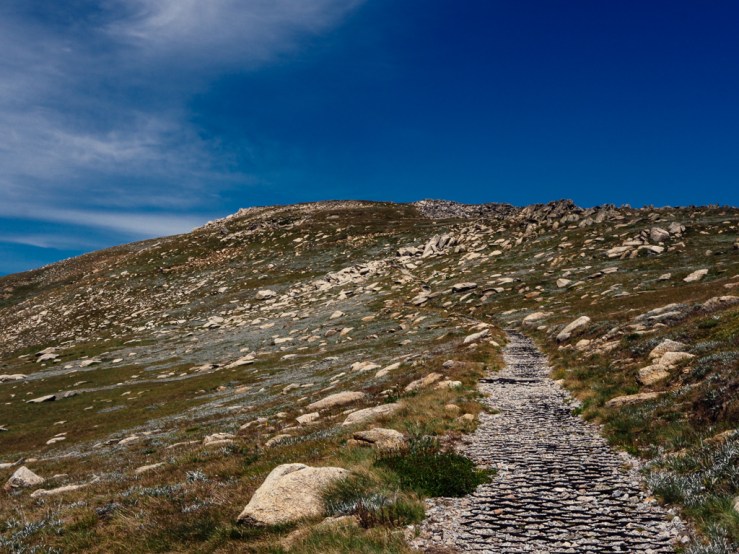
Last week, Steve and I rented a car and drove seven hours from Melbourne to Mount Kosciuszko National Park in New South Wales to hike to the highest point in Australia. We stayed overnight in Jindabyne, about half an hour away, and got up bright and early on Friday morning to head up the mountain. In order to make it more of a hike, we forewent the Threadbo trail with its chairlift and headed around the other side to Charlotte Pass for a 22km loop trail that connected the Summit Road and the Main Range Track.
The first thing that surprised me was how beautiful it was. I was expecting a dry, sparse range based on the endless stretches of red dirt and leafless trees we had passed on the Hume Highway on the way up, but the views were actually mountainous and lovely. The track was also wonderfully peaceful. On our way up, we only encountered one other group—a pack of older folks kitted out with tramping poles and wide-brimmed hats, who kept up a solid pace even on the steeper sections. There was no one blasting shitty EDM off their cell phones for all to hear, thank christ.
On the way to the summit
The top was a bit busier because the three trails—Summit, Main Range, and Chairlift—converged (I’d guess most folks came up on the chairlift based on the lack of daypacks or hiking boots) but it was still very quiet compared to some of the hikes I’ve done in New Zealand and elsewhere. A surveying trig and elevation sign mark the summit, where we took a break for lunch before following the mild downward grade of the Summit Road back to our car.
At the top!
The hike took us just over six hours in total, lunch included, and was only strenuous in its length, but it was still a fun way to spend a few days (on the trip, we also drove up to Canberra to visit the NASA Deep Space Communications Centre and the National Gallery and Museum), and it’s fun to be able to say we’ve climbed one of the Seven Summits, no matter how small.
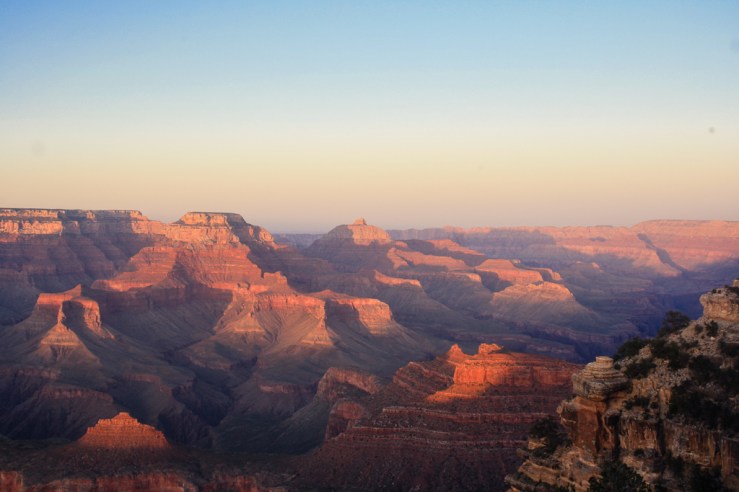
Whenever someone I meet in my travels asks me the best thing about the United States, the National Parks system is always the first thing that immediately comes to mind. There are plenty of places in the world that have incredible national parks, but the National Parks of the USA are special in their breadth and scope. Rock formations and rainforests, caves and canyons, islands and geysers and volcanoes and mountains… there’s something for everyone, representing the most incredible of Mother Nature’s offerings and welcoming over 300 million visitors per year.
Like everyone who love the National Parks system, I am heartbroken to read about the damage being caused to the parks by unsupervised visitors during the government shutdown. Trash overflows the rubbish bins, and let’s not even mention the toilets. Worse, there have been reports of vandals cutting the endangered namesake trees of Joshua Tree National Park in order to create access for their 4WD vehicles. Even during normal operating, there are many instances of graffiti and carved rocks from people who are too inconsiderate to follow Leave No Trace principles, so I can only imagine how much worse it is at the moment.
If you are also devastated by the destruction these thoughtless visitors are doing to some of the world’s most stunning sites, here are some ways you can help:
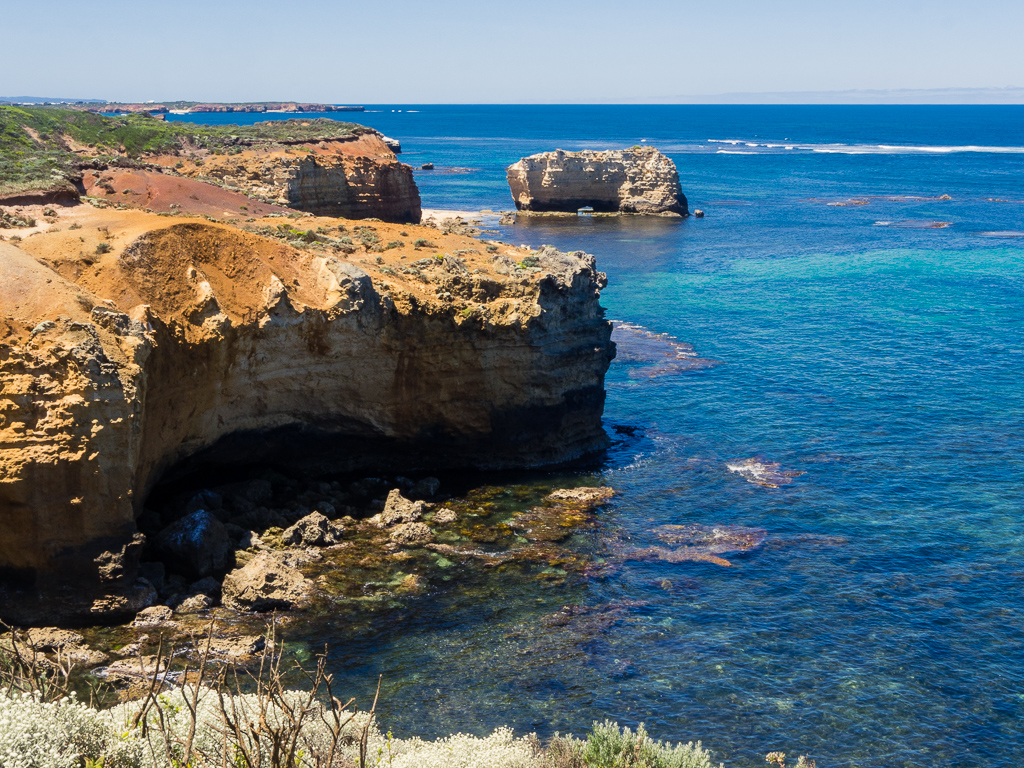
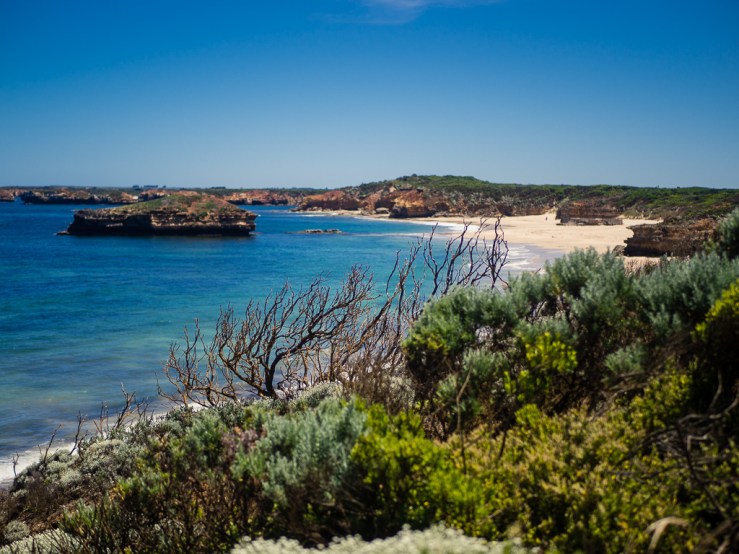
Since we arrived in Melbourne a month ago, most of our exploring has taken place around the city. Moving from Wellington, a city of 400,000 and just over 100km², to Melbourne, with its 5 million inhabitants and almost 10,000 square km, there is plenty to see and do within the city limits. However, we obviously much prefer to get out into nature, and so over the weekend we took a day trip out along the world-famous Great Ocean Road.
The Great Ocean Road is 243km long (plus an hour or so drive from Melbourne to its start) and features a number of beaches, towns, and other sights to see, so ideally you would do it over at least two days or as many as five or six. However, our spur-of-the-moment planning meant that we only had a day; we will definitely head back at some point to see more, but we still got to hit the highlights and I think the trip was worth it for sure.








 thebestpossibletime