November 9.

I’ve learned a lot about our country and our world in the past year, but I don’t think I learned enough. I learned about the bad, of course, inescapable as it was, but I, like so many of us, still believed it was a vocal minority. I’ve felt the effects of systemic and everyday sexism. I’ve seen the effects of systemic and everyday racism, homophobia, xenophobia, all the things that Trump espouses and champions, on friends and acquaintances, but I still, maybe naively, believed that when it came down to it, love would trump hate. Yesterday, it did not.

That makes me afraid, it makes me determined to fight back, but it also makes me aware of the bubble I live in. I grew up in a swing state that just went red for the first time since before I was born, I went to a progressive town for college, moved to a progressive state, and currently live in a progressive country. The Trump supporters I know are few and far between, and none of them would fit under the label of “deplorable.” And yet, outside of my bubble, a different story.

Those of us with the privilege not to fear speaking to those with views anathema to ours must do so. I’m sure there will be many who won’t be open to change, but (and here I reference what was, to me, one of the most shocking moments of the whole election cycle) if Glenn Beck can now publicly consider himself a supporter of the Black Lives Matter movement, I suspect there are many who might learn to reconsider what will make America great. Those of us with the privilege to step outside our groups of friends who believe in gay marriage and Roe v. Wade and multiculturalism and respect for all genders and religions without fear must do so for those without.

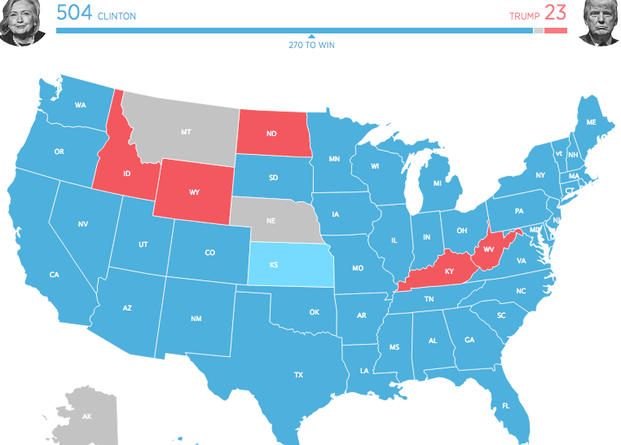
The map (see above) showing that if only millennials voted Clinton would have likely won by a landslide is a hopeful sign but also a sobering reminder that deplorable ideals have not, to be blunt, died out. It makes me all the more determined that we must not let our generation stray from a path of progression, and we must guide the younger generation onto that path. I still believe that love trumps hate, but I must now always remember that it needs our help, my help.

You must remember too. Not only you, us, Americans, but you, us, the world. Remember when we watched Brexit and thought there was no chance it could go through? Remember when you watched our election and thought there was no chance Trump could win? Imagine someone running for election in your country and says “We’ll send all the [Muslims / Eastern Europeans / refugees / Chinese immigrants / insert group here] home” and “We’ll make sure abortion stays illegal” (Irish friends) and “I’ll make your country great again.” You would hate this man, your friends would too. But do you know enough about your country to know that the rest would feel the same? I thought I knew enough about mine and I was wrong. Alt-right sentiment is rising across the Western world. Don’t be complacent.

I don’t feel hopeful today, so it’s hard for me to write about the good things that came from this election. The women born before suffrage who were able to vote for a female candidate for the first time. The women of color elected to congress. The folks who, in the immediate aftermath of the election, swore to do their all to protect their POC and LGBT and female and immigrant and scared friends and neighbors and strangers. The helpers, as Mr. Rogers would have said, who were and are ready to fight for our country and our world.

It may be hard, today, to feel like our country is worth fighting for, but that’s all the more reason to do it. I’m not ready to fight yet, I need to take a few days to come to terms with the fact that a man who thinks it’s okay to grab women like me by the pussy and take away our reproductive rights is the leader of our country, but I will be ready soon. And when I’m ready, if you’re not ready yet—if you’re still mourning the fact that the leader of our country wants to build a wall to keep your family out, to send your family away based on your religion, to belittle you because of your disability, to marginalize and mock you and incite hatred toward you—I will fight for you. And when you’re ready to fight, we will fight for us.

Here, from Jezebel, is A List of Pro-Women, Pro-Immigrant, Pro-Earth, Anti-Bigotry Organizations That Need Your Support, as a jumping off point.


Stories You Should Read This Week (4/2/16)

It’s time for the latest edition of Stories You Should Read This Week. I’ve got six links to awesome things I’ve read around the internet recently. Read them at work, read them on the bus, read them in bed. Tell me what you think, tell the authors what you think, tell everyone what you think.


Burgers, Bitches, and Bullshit by Bethany Cosentino (via Lenny Letter)

I generally like to avoid most-things-Lena-Dunham, but this essay by Best Coast’s front woman Bethany Cosentino on Dunham’s Lenny Letter site is a must-read. Not because her experiences–being told to smile, being lauded for her looks over her achievements–will be unfamiliar to many (most) women, nor because should come as a surprise that success may only increase these sexist instances, but because Cosentino rightly joins artists like Cvrches’ Lauren Mayberry in loudly and boldly calling these assholes out.


A Chat About Diversity in Publishing by Nicole Chung and Linda Z (via The Toast)

Like the interviewee, who works in my dream career of publishing, I fit the majority demographic of the publishing industry: female, white, straight, cisgender, able-bodied, and from an educated, middle-class background. Yet books about people in this demographic are still so often pigenholed as “Women’s lit” rather than just “lit,” and books by women who are minorities in other ways (non-white, LGBT, and so on) are even further marginalized on the shelves. The current cultural conversation is about another media format (see #OscarsSoWhite) but it’s just as relevant in books.


Marcia Clark On What Episode One of The People v. O.J. Simpson Got Right and Wrong by Maria Elena Fernandez (via Vulture)

I’m a little too young to really remember the O.J. Simpson trial, but I still remember and know that it was a major event if not the major event of the mid-90s, so of course I was excited for the start of this miniseries, even if it’s helmed by Ryan Murphy. In this interview, Marcia Clark talks about her reaction to the premiere episode.


An Invitation Into the Shadowy World of Match Fixing by Ben Rothenberg (via NY Times)

Match fixing conspiracies seem to abound whenever there’s an upset, or a lot of betting on a match, or pretty much any time a sport is played. But it does happen, sometimes obviously and sometimes not. Tennis is the sport currently embroiled in the scandal, but this fascinating read could surely occur in any sport.


Alternatives to Resting Bitch Face by Susan Harlan (via McSweeney’s)

I’ll just post an excerpt from this perfect list:

I Would Prefer Not To Face

A Smidge of Self-Awareness Would Not Go Amiss Face

The Situations Are Really Not Analogous Face

Please Tip a Bottle of Bourbon Down My Throat Immediately Face


Stop Trying To Out-Feminist Each Other by Maya Kachroo-Levine (via The Financial Diet)

I’ve been reading The Financial Diet recently since my fellow Ithaca journalism alumna Maya is a writer there, and I enjoyed this piece she wrote about your earning versus your partner’s earning and whether it matters as a feminist. She says, and I agree, that it doesn’t. If you earn less than—or more than! or the same as!—your SO, your partnership and everything else in your life can empower you as a woman and a feminist, and just because you don’t shout about it doesn’t mean people can tell you otherwise.

Stories you should read this week (7/1/16)


How Our February Cover Star Amandla Stenberg Learned to Love Her Blackness by Solange Knowles (via Teen Vogue)

Warning: this profile of the very cool Hunger Games actress Amandla Stenberg by the equally cool Solange will definitely make you wonder why you couldn’t be this awesome at 17.

How Islamophobia Hurts Muslim Women the Most by Sirin Kale (via Broadly)

This article from Vice explains how the intersection of Islamophobia and misogyny makes Muslim women particularly vulnerable to violence and harassment.

Two Sisters’ Escape from Syria by Sarah A. Topol (via The Cut)

This article focuses on two young female refugees (a minority, as most women who leave are traveling with their families) as they journey from Syria to seek asylum in Europe.

This Couple Wants to Show How Traveling With A Partner Isn’t Always A Fairy Tale by Annie Daly (via Buzzfeed)

As someone who also hopes to do extensive traveling with her partner in the future, I enjoyed reading this honest piece about the relationship struggles created by full-time travel.

The Wall Dancer by Nick Paumgarten (via The New Yorker)

This New Yorker piece profiles Ashima Shiraishi, the incredible girl who is, at the age of 14, already one of the most (if not the most) talented rock climbers in the world.

Read these when you need a break from your relatives this week

The holidays can be stressful.  So many people, so much socializing. Sometimes you need to take a break and curl up in your room with something to read, but I know from experience that trying to fit in an entire novel between dinner and coffee is generally frowned upon. For a shorter pick, here are five essays posted in the last month that are definitely worth a look. Bonus: you’ll have something to talk about when you rejoin the group.

On Dossiers, Permitting Shame, Error and Guilt, Myself the Single Source by Brian Blanchfield (BOMB Magazine)

A dossier then is a repository of otherwise loose relevant material, a file, on a subject. Usually a human subject. The term is professional, and may be primarily legal. I believe there is even a kind of briefcase called a dossier briefcase, one which—in my image of it—is still portable by a handle but larger than standard, with an overtop flap and front clasp. One might keep a dossier on a client or a suspect, or, in other professions, a recruit. I think it has currency in the world of espionage. For me, though, for many teaching writers, more than ever, the term is a codeword of academia, full of a kind of consternation for those who struggle for a career there. As I write this, it is again high season for applications, and I am yet again updating my teaching dossier, which has been kept on file with a dossier service since 2005.

On Pandering by Claire Vaye Watkins (Tin House)

 Now, I realize I’m not a special snowflake, that every woman who writes has a handbag full of stories like this. There is probably an entire teeming sub-subgenre titled “Stephen Elliott Comes to Town.” I offer this here partly because it was my very first personal run-in with overtly misogynistic behavior from a male writer, and so perhaps my most instructive. I learned a lot from that Daily Rumpus e-mail (which is a sentence that has never before been uttered). I want to stress that I’m not presenting Stephen Elliott as a rogue figure, but as utterly emblematic. I want to show you how, via his compulsive stream-of-consciousness monologue e-mailed to a few thousand readers, I was given a glass-bottom-boat tour of a certain type of male writer’s mind.

Teach Yourself Italian by Jhumpa Lahiri (The New Yorker)*

 In a sense I’m used to a kind of linguistic exile. My mother tongue, Bengali, is foreign in America. When you live in a country where your own language is considered foreign, you can feel a continuous sense of estrangement. You speak a secret, unknown language, lacking any correspondence to the environment. An absence that creates a distance within you.

In my case there is another distance, another schism. I don’t know Bengali perfectly. I don’t know how to write it, or even read it. I have an accent, I speak without authority, and so I’ve always perceived a disjunction between it and me. As a result I consider my mother tongue, paradoxically, a foreign language.

As for Italian, the exile has a different aspect. Almost as soon as we met, Italian and I were separated. My yearning seems foolish. And yet I feel it.

How is it possible to feel exiled from a language that isn’t mine? That I don’t know? Maybe because I’m a writer who doesn’t belong completely to any language.

Men Explain Lolita to Me by Rebecca Solnit (LitHub)

It is a fact universally acknowledged that a woman in possession of an opinion must be in want of a correction. Well, actually, no it isn’t, but who doesn’t love riffing on Jane Austen? The answer is: lots of people, because we’re all different and some of us haven’t even read Pride and Prejudice dozens of times, but the main point is that I’ve been performing interesting experiments in proffering my opinions and finding that some of the men out there respond on the grounds that my opinion is wrong, while theirs is right because they are convinced that their opinion is a fact, while mine is a delusion. Sometimes they also seem to think that they are in charge, of me as well of facts.

My Life as an Abortion Provider in an Age of Terror by Dr. Natalie Whaley (Broadly)

 I wasn’t yet a doctor when Dr. George Tiller was murdered, though the memory of it is indelible. It would be impossible to ever forget the way he was taken: executed while serving as an usher at his church. Acts of terrorism are the most profound for those who have the lived experience of being afraid. In the 1990s, long before I started providing abortion care, abortion clinics were bombed and set on fire, abortion providers were shot and murdered, and so much violence occurred that the FBI and Department of Justice began tracking and addressing it as a form of domestic terrorism. I knew about these acts of violence, but I was not directly involved in abortion care when they occurred.

*I have such trouble choosing a no. 1 favourite anything, but this is probably the best essay I have read this year.

Patriotism.

I’ve never quite understood patriotism. It’s not that I dislike America or that I’m unhappy to be American, but I’ve never felt the need to express it through a $5 Old Navy flag t-shirt (after the age of 8 or so). I find the USA USA chants that break out during every sporting event (even those where both teams are from the states) almost as cringeworthy as that awful, sappy “Proud to be an American” song.

A couple of truly great Americans

What’s especially weird to me is that the people who are most invested in this kind of materialistic patriotism are often the ones who don’t understand how others may not benefit from the “land of the free” as much as they do. The people who say they “don’t see race” and then take seriously the idea of the President’s birth certificate being a forgery. The people who would try to stop a female Senator from preventing a bill restricting womens’ rights because of “the sanctity of life” but would, in the same week, justify the 500th death penalty execution in the state since 1982. The people who put up signs in their businesses reading “This is America; speak English” but don’t know enough about their country to know it does not have an official language. The people who would keep secret a program spying on peoples’ internet activities (but only the foreign-seeming ones) but who would tell those who complain that if you’re not doing anything wrong you have nothing to hide.

Continue reading “Patriotism.”

In NOLA, culture and current events

Well, I’ve had an eventful couple of weeks. In backwards chronological order, I’ve

  • started my final semester at Ithaca College. I’m taking five classes, two of which are required for my major/minor, and all of which I will hopefully manage to handle despite the fact that I can already feel senioritis setting in. 
  • been accepted to grad school. Next year I’ll be studying for an MA in Literature and Publishing at the National University of Ireland, Galway. I was looking at a number of different routes for my post-graduate plans, but this was my secret number one, so when I was accepted I knew it was where I wanted to be.
  • spent a week in New Orleans, working with local nonprofit Lowernine.org along with fourteen other Ithaca College seniors, our advisor, and several others. And that’s what I want to write about now.

A lot of people don’t realise the extent to which Hurricane Katrina and its aftermath are still affecting New Orleans. I didn’t, having never visited the city before. And after a week there, I certainly can’t say that I fully understand the impact of the storm and what followed, but even more than becoming aware of it, I now realise how unaware I was before. There’s this sort of dichotomy when it comes to short-term volunteer work or visiting the site of a disaster—you can’t fully understand a situation just by being there a week, and you can’t make the trip all about you by saying “yes I feel so enlightened/inspired/whatever now,” but at the same time, but at the same time awareness and knowledge is really important. There’s a fine line between helping out and disaster tourism, and that’s a line that we worked hard not to cross. I liked working with Lowernine because they had strong connections to residents—one of their coordinators was born in raised in the Ninth Ward—and it never felt like they were doing what they thought should be done, but instead they were looking for guidance from residents and homeowners as to what was needed.

Continue reading “In NOLA, culture and current events”