To-do list: now ’til Tuesday?

It seems like every birthday is a milestone birthday for some reason or other. There are the obvious ones like 18 (adult), 21 (drinking), 30 (flirty and thriving, as the Jennifer Garner movie taught us), 40 (over the hill), and so on, but then there are the lesser known milestones like 27 (“will I become a rock star and die this year, joining the infamous 27 club?”) and 80 (retirement? maybe?).

Age 25 is something in between. It doesn’t really come with any new responsibilities or perks (except for not having to pay a shitload extra for car rentals, which as I’m renting a car next weekend I guess is a perk) but a “quarter of a century” does sound pretty cool.

Also, being the aforementioned quarter of 100, 25 is a favoured number for lists, bigger than 10 but not quite the commitment of 50. While “30 Things to Do Before You Turn 30” seems to be the most popular age-related list, there’s no shortage of “25 Things to Do Before You Turn 25” advice. Since I hit that “start your quarter-life crisis” milestone in less than a week, I decided to take a look at four of those lists (100 items total) and see if I’m on track.


Thought Catalog: 25 Things Every Woman Should Have Before She Turns 25

My score: 18/25

According to TC, that bastion of cluelessly privileged,, pseudo-profound lists like this one, I’m doing pretty well. Okay, so I have way too many numbers in my phone because I’m a hoarder of all-things digital and I can’t access Plan B on a moment’s notice (has this writer not heard of the pill?). But I can cook, I have a passport, and I call my mom frequently. So great, it sounds like this list is basically “are you an adult, more or less?” and it looks like, more or less, I am.


SugarScape: 25 books every girl should read before they turn 25

My score: 13/25

Not so great on this one, although a few are high on my to-read list (my boyfriend bought me a copy of #Girlboss for Christmas, so there’s a good chance I might actually up that number to 14 if I finish the third book in J.K. Rowling’s Cormoran Strike series in the next few days). However, while there are some favourites on the list (Harry Potter, Mindy Kaling’s Is Everyone Hanging Out Without Me?) and a few I think should absolutely be required reading for women (Play it as it LaysThe Handmaid’s Tale), there are also a few I didn’t enjoy at all (Jane EyreThe Lovely Bones), so it’s possible this just isn’t a good list for me from which to take my life’s guidance.


Hello Giggles: 25 Habits To Break Before Age 25

My score: 10/25

This is my worst score of the four, but you know what? I don’t feel bad about it. I’m not sure why the author thinks some of these habits need to be broken. Yeah, I’ll  use my credit card on a $2 bottle of water but I track my spending and I’m pretty good about sticking to my budgets. And I don’t enjoy talking on the phone, so I definitely don’t find it more meaningful than texting. Also, why was stealing one of the author’s habits to begin with? I will say I could do with breaking the “going to the grocery store while hungry” habit, though.


Buzfeed: 25 Movies You Have to See Before You Turn 25

My score: 15.5/25

(The 0.5 is because I’ve read the book Persepolis although I haven’t seen the film)

While I’m not sure why some of the films on this list need to be seen specifically before you turn 25, like North by Northwest and Requiem for a Dream  (unless you need a big wake-up call regarding your drug use?) but all of the films I’ve seen on this list are great and there’s a few that look interesting. Maybe I can squeeze a few more in between now and Tuesday.


Total score: 56.5/100

According to these lists I’m not doing so hot. I’ve done a lot in the last 25 years, and since I won’t spend any of the next 25 being a baby, a toddler, or (ugh) a preteen, I expect I’ll accomplish a lot more in the next 25. And since, again, I haven’t had to spend any of the last quarter-century breaking a stealing or a drug habit, I’ve got a feeling I’ll manage just fine. Anyway, there are always the “30 Before You’re 30” lists to measure up against in another… well, let’s not think about how many years or my quarter-life crisis will start a few days early.

Stories you should read this week (7/1/16)


How Our February Cover Star Amandla Stenberg Learned to Love Her Blackness by Solange Knowles (via Teen Vogue)

Warning: this profile of the very cool Hunger Games actress Amandla Stenberg by the equally cool Solange will definitely make you wonder why you couldn’t be this awesome at 17.

How Islamophobia Hurts Muslim Women the Most by Sirin Kale (via Broadly)

This article from Vice explains how the intersection of Islamophobia and misogyny makes Muslim women particularly vulnerable to violence and harassment.

Two Sisters’ Escape from Syria by Sarah A. Topol (via The Cut)

This article focuses on two young female refugees (a minority, as most women who leave are traveling with their families) as they journey from Syria to seek asylum in Europe.

This Couple Wants to Show How Traveling With A Partner Isn’t Always A Fairy Tale by Annie Daly (via Buzzfeed)

As someone who also hopes to do extensive traveling with her partner in the future, I enjoyed reading this honest piece about the relationship struggles created by full-time travel.

The Wall Dancer by Nick Paumgarten (via The New Yorker)

This New Yorker piece profiles Ashima Shiraishi, the incredible girl who is, at the age of 14, already one of the most (if not the most) talented rock climbers in the world.

Vhy Ve Love Viktor Krum

I just finished rereading the Harry Potter series for the first time in a few years. The earlier books I’ve read and reread at least a dozen times; the later books, fewer, but still three or four times apiece. Usually when I reread a book (which is frequent, with my favourites) I notice something new each time through—some small detail I missed the first time around (or the second, or the third). However, I think I may have finally reached the point where I’ve caught everything there is to catch in the Harry Potter series. For the first time rereading it, there were no moments where I thought “Oh! I hadn’t noticed this before.” I suppose I’m not surprised given that there are a good few passages throughout the series that I know by heart.

In place of lines I feel as though I’d never read before or events that I feel that I am eagerly turning the pages to read for the first time, however, I find myself interested in different characters than I had been on previous read-throughs. I still love the main characters, of course, and I still have my favourite secondary characters, but I notice the awesomeness of various minor characters as if meeting them for the first time. I’ll talk about the three I loved a lot in this most recent reread in this and upcoming posts, beginning with a character I find very underrated (by us, not by the wizarding athletic world): Viktor Krum.

We first meet Krum at the Quidditch World Cup, where he is the star seeker of the Bulgarian NT. Famously, just as Fred and George Weasley predict, he catches the snitch although it is not enough for them to beat Ireland. And as we, and Harry and friends, soon find out, he is not only an incredible Quidditch player but an accomplished wizard at a young age when he arrives at Hogwarts from Durmstrang and is, of course, chosen to compete in the Triwizard Tournament.

Now, at this point we know he’s a good wizard and a great sportsman, but he seems pretty unremarkable as a character apart from being fairly dour. But the more I learned about him reading the books time and again, the more I like him.

The chapter of the books that most exemplifies the reasons I think Krum is an underrated character is not from Goblet of Fire, where he preforms acts of skill, magic, and athletic ability, but his cameo-sized role in Deathly Hallows, at Bill and Fleur’s wedding.

First, there’s the fact that he chooses to attend the wedding to begin with. Sure, Harry’s there, but it’s clearly more for the groom than the bride. Although they were Triwizard Champions together, it seems unlikely that he would’ve showed up to Fleur’s wedding had she been marrying, say, Roger Davies. And while Cedric would likely have gone had it not been for his untimely death, he was known to be friendly and sociable, unlike the surly Krum. And yet Krum makes the trek, showing respect for Fleur by doing something that is important to her.

In a similar way in the fourth book, he showed respect for Harry by noticing and mentioning something important to him (to both of them), his flying skills. Also in the fourth book is, of course, when he dates Hermione, but since that is probably the most well-known aspect of his character I won’t touch much on it since we fans have surely poured enough over their connection and Ron’s ensuing jealousy. The one thing I do want to mention is that when Krum sees Ron and Hermione, he does not seem to be annoyed or feel any anger toward Ron, unlike Ron who still (fairly or not) holds a grudge against Krum. He is understanding of Hermione’s choice.

Instead I want to point out one more important thing that happens at Fleur’s wedding: Krum is angry at seeing the symbol of what we later find out is the Hallows but what Krum describes as the symbol of Grindewald, who passed through school at Durmstrang and became a dark wizard much like Voldemort did at Hogwarts. Despite going to a school known for connections to the Dark Arts and, indeed, having a headmaster during Krum’s time who was a Death Eater, Krum is against Dark wizards such as Grindewald.

What’s interesting about this is that a main criticism levied against J.K. Rowling is that the Slytherins are seen to be almost universally bad. No Slytherin, unsurprisingly, joins the DA, and no Slytherin stays behind to fight to protect Hogwarts in the final battle. The only Slytherins we see do anything good are the ones who are essential to the plot like Snape, Malfoy, Slughorn, and Regulus Black. The others are either outright evil or, in the background, negatively indifferent.

In contrast, while Krum does nothing plot-relevant to fight against the Dark Arts, he is mentioned to be against it, despite having attended what is basically the school version of Slytherin. Whereas Rowling defaults all except a select few plot-critical Slytherin’s to “generally bad,” Krum is specifically good, which makes him an even more interesting and compelling character given his educational background.

Read these when you need a break from your relatives this week

The holidays can be stressful.  So many people, so much socializing. Sometimes you need to take a break and curl up in your room with something to read, but I know from experience that trying to fit in an entire novel between dinner and coffee is generally frowned upon. For a shorter pick, here are five essays posted in the last month that are definitely worth a look. Bonus: you’ll have something to talk about when you rejoin the group.

On Dossiers, Permitting Shame, Error and Guilt, Myself the Single Source by Brian Blanchfield (BOMB Magazine)

A dossier then is a repository of otherwise loose relevant material, a file, on a subject. Usually a human subject. The term is professional, and may be primarily legal. I believe there is even a kind of briefcase called a dossier briefcase, one which—in my image of it—is still portable by a handle but larger than standard, with an overtop flap and front clasp. One might keep a dossier on a client or a suspect, or, in other professions, a recruit. I think it has currency in the world of espionage. For me, though, for many teaching writers, more than ever, the term is a codeword of academia, full of a kind of consternation for those who struggle for a career there. As I write this, it is again high season for applications, and I am yet again updating my teaching dossier, which has been kept on file with a dossier service since 2005.

On Pandering by Claire Vaye Watkins (Tin House)

 Now, I realize I’m not a special snowflake, that every woman who writes has a handbag full of stories like this. There is probably an entire teeming sub-subgenre titled “Stephen Elliott Comes to Town.” I offer this here partly because it was my very first personal run-in with overtly misogynistic behavior from a male writer, and so perhaps my most instructive. I learned a lot from that Daily Rumpus e-mail (which is a sentence that has never before been uttered). I want to stress that I’m not presenting Stephen Elliott as a rogue figure, but as utterly emblematic. I want to show you how, via his compulsive stream-of-consciousness monologue e-mailed to a few thousand readers, I was given a glass-bottom-boat tour of a certain type of male writer’s mind.

Teach Yourself Italian by Jhumpa Lahiri (The New Yorker)*

 In a sense I’m used to a kind of linguistic exile. My mother tongue, Bengali, is foreign in America. When you live in a country where your own language is considered foreign, you can feel a continuous sense of estrangement. You speak a secret, unknown language, lacking any correspondence to the environment. An absence that creates a distance within you.

In my case there is another distance, another schism. I don’t know Bengali perfectly. I don’t know how to write it, or even read it. I have an accent, I speak without authority, and so I’ve always perceived a disjunction between it and me. As a result I consider my mother tongue, paradoxically, a foreign language.

As for Italian, the exile has a different aspect. Almost as soon as we met, Italian and I were separated. My yearning seems foolish. And yet I feel it.

How is it possible to feel exiled from a language that isn’t mine? That I don’t know? Maybe because I’m a writer who doesn’t belong completely to any language.

Men Explain Lolita to Me by Rebecca Solnit (LitHub)

It is a fact universally acknowledged that a woman in possession of an opinion must be in want of a correction. Well, actually, no it isn’t, but who doesn’t love riffing on Jane Austen? The answer is: lots of people, because we’re all different and some of us haven’t even read Pride and Prejudice dozens of times, but the main point is that I’ve been performing interesting experiments in proffering my opinions and finding that some of the men out there respond on the grounds that my opinion is wrong, while theirs is right because they are convinced that their opinion is a fact, while mine is a delusion. Sometimes they also seem to think that they are in charge, of me as well of facts.

My Life as an Abortion Provider in an Age of Terror by Dr. Natalie Whaley (Broadly)

 I wasn’t yet a doctor when Dr. George Tiller was murdered, though the memory of it is indelible. It would be impossible to ever forget the way he was taken: executed while serving as an usher at his church. Acts of terrorism are the most profound for those who have the lived experience of being afraid. In the 1990s, long before I started providing abortion care, abortion clinics were bombed and set on fire, abortion providers were shot and murdered, and so much violence occurred that the FBI and Department of Justice began tracking and addressing it as a form of domestic terrorism. I knew about these acts of violence, but I was not directly involved in abortion care when they occurred.

*I have such trouble choosing a no. 1 favourite anything, but this is probably the best essay I have read this year.

Top 10 Books I Read in 2015

As I have for the last three years (that I kept track of thanks to Goodreads) and probably for quite a few years preceding them, I’ve read at least book a week all year. Well, I’ve averaged at least a book a week. Some weeks I’ve read nothing because I was busy binge watching Jessica Jones or Bob’s Burgers. Other weeks I’ve stayed up way too late to finish a book in a night, only to start another the next morning. Either way, I’ve read 50 books so far this year, and I’m on track to read at least three more (the last couple Harry Potter books in my current re-read plus maybe a few others) before the end of the year, so it’s time to talk about my favourites, Here are the top 10 books I’ve read (for the first time) this year (in no particular order):

1

The Silkworm by Robert Galbraith – It’s not just because, as I mentioned above, I’m rereading Harry Potter that I’m thinking about how much I love J.K. Rowling’s writing. The second novel in her pseudonymously-published crime trilogy is a tight, tense thriller. Unlike the recent crime series by one of my other favourite authors, Stephen King, which (spoiler alert) sneaks back into the genre for which he’s most known, the Cormoran Strike series is pure crime, and it’s awesome.

A Girl is a Half-Formed Thing by Eimear McBride – This has been on my to-read list since it came out a few years ago and I finally got around to reading it a few weeks back. I wish I’d gotten to it sooner but it was worth the wait, Half poem, half stream of consciousness, this isn’t an easy read due to both the style and the content, but again, it’s worth the effort.

2

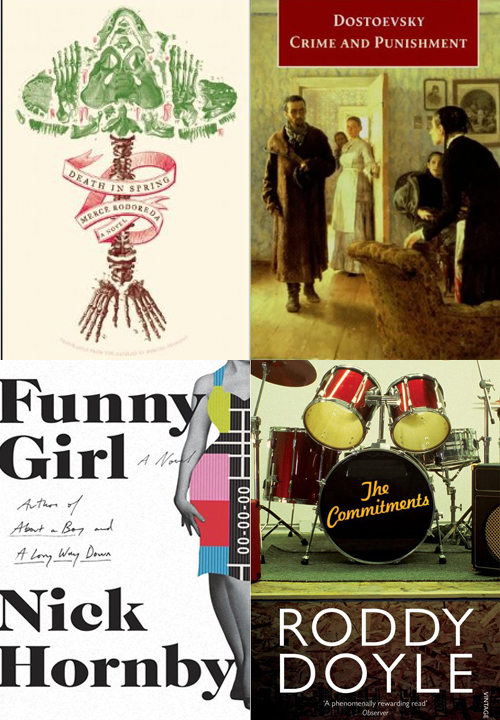
Death in Spring by Merce Rodoreda – My coworker recommended this to me with the pronouncement of “Best Book I’ve Read This Year.” While it’s hard for me to narrow my favourites down even for this top ten list, let alone pick a number one, but I can understand why he said it. A dark, surreal story full of magical realism and part-allegory for Franco’s dictatorship, this novel by one of Catalunya’s most celebrated writers can be read in a weekend but will stay with you for much longer.

Crime & Punishment by Fyodor Dostoevsky – The thing that always surprises me about Russian lit is how readable it is. I always expect it to be dense and dry it’s dense but also full of murder. I didn’t like Crime and Punishment as much as The Brothers Karamazov, but I still found it immensely enjoyable and I’m looking forward to reading more of Dostoeky’s work, and more work by Russian authors, in 2016.

Funny Girl by Nick Hornby – Nick Hornby’s books are always favourites of mine, with few exceptions, and Funny Girl is not one of those exceptions. His female characters have never really stood out to me in other books but there’s something so affecting about the ingenue-turned-comedienne protagonist of this one that makes her as memorable to me as a reader as it does to her fictional audiences.

The Commitments by Roddy Doyle – Roddy Doyle is one of the best contemporary Irish writers, whether in novels, short stories, or in clever dialogues about current events posted on his facebook. Steve gaves me The Barrytown Trilogy for Christmas and all three novels about the working-class Dublin family the Rabbittes are darkly comic and entertaining, but the first of the trilogy is the best.

3

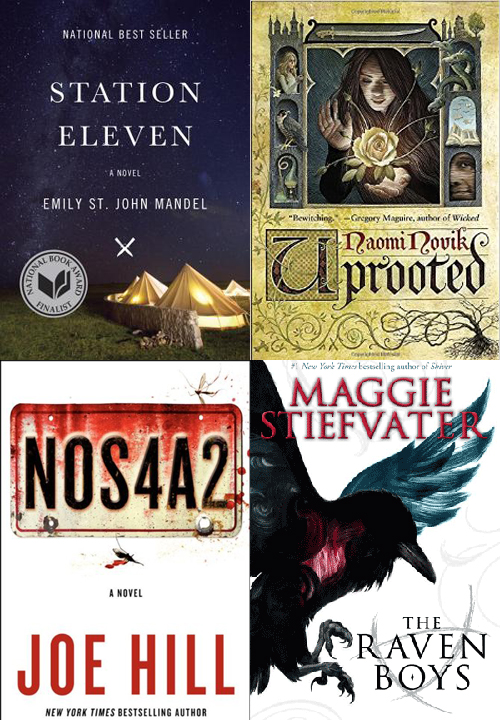
Station Eleven by Emily St. John Mandel – My mom recommended this one to me. When I first started reading it I was surprised she enjoyed it so much; it’s certainly not her usual genre. It’s definitely mine, but it just goes to show that this book is good enough that it finds fans who wouldn’t usually look for dystopian fiction. So even if it doesn’t sound like your thing, it might be worth a look.

Uprooted by Naomi Novik – Adult fairy tales are as trendy right now as adult colouring books, which I love, but many of them fall flat for me trying to make “edgy” versions of classic stories. If I wanted a darker version of the Little Mermaid, I’d reread the original. Uprooted, unlike these retellings, is an original take on classic fairy tale tropes, and it’s dark and spooky and absolutely magical.

Nos4A2 by Joe Hill – Speaking of dark and spooky, this book creeped the hell out of me. It started off slow—I actually tried to read it a time or two before I actually got through it and put it down because it didn’t grab me even though I love the rest of Hill’s books—but once I was into it, I couldn’t stop.

The Raven Boys by Maggie Stiefvater – The Raven Cycle is the uber-hyped Young Adult series du jour (what a multilingual clause!) and it deserves that hype. I was hoping I’d be able to read the fourth book in the series this year but unfortunately its publication has been pushed back until April 2016. But that gives you plenty of time to get up to date! And me time to reread the first three, probably.

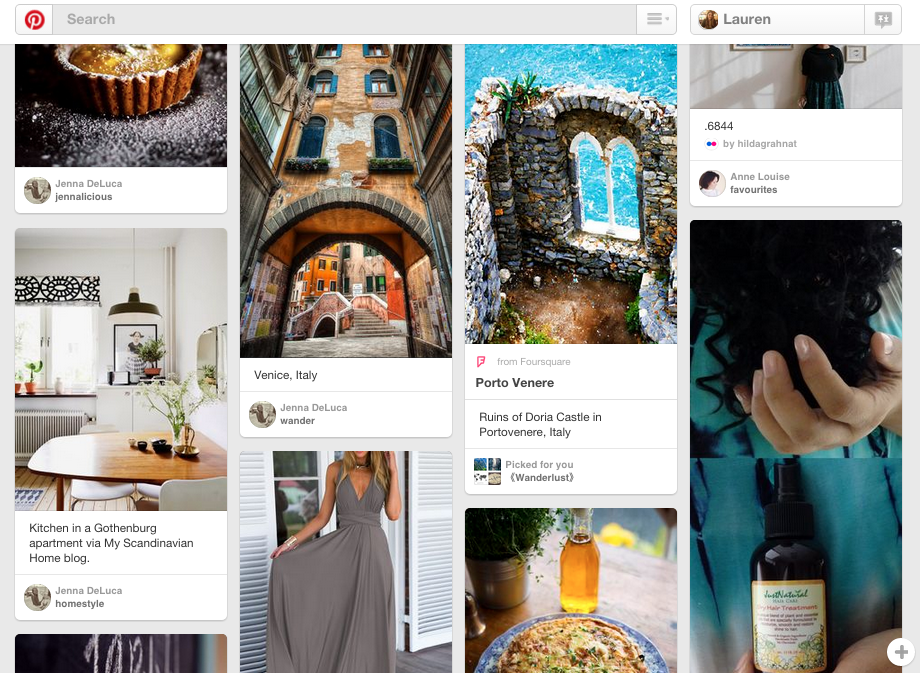
Pinterest Peeves: The Worst of Pinterest Trends

I’ve used Pinterest on and off for the past few years, but only in the last couple of months has it, for the first time, become one of my daily-read websites. Forget Twitter: Pinterest is truly the alpha social media site of our attention-deficit world. Who needs to read words when you can scroll through page after page of pretty photos and only click to find out more if you really want to? Ideal.

Like any social media platform, Pinterest has its own popular trends. And like any social media platform, some of these trends are awful. Here are a few of the worst of the worst.


Screen Shot 2015-10-11 at 15.34.14


Cauliflower Crust

What is with this? I’m not a low-carb-advocate, but I’m always up for finding a healthier way to continue eating copious amounts of my favorite junk food. So it’s a huge disappointment when I think I’m about to read an awesome, lighter pizza or tater tot or any-damn-food recipe and I find out the secret ingredient is… cauliflower. Not only is cauliflower the worst vegetable—it’s bland, tasteless, and looks like something has sucked the color out of perfectly good broccoli—but it is not bread. Don’t even pretend otherwise.


DIY-Wild Weddings

My best friend is engaged, and is therefore one of the only people I follow on Pinterest who has a wedding-themed pinboard and is actually anywhere near getting married. There’s obviously nothing wrong with a bit of fantasy (I’ve been known to pin a pretty, flowy, white Free People dress or two), but if you get your heart set on your Pinterest-inspired wedding being a 400-person Disney-but-also-rustic-country-affair where you DIY all the table settings, favors, bouquets, and bake your own wedding cake, your dream wedding is far more likely to become a nightmare than a reality.


Copycat Tats

I’m not one of those people who thinks that every tattoo has to have deep, eternal meaning. If you want an infinity symbol with the word “love” in it because you like it, it doesn’t matter how cliche it is. But on the flip side, just because somebody decided to post a picture of their designed-just-for-them, one-of-a-kind, intricate, elaborate, meaningful tattoo, it doesn’t mean you should pin it to your board with the comment “omg, totally getting this some day.” To be honest, I doubt most of these people are actually ever going to get a tattoo, let alone one copying someone else’s, but still. Not cool, and if your artist is decent they won’t do it anyway.


Five-Minute Fitness

While it’s true that “this one weird trick” click-bait posts are more prevalent on other forms of social media (Buzzfeed is practically social media these days, c’mon), there are still plenty of examples on Pinterest of short (think one or two moves), simple fitness routines that promise to have you bikini-ready in a week. But unless you’re combining it with a whole bunch of other short, simple fitness routines and a diet that does not include the fifteen brownie recipes you pinned immediately after, it’s not going to happen.


Too-Complicated Top Knots

I love top knots. They’re the ultimate lazy-girl look. And they’re so easy, although you wouldn’t know that to look at the hair tutorials on Pinterest. A 15-step guide on the perfect messy  bun? That’s about 13 steps too many. Here’s your perfect messy top knot tutorial:

  1. Pile all your hair haphazardly on the top of your head.
  2. Secure with an elastic (or with bobby pins if you’re feeling fancy).

There, done. I promise the only reason that instagram model’s hair looks better than yours is that she got a blowout before she put it up there, and if you’re going to go through all that effort, wouldn’t you want to show it off by leaving it down?


If you love carbs, cocktails, great workouts that you’ll probably never do, and Pinterest, you can follow me HERE.