
Apparently all I want to do is write book reviews, but I’m just going to go ahead on keep on doing it. This is a book I received as an ARC late last year, but it was just published on Tuesday so I wanted to share my review here in case you’re looking for a solid non-fiction book to pick up this week. Support your favourite indie bookstore!
When a demon inhabits a body, it takes ownership of a person, a monster is temporarily housed inside of its victim, our body invaded, repossessed. The ghost does the same with s house: it breaks into it, takes possession of what is yours, and you can no longer trust the place you trusted the most. What’s more frightening than your own home turning against you?
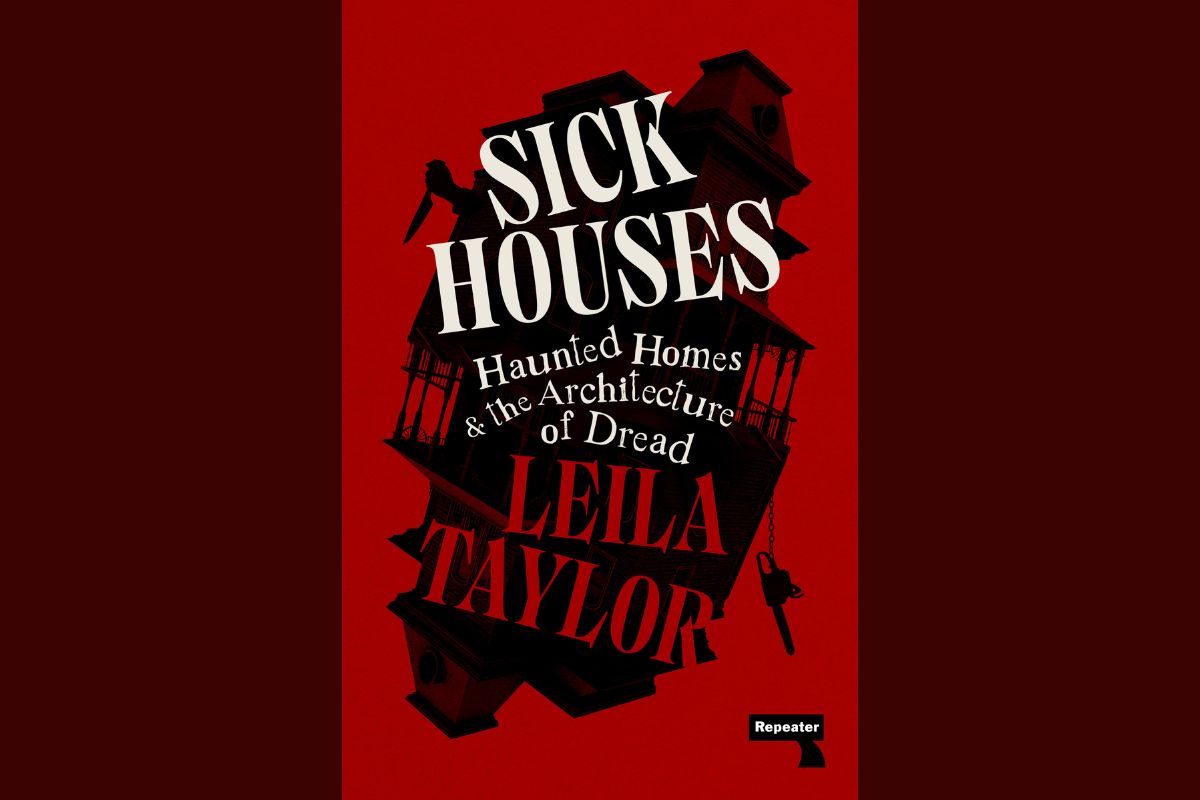
A look at the haunted house in both fiction and non-fiction, Sick Houses by Leila Taylor is an interesting exploration of what happens when the place that, by definition, we feel most at home in becomes something Other, something not quite right. Each chapter looks at a different kind of house, from houses of witchcraft (real or alleged) to houses in miniature, dollhouses or dioramas that reflect or influence their life-size counterparts.
First of all, I appreciated the parameters that the author put on her subject. She says in the introduction that “I’m not talking about plantation houses because 1) fuck them, and 2) I don’t consider slave quarters homes,” and she avoids prisons and hotels as well. By offering a clear focus on homes and not just houses/buildings, it creates an immediate connection with the reader — we will of course consider our own homes, the feeling of safety and comfort we feel in them, and we will contemplate the horror we would feel if that sense of safety was pulled out from under us.
I was also very interested in her discussion of the contradictory nature of the ideals of the American Dream: “Manifest destiny told us to ‘go west, young man,’ but this part of the American ideology is in direct contradiction with the long-term mortgage that locks you not only to a city or state but to a specific property for decades.” This contrast relates to a tension that often appears in horror films — a family moves into a dream home and is loath to leave it even when the going gets bad, or a family moves into a home that turns out to be haunted, but they don’t necessarily have any other option other than to try to see it through — and the tying of classic horror movie tropes to broader societal concepts is always interesting, especially when laid out well and backed by solid examples, as is seen in this book.
Some chapters are more thorough than others — the Witch Houses chapter has many more references than the chapter on Brutalism, for example — but overall there is a good amount of evidence and a good balance between real-life and fictional examples. The chapter on houses in miniature was particularly interesting. The author writes about the dioramas in Ari Aster’s Hereditary, and the way that the film’s sets were built to evoke the feeling that the actors, too, are moving (or, more accurately, being moved) within a diorama. On the real-life side of things, the discussion of the Nutshell Studies of Unexplained Death, a diorama series of crime scenes used to improve forensic investigation, was fascinating.
I did have a few issues with the book. For one, the author spoils the ending of several films in instances where I don’t feel that it’s necessary to support her thesis. Obviously in some cases of books like this, you have to give away the major plot points of your examples in order for them to be relevant — if you’re discussing antagonistic father-son relationships you can’t really use Star Wars as an example unless you tell anyone in your audience who isn’t yet aware of the connection between Luke and Vader.
However, in this book, regarding films discussed like The Others and His House, I think that enough information about their plots could have been given to make the intended point while still leaving some mystery for those who haven’t seen them. I know that I often use this type of book as a way to add to my to-watch or to-read list, offering more examples of a trope I am interested in, so spoiling the endings of books or films I haven’t seen yet is frustrating.
It also felt in some places that more time was spent cataloguing the “contents” of the houses (i.e. the plots of the films set there or, in the case of the real life examples, the crimes committed there) than the houses themselves.
In particular, some of the examples focusing on true crime started to feel too tangental, straying away from the connection to the houses/homes and delving too much into the events themselves. For example, I understood what the author was going for in connecting the novel Room and the tragic real-life story of “feral child” Genie, but in the case of the latter there was little connection to the thesis of the book.
Furthermore, at the start of the book the authors understandably says she won’t include places like slave’s quarters because these were not “homes” to the enslaved people living there, but then it follows that surely a place of imprisonment for Genie (or, in fiction, for the kidnapped inhabitants of Room) was not a “home” to be discussed either.
From the second half of the subtitle, “the Architecture of Dread,” I was hoping for more on the design of houses themselves. While this aspect does certainly get coverage in some sections of the book, looking at architectural oddities on screen and in reality, the trope of architecture that is Not Quite Right — houses that are bigger on the inside, stairways that don’t lead where they’re supposed to — is one of my favorites and I would’ve liked a deeper dive into some of these given the supposed secondary premise of the book.
That said, the sections looking at strange and unusual architecture did have some good moments, most interestingly in dispelling myths about the Winchester Mystery House (no, Sarah Winchester wasn’t taking her orders from ghosts; she was just a hobby architect). On the fiction side of things, I enjoyed the brief foray into one of my favorite books of all time, Susannah Clarke’s Piranesi, as a particularly good example of both impossible architecture and a false home (although I found it odd that one of the other most well-known examples of these tropes, Mark Danielewski’s House of Leaves, did not get a mention).
This book is a catalog of houses that have gone wrong and the ways our built environment can evoke terror and dread. But more so this is a book about the home, and the idea of home, and how horror perverts and manipulates one of the most personal and intimate experiences we have as human beings.
I think that Sick Houses will appeal mostly to readers who already have an interest in the topic. At points it feels as though the author has cornered you at a party and is explaining her research project to you. For me, that’s fine, as it’s a long-standing interest of mine as well. But it may not work as well for readers who aren’t already fascinated by architectural horror or the unheimlich feeling of a haunted house.
But if the above quote draws you in, then this is definitely one to keep an eye out for. Many thanks to the author, publisher, and Netgalley for the advanced copy in exchange for an honest review.
Also, if this sort of book is right up your alley, you might also enjoy Feeding the Monster by Anna Bogutskaya (link to my review), American Scary by Jeremy Dauber (link to my review on Goodreads), and of course Danse Macabre by Stephen King.
 thebestpossibletime