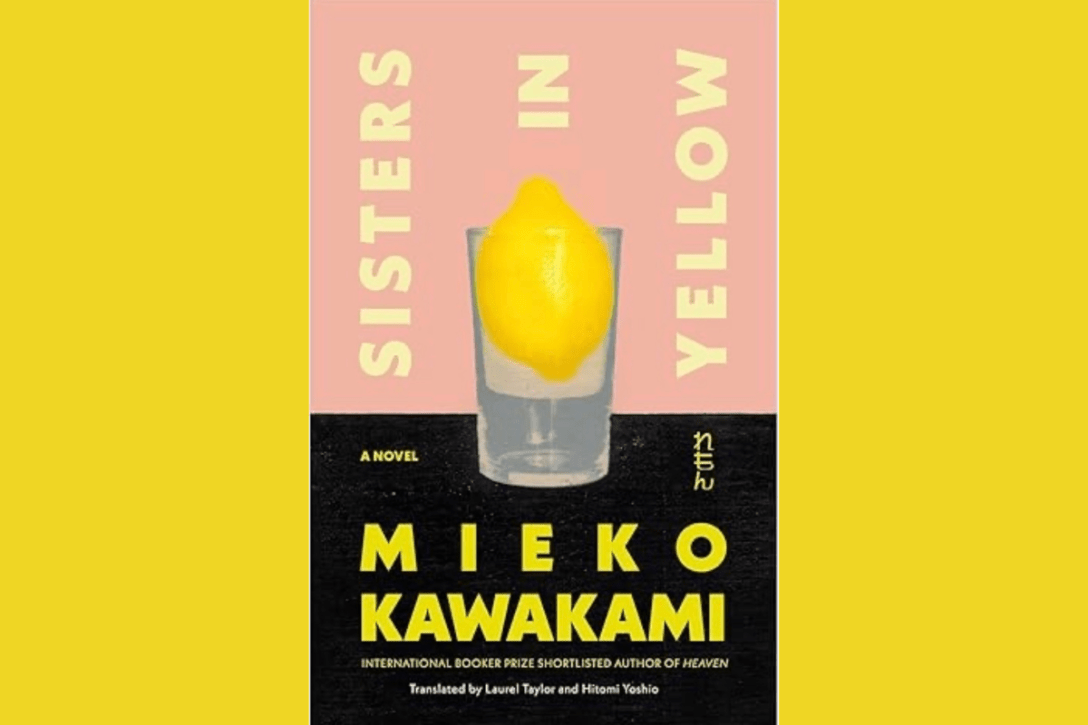
The best way I can describe how Sisters in Yellow made me feel is wrung out. Like a bit of fabric left on the ground under a leaky roof or tap, each chapter the drip, drip, dripping water, filling to the point of saturation. Then the ending, when the fabric was picked up and twisted and twisted until every bit of water was squeezed back out, emptied.
I’d only previously read Kawakami’s Breasts and Eggs, which I liked but did not love, but Sisters in Yellow really, really worked for me. It’s a ball of contradictions in the best way: slow burning yet propulsive, stoic yet thrilling, unassuming yet memorable. And if you’re wondering how the novel can be all of those things at once, you need only look at its protagonist Hana, who is herself a mess of contradictions as well. She’s naive in some ways but mature in others, obsessed with earning money but quick to give it away, compassionate and self-sacrificing and also dictatorial and ruthless.
The story begins in the present day, when Hana reads a news article about someone she used to know some twenty years before. It dredges up memories that she had willfully repressed. She reaches out to Ran, another friend from the time, who validates her feelings but does not want to speak about the events that Hana is beginning to remember, nor to Hana in general. And so the novel transitions into an extended flashback (that lasts until the final chapter) in which Hana revisits a strange period in her life.
We meet Hana as a teenager, living a haphazard life with her mother, who works long hours but makes little money (or who cannot manage the money she makes) and who Hana sees only fleetingly due to their opposite schedules. Hana is slipping through the cracks — she should be in school, living the normal, routine life of a teen, but nobody is looking out for her.
Then Kimiko, one of her mother’s friends, comes to visit, and Hana gets a taste of the care and comfort she has not often had in life. A day in which she opens her fridge and finds it uncharacteristically stocked with healthy food is a memory that stays with her through the course of the novel. It is no wonder, then, that when Kimiko suggests they first move in to an apartment together and then open up a bar called Lemon. No matter that Hana is underage, with no official documents or ID.
As a protagonist, Hana is fascinating, both for her contradictory nature that I mentioned at the start and for the hints at her unreliable narration as the flashback unfolds in contrast to the opening and closing chapters. I was often reminded of Olivia Liang’s The Lonely City, and Liang’s descriptions of loneliness in a bustling metropolis. That fits Hana so well, and so many of the choices she makes, however misguided (and sometimes worse than misguided), stem from her search for connection and a less lonely life.
The strange, codependent relationship between Hana and Kimiko is hard to pin down. At first Kimiko seems like a mother figure, or at least an older sister (and of course the title nods to this), although her motives quickly feel more sinister when she encourages Hana to flirt and drink with the businessmen who come to the bar, and when she introduces Hana to acquaintances with less-than-legal business dealings. In some ways, Hana and Kimiko’s relationship feels like that of a couple in its closeness, although there doesn’t seem to be any sexual element (and Hana seems uninterested in sex or romance in general). If their connection were easier to explain, it would probably be less interesting.
Simpler to describe are Ran and Momoko, two other misfits who become part of the sisterhood. Ran works in a local hostess bar and Momoko is a schoolgirl rebelling against her wealthy family. Ran, Momoko, and Hana become fast friends, and along with Kimiko settle into a routine at the bar. But when an unexpected event upends that routine, they find themselves leaving the grey area between legal and illegal business and stepping further into the criminal underbelly of Tokyo.
This is a story about women on the margins — even at their most stable, they are living an uneasy truce between comfort and poverty. Everything they have could be torn away from them at any moment (and is, several times over the course of the novel). Kawakami is an able tour guide to this edge-of-society life; her Tokyo is vividly rendered despite the clean simplicity of her prose, and even the minor characters feel real.
Some readers will be put off by the slow pacing. Despite being a crime novel, Sisters in Yellow is not an action-packed thriller. Many pages are dedicated to straightforward, back-and-forth dialogue, and there are long expository passages that you might be forgiven for skimming (I’m not going to pretend I read every line of the digression into the difference between debit and credit cards). But the slow burn is deliberate, drawing us along with the characters in a slow descent into the murky depths. Kawakami makes no excuses for their actions, but she ensures we know this slip into the mire is involuntary, a matter of circumstances.
Despite the slowness, I couldn’t put this novel down. I snuck glances between appointments at work, carried in into the kitchen with me to read while I was cooking dinner. I liked that Kawakami didn’t try to hurry us along with time jumps or multiple POVs or timelines. We were fully in Hana’s head for the entire journey, which was one of self-discovery and the way our formative years and friendships shape us, and how their effects linger. For me, Sisters in Yellow will linger.


