“I have to have something to show at the end of this life. If I’m for hell, then I deserve a love that was worth it.”
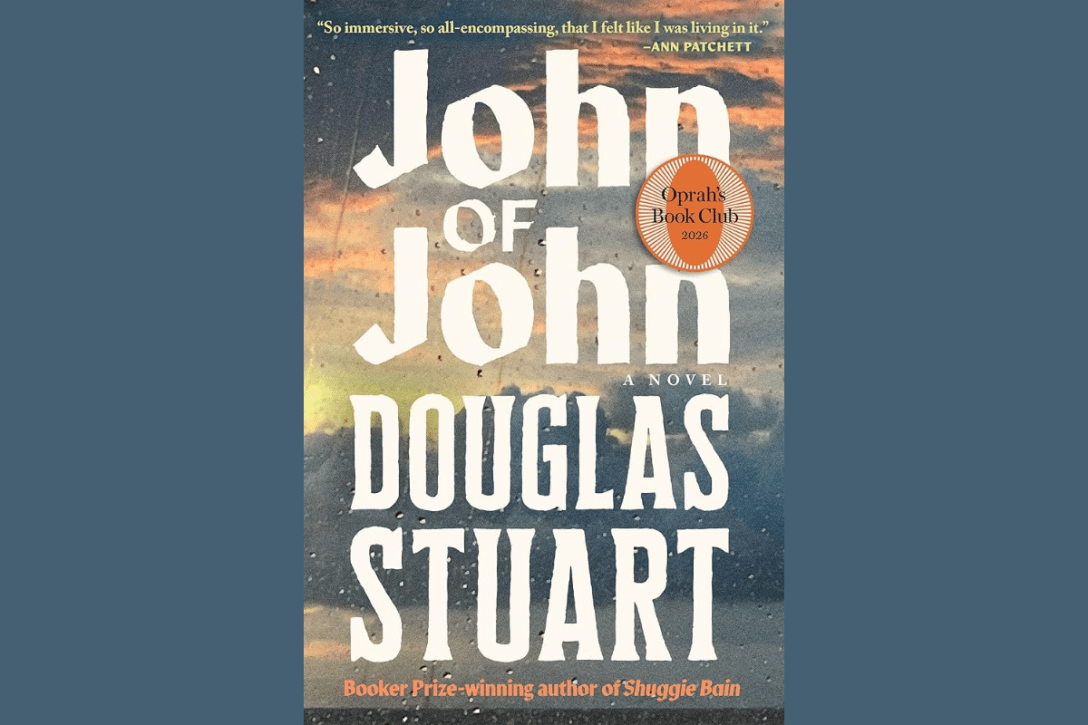
Were it not for the fact that I have a half dozen novels borrowed from the library with impending due dates (plus the new books by Doireann ní Ghríofa and Maggie O’Farrell waiting to me on my bookshelf), I might’ve finished John of John and then started it right over again. I loved both of Douglas Stuart’s previous novels, but this one is a real masterpiece.
In John of John, Douglas Stuart whisks us away from the gritty Glasgow streets that served as the setting for Shuggie Bain and Young Mungo and takes us to the Outer Hebrides. The book is set in the late 90s (or early 2000s?), but the Isle of Harris feels like it is in a world at least two decades earlier thanks to the decline of the weaving trade that has mired many of its residents into seemingly unshakeable rural poverty. Even if they’re accurately topical, mentions of Charles and Diana’s divorce and the growing popularity of email feel anachronistic on this lonely island.
Cal and his father John are two of the island’s residents. In some ways, the two men couldn’t be more different — Cal returns after doing a degree in textiles at an art college and being unsuccessful in finding work that will keep him on the mainland, but he dreams of more than the island on which he was raised. John is a crofter, a weaver, and a devoutly religious man who feels, for better or worse, deeply rooted in the fabric of his rural, strictly Presbyterian community.
In one important way, they couldn’t be more similar, although neither of them knows it about each other. Both are gay, with Cal hoping that a life outside of Harris might allow him to live this truth openly, and with John carrying on a decades-long clandestine romance with his neighbor Innes. This dual-secrecy drives the relationship between father and son, although of course they don’t know that this shared trait has such an impact on their lives as individuals and as a family.
From a fraught relationship with Cal’s mother (who left her marriage when she learned about John and Innes, and who carried the burden of responsibility in order to preserve John’s secret), to an event toward the end of the novel that attempts to force Cal’s hand in choosing whether to settling in to a half-life at home or continuing to search for something more, Stuart writes about queer lives, religious shame, and the wistful dreams of his characters with such tenderness and care, even at their most restless and unsettled.
While the dual-protagonists of Cal and John of course carry the novel, the supporting characters do so much to bring the story to life. There’s something of the maiden / mother / crone in the trinity of Cal’s young friend Isla, his mother Grace, and his Glasgow-born grandmother Ella, who has lived many decades on the croft and yet is still treated as an outsider in both her community and her family. Ella in particular doesn’t have a lot of time on the page but she is such a richly drawn and memorable character. I also loved Innes, who we see through the perspectives of both Cal and John, and who in a way forms a bridge between the life that John lives and the one that he could live.
There’s something really cinematic about the atmosphere of this book; in the right hands (perhaps with Stuart adapting his own work into a screenplay) it could make for an incredible film. At the same time, there are character details that I don’t think could ever quite translate from the page. At dinner one evening, Cal tastes the soup his father has prepared and realizes that John has mixed together two different flavors. There was only one can of each left, and he thinks that it would never have occurred to his father that they could have one each, two different. Small moments like this capture and reveal so much about the character.
On that note, this is one of those novels where the setting itself is undoubtably as much a a character as any of those with speaking roles. The farthest north I’ve been in Scotland is Inverness, and I’ve never visited any of its islands, but as I read John of John I felt as though I could feel the sea air settling damp and salty on my skin. I could picture the vastness of the sea between the island and the mainland, and I could feel the isolation, the dilapidation, the stress from the poverty and scarcity in the community, and the weight of the judgment from its religious beliefs and traditionalistic mindsets.
Every time I read a novel by Douglas Stuart, I am more and more blown away by the beauty of his prose, and his ability to capture the lives of his working-class, queer, Scottish characters. Despite the hardships of the story, John of John is probably the most hopeful of his novels, but this makes it no less emotional. And in my opinion, this is his best work so far, an extraordinary work that will linger in the bones.
“You cannot show up for judgement and say: ‘Yes, I sinned, but oh Lord, I was happy.‘“


