One requirement of the uncanny is that it cannot be entirely removed from our realm of experience. Cosmic and existential horror are not uncanny, because they force us to reckon with things beyond our comprehension. The uncanny relies on the abjection of familiarity, something that feels as though we should be able to understand it, but which has an element we cannot recognise.
Imagine a funhouse mirror, or better yet, imagine an Instagram filter. You’re looking at your own reflection, a face you know better than any other, but it is distorted. You can still recognise yourself, but it’s not you, not quite.
Unit 2: Doppelgängers, Doubles, and the Uncanny Valley Reading List
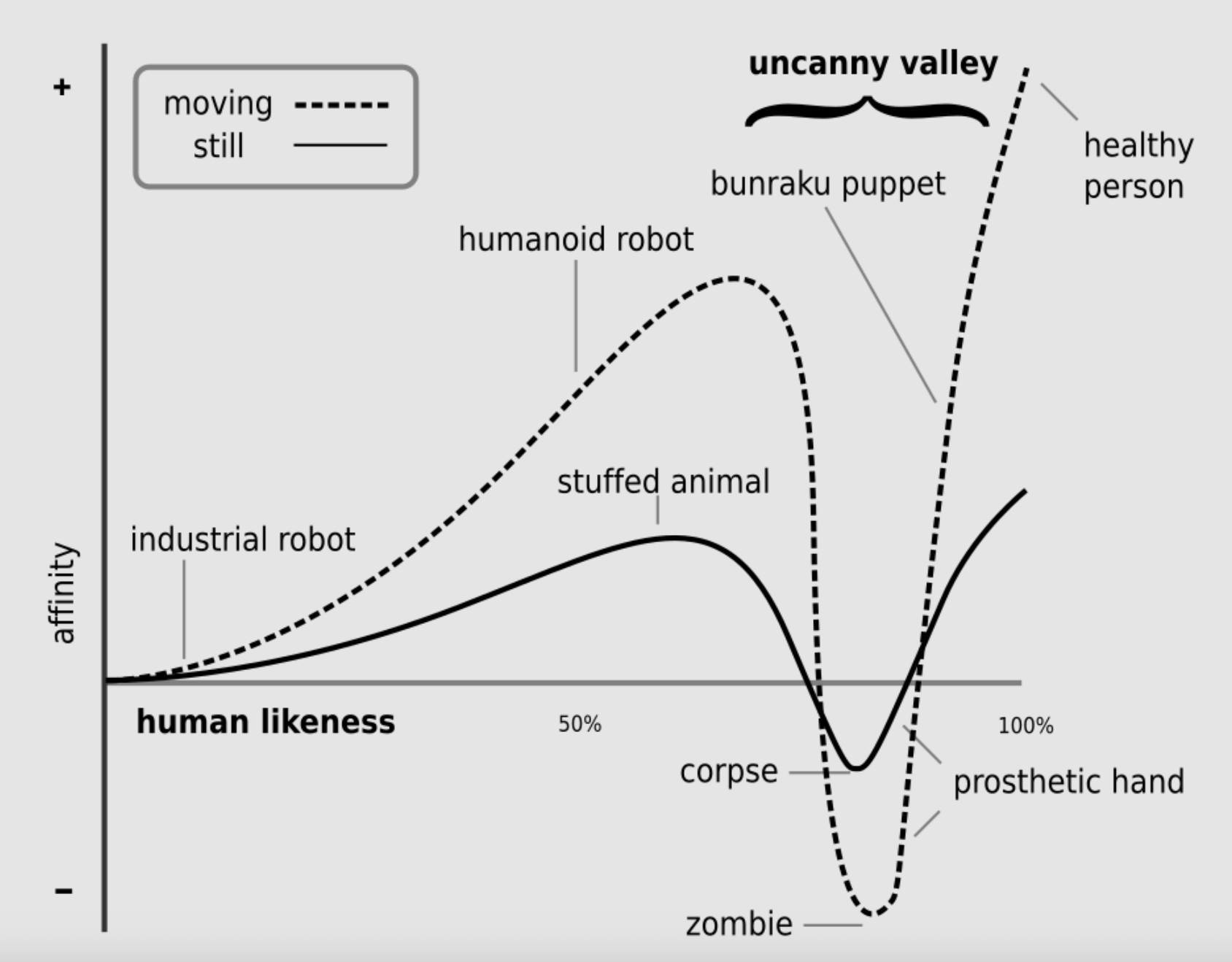
The “uncanny valley” is a concept introduced by Masahiro Mori in 1970. As a robotics professor, Mori was well placed to explain this phenomenon, which posits that as a robot’s traits are made increasingly human, we become more positive and empathetic to it… to a point. The “valley” part of the concept’s name comes from the moment in which the robot looks almost human but is still distinguishably inhuman, at which point we experience a sharp dip in empathy and instead feel fear and revulsion toward it.
If the robot can cross the valley and perfectly mimic a human in appearance and action, we will feel warmly toward it once more (even more warmly, actually, because we will no longer recognise it as being separate from ourselves), but for the most part technology is not yet advanced enough to do that. There’s always something that’s not completely believable about a humanoid robot, something uncanny, something abject.
The uncanny valley is closely associated with the doppelgänger, the person who looks like you but isn’t you. From changelings to evil twins, from fetches to multiversal doubles, the doppelgänger long predates Mori’s hypothesis, or the modern robot (a term coined by a Czech playwright in 1923).
One’s double is usually an abjection of one’s self: sinful where one is virtuous, criminal where one is law-abiding, frightening while one is familiar. Sometimes, as in Robert Louis Stevenson’s The Strange Case of Dr. Jekyll and Mr. Hyde, the doppelgänger allows a character to act on his most awful thoughts and desires without consequence (at least at first). More often, the protagonist does not have that sort of control over his double, and the ultimate goal of the evil twin is to supplant the protagonist’s place in the world (as in Us, directed by Jordan Peele, or basically every soap opera ever).
Even real life is not immune to the doppelgänger phenomenon. Naomi Klein’s book of the same name looks at her experience being constantly confused for another Naomi, one whose conspiratorial thinking is at odds with Klein’s war against misinformation. It’s a fascinating book about encountering the “other” in your own life.
But to me, there is one book that most chillingly exemplifies the intersection of the doppelgänger/evil twin/uncanny valley. Published in 1972, The Stepford Wives by Ira Levin feels like it’s only becoming more relevant year upon year.
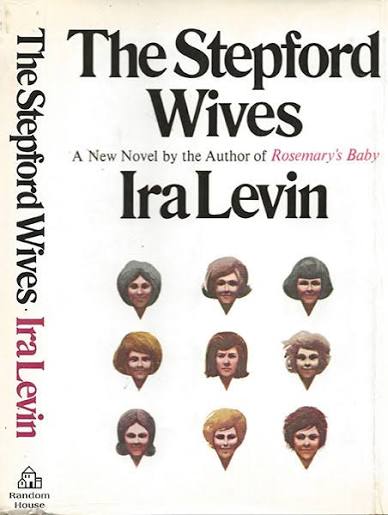
The novel follows Joanna as she and her family move to a beautiful house in the charming town of Stepford. Joanna’s a semi-professional photographer, an avid tennis player, and an outspoken feminist, and she’s shocked at how difficult it is to find like-minded friends. Apart from a select few, all the other women of Stepford claim to be too busy with domestic duties for anything so frivolous as hobbies or friendships or being independent or empowered. Joanna begins to suspect that there might be a dark underbelly to Stepford, and we all know that she’s right.
Despite initially agreeing with her view that it is sexist and outdated for the local community association to only admit men, Joanna’s husband — who at the beginning of the novel is a progressive, thoughtful man who is happy to share chores and cigarettes with his progressive, thoughtful wife — eventually throws her to the wolves. The wolves, in this case, being the mad scientist of sorts who transforms Joanna into a tradwife version of her former self. Is she brainwashed? A cyborg? The novel leaves it ambiguous, but it doesn’t matter; she is under control, and she thinks she’s happy about it.
Ever since Levin’s novel, “Stepford” and “Stepford wife” have been in the lexicon for seemingly too-perfect towns and seemingly too-”perfect” women, but lately it almost feels like “Stepford” is the goal. Social media has long allowed us to create our own doppelgängers, a version of ourselves that is as exactly as we want to be seen, hiding our literal and figurative blemishes (unless we choose to reveal a select few in the name of “authenticity”).
And in doing so, it feels like we have also flattened our desires. What we long for is no longer the reality, but its uncanny valley mirror image. Instead of shying away from this not-quite reality, we try to emulate it. In 2019, Jia Tolentino wrote about “The Age of Instagram Face,” which she describes as:
“the gradual emergence, among professionally beautiful women, of a single, cyborgian face. It’s a young face, of course, with poreless skin and plump, high cheekbones. It has catlike eyes and long, cartoonish lashes; it has a small, neat nose and full, lush lips. It looks at you coyly but blankly, as if its owner has taken half a Klonopin and is considering asking you for a private-jet ride to Coachella. The face is distinctly white but ambiguously ethnic…”
Tolentino explains that millions of women are spending millions of dollars on plastic surgery to try to emulate celebrity photographs that are Facetuned and filtered — faces that don’t actually exist in real life. “I couldn’t shake the feeling,” Tolentino writes in her article, “that technology is rewriting our bodies to correspond to its own interests—rearranging our faces according to whatever increases engagement and likes.”
And the rise of AI has only made things worse. I’ve seen countless posts from hairdressers and makeup artists bemoaning the fact that their clients are bringing in AI-generated reference images that they don’t realise cannot be transformed into real haircuts or makeup looks on real people. I’m sure plastic surgeons are experiencing the same.
Then of course there’s the tradwife movement. The women who promote a return to traditional gender roles with posts that look straight out of Stepford: women in 50s-style A-line skirts and cottagecore dresses and aprons, baking bread — and often neglecting to mention that, with their huge social media followings and brand deals, they are not just the breadmakers but the breadwinners, even while advocating for women to leave the workforce and focus on their homes and their husbands. While one of the year’s biggest books, Claire Caro Burke’s Yesteryear, isn’t classified as a horror novel, there is certainly an element of the uncanny in her tradwife protagonist’s carefully manufactured life.
Joanna’s assessment of the other wives of Stepford, that they were like “actresses in commercials […] playing suburban housewives unconvincingly, too nicey-nice to be real” could just as easily apply to the faces of real people pushed into the uncanny valley that we see on social media. As in Stepford, the ideals are influenced by capitalism and the patriarchy, but unlike in Stepford, women are creating their own doppelgängers. And that’s its own kind of horror.
—
Next week’s unit and reading list:
Unit 3: The Uncanniness of Grief
Primary recommendations:
Pet Sematary by Stephen King
Our Wives Under the Sea by Julia Armfield
The Haunting of Hill House (dir. Mike Flanagan)
The Babadook (dir. Jennifer Kent)
he Haunting of Hill House (dir. Mike Flanagan)
The Babadook (dir. Jennifer Kent)
Secondary recommendations:
Beloved by Toni Morrison
Next to Normal (stage musical)
Bring Her Back (dir. Danny & Michael Philippou)
In the Dream House by Carmen Maria Machado
Bring Her Back (dir. Danny & Michael Philippou)


