Top 10 Books I Read in 2015

As I have for the last three years (that I kept track of thanks to Goodreads) and probably for quite a few years preceding them, I’ve read at least book a week all year. Well, I’ve averaged at least a book a week. Some weeks I’ve read nothing because I was busy binge watching Jessica Jones or Bob’s Burgers. Other weeks I’ve stayed up way too late to finish a book in a night, only to start another the next morning. Either way, I’ve read 50 books so far this year, and I’m on track to read at least three more (the last couple Harry Potter books in my current re-read plus maybe a few others) before the end of the year, so it’s time to talk about my favourites, Here are the top 10 books I’ve read (for the first time) this year (in no particular order):

1

The Silkworm by Robert Galbraith – It’s not just because, as I mentioned above, I’m rereading Harry Potter that I’m thinking about how much I love J.K. Rowling’s writing. The second novel in her pseudonymously-published crime trilogy is a tight, tense thriller. Unlike the recent crime series by one of my other favourite authors, Stephen King, which (spoiler alert) sneaks back into the genre for which he’s most known, the Cormoran Strike series is pure crime, and it’s awesome.

A Girl is a Half-Formed Thing by Eimear McBride – This has been on my to-read list since it came out a few years ago and I finally got around to reading it a few weeks back. I wish I’d gotten to it sooner but it was worth the wait, Half poem, half stream of consciousness, this isn’t an easy read due to both the style and the content, but again, it’s worth the effort.
2

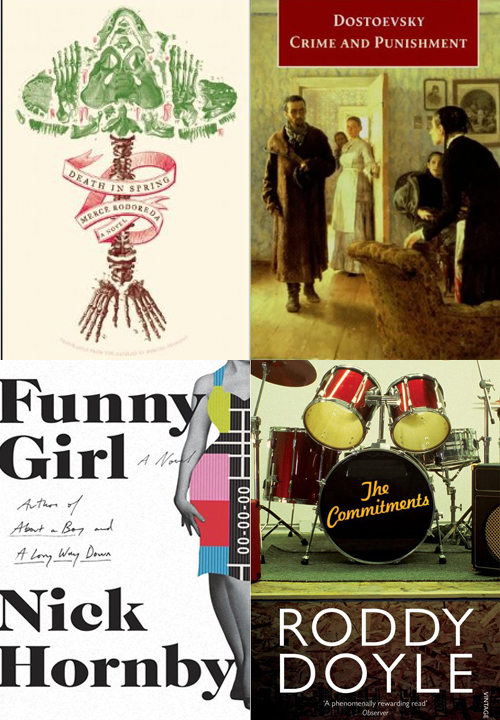
Death in Spring by Merce Rodoreda – My coworker recommended this to me with the pronouncement of “Best Book I’ve Read This Year.” While it’s hard for me to narrow my favourites down even for this top ten list, let alone pick a number one, but I can understand why he said it. A dark, surreal story full of magical realism and part-allegory for Franco’s dictatorship, this novel by one of Catalunya’s most celebrated writers can be read in a weekend but will stay with you for much longer.

Crime & Punishment by Fyodor Dostoevsky – The thing that always surprises me about Russian lit is how readable it is. I always expect it to be dense and dry it’s dense but also full of murder. I didn’t like Crime and Punishment as much as The Brothers Karamazov, but I still found it immensely enjoyable and I’m looking forward to reading more of Dostoeky’s work, and more work by Russian authors, in 2016.

Funny Girl by Nick Hornby – Nick Hornby’s books are always favourites of mine, with few exceptions, and Funny Girl is not one of those exceptions. His female characters have never really stood out to me in other books but there’s something so affecting about the ingenue-turned-comedienne protagonist of this one that makes her as memorable to me as a reader as it does to her fictional audiences.

The Commitments by Roddy Doyle – Roddy Doyle is one of the best contemporary Irish writers, whether in novels, short stories, or in clever dialogues about current events posted on his facebook. Steve gaves me The Barrytown Trilogy for Christmas and all three novels about the working-class Dublin family the Rabbittes are darkly comic and entertaining, but the first of the trilogy is the best.
3

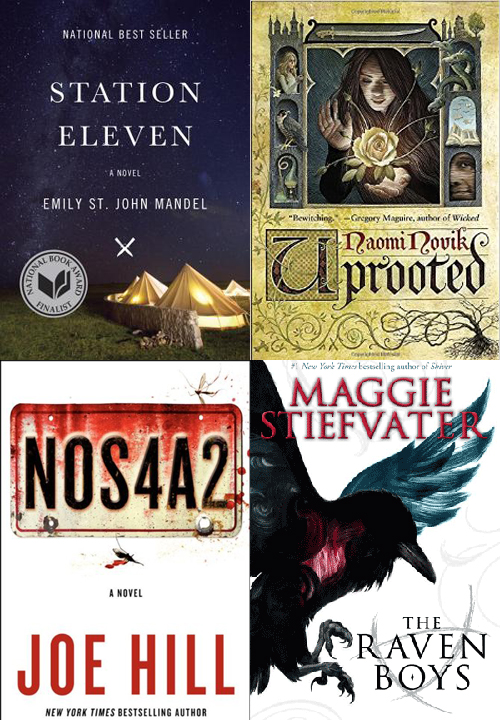
Station Eleven by Emily St. John Mandel – My mom recommended this one to me. When I first started reading it I was surprised she enjoyed it so much; it’s certainly not her usual genre. It’s definitely mine, but it just goes to show that this book is good enough that it finds fans who wouldn’t usually look for dystopian fiction. So even if it doesn’t sound like your thing, it might be worth a look.

Uprooted by Naomi Novik – Adult fairy tales are as trendy right now as adult colouring books, which I love, but many of them fall flat for me trying to make “edgy” versions of classic stories. If I wanted a darker version of the Little Mermaid, I’d reread the original. Uprooted, unlike these retellings, is an original take on classic fairy tale tropes, and it’s dark and spooky and absolutely magical.

Nos4A2 by Joe Hill – Speaking of dark and spooky, this book creeped the hell out of me. It started off slow—I actually tried to read it a time or two before I actually got through it and put it down because it didn’t grab me even though I love the rest of Hill’s books—but once I was into it, I couldn’t stop.

The Raven Boys by Maggie Stiefvater – The Raven Cycle is the uber-hyped Young Adult series du jour (what a multilingual clause!) and it deserves that hype. I was hoping I’d be able to read the fourth book in the series this year but unfortunately its publication has been pushed back until April 2016. But that gives you plenty of time to get up to date! And me time to reread the first three, probably.

This Love is Not for Cowards by Robert Andrew Powell (2012): 4.5/5 stars

tlinfc-coverI don’t know much about the Liga Mx. I follow the English Premier League and the Spanish Liga, and I’ve even started watching a bit of Bundesliga recently (although I’ve yet to find a broadcast with English commentary so the only words I can pick up are things like “Dortmund” and “das fitness coach”), so I hardly have time to watch yet another league anyway, although I sometimes catch a match on Univisión while I’m at the gym. I know a few key words and names in Mexican football, Hérculez Gómez and Chivas and Chicarito and the Azteca, but comparatively, I’m in the dark. Before reading Robert Andrew Powell’s gripping book, This Love is Not for Cowards: Salvation and Soccer in Ciudad Juárez, I had certainly never heard of Los Indios de Ciudad Juárez.

Continue reading “This Love is Not for Cowards by Robert Andrew Powell (2012): 4.5/5 stars”

The Wind Through the Keyhole (Dark Tower 4.5) by Stephen King (2012): 3.5/5 stars

The Dark Tower 4.5
The Dark Tower 4.5

It’s no secret that I’m a big Stephen King fan. It’s even less of a secret that I’m a big Dark Tower fan, given that I have the Sigil of Eld tattooed on my wrist (although I suppose one would also have to be a big Dark Tower fan to recognize it as such). Therefore, I was excited when I heard that King would be releasing a new Dark Tower novel this year, if “excited” is a strong enough term. I was even more excited when I found out it was to be set between the fourth and fifth novels (Wizard and Glass and Wolves of the Calla), an excellent place for a little more information about Mid-World and Roland Deschain’s ka-tet.

Continue reading “The Wind Through the Keyhole (Dark Tower 4.5) by Stephen King (2012): 3.5/5 stars”

Ten Thousand Saints by Eleanor Henderson (2011): 4.5/5 stars

I first picked up Ten Thousand Saints because I thought it was cool that it was written by an Ithaca College writing professor. That is cool, but the book is even cooler. The novel addresses drugs, sex, pregnancy, AIDS, love, loss, grief, death, and family set against and embedded in the 1980s straight edge scene in New York City.

When fifteen-year-old Teddy McNicholas dies of a drug overdose in a small town in Vermont at the end of 1987, teenage rebel Jude Keffy-Horn, Tedd’ys brother Johnny, and new acquaintance Eliza come together in the city to struggle with holding on and moving forward. Johnny introduces Jude to the hardcore straight edge culture, and Jude’s initiation into the vegan, celibate, drug free world is a sharp contrast to his previous life and the people in it. Meanwhile, all three characters’ lives are changed when Eliza discovers that she is pregnant.

Jude. Johnny. Eliza. Teddy. Les. Rooster. I was absolutely fascinated by every character in this novel, from the protagonists down to those who only had minor roles in a few scenes. Each one had a strong voice and motivations, and the interactions between the characters were honest and powerful. I was especially drawn to Johnny, the tattoo artist and musician who served as Jude’s guide into the scene with simultaneously coping with his own losses and secrets. I was somewhat worried that Eliza would be playing the role of Manic Pixie Dream Girl when she first showed up, brash and beautiful from the big city, ready to change the lives of our heroes, but over the course of the novel I really warmed to her. She had the vulnerability you would expect of someone her age in her situation, but an independence and strong willed personality that let her hold her own against parents, love interests, and her own fears. There are no heroes and no villains (except for maybe death and the beginning of the AIDS epidemic) in this story; each character’s flaws are on full display, but at their hearts they believe they are doing the best they can.

Henderson’s voice is as strong in her setting as it is in her characters. I know very little about the 80s punk, hardcore, or straight edge scenes in New York City. However, I imagine that the atmosphere of the time was full of the same intensity that electrifies this novel. Every page is bursting with description and emotion, so much that sometimes I felt like I didn’t know where to look or what to think. Occasionally this was overwhelming; even more occasionally it seemed unnecessary. But for the most part I was engrossed by this portrayal of a subculture rife with passionate ideals and equally passionate characters. I was fascinated by the politics and the religion, the sexual and sometimes homoerotic undertones of the culture, and the way that the people in it connect and break apart. All of this is relayed with vivid and intense description.

The novel’s “weak” point is in the plot itself, which is sometimes meandering, sometimes jagged, and mostly unresolved. At the same time, I put “weak” in quotation marks because this lack of a single focus or closed ending is fitting with the tone of the book and the characters in it. The novel captures a moment in time, and the characters go on beyond it, profoundly changed by their experiences but not stagnated within them. A more focused conclusion would artificially end their stories, when the realism of the novel dictates that they should go on. Overall, Ten Thousand Saints is a novel full of authentic characters and rich in its description of an intense, emotional era.

11/22/63 by Stephen King (2011): 5/5 stars

Yes, this is a book about a man going back in time to change the course of history. It’s not the first, and it won’t be the last. There is a plethora of media covering the alternate history that would have occurred had Hitler been killed before he could become the leader of Germany, and another plethora speculating the opposite: what if Hitler and the Nazis had won World War II? Some stories are more serious while others are more of Quentin Tarantino’s farcical Inglourious Basterds ilk. And Hitler’s rise to power is far from the only event altered in such stories. Harry Turtledove wrote a series in which the Confederacy won the Civil War, and Newt Gingrich one where the south at least won at Gettysburg. Alan Moore’s graphic novel Watchmen speculates on a United States that won the Vietnam War. Even fictional history has been changed, from Back to the Future to Doctor Who.

Continue reading “11/22/63 by Stephen King (2011): 5/5 stars”