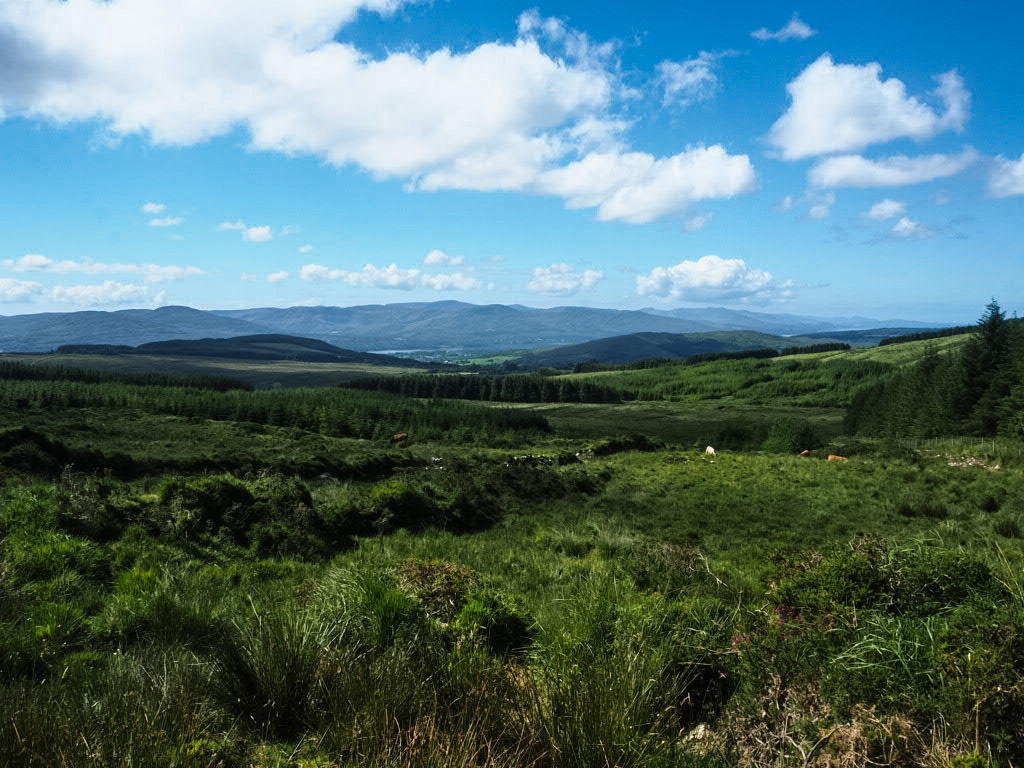
Earlier this week I wrote about three routes I’ve recently hiked in and around Killarney, but there’s a fourth I trekked this week, taking advantage of a weekend of gorgeous weather. Carrauntoohil is the highest mountain in Ireland, and although it’s not particularly impressive compared to the highest mountains in most countries (only 1038m/3047f, not even as tall as the last “top of a country” I’ve visited), it was still a fantastic adventure.
Category: Ireland
Three Hikes Around Killarney
Moving to another country is never easy, and even more so during a pandemic. I’m still trying to get my residency card, set up a bank account, etc. etc. And job-hunting during a pandemic, in a small town known mostly for tourism? Nightmare. At least while I’m in the midst of getting all the logistics sorted out and sending an endless stream of CVs, I’m lucky enough to live in one of the most beautiful places ever. There’s a reason that Co. Kerry is known as The Kingdom. And the magnificent weather over the last week has offered ample opportunity to explore it with beautiful local hikes. I’m writing about them here in order of easiest to most difficult:
Planes and Pandemics: Moving Internationally During Covid-19
The plan was this: Finish our Southeast Asia adventure on March 25, spend two weeks visiting friends in Seattle and Vancouver, arrive in Philadelphia on April 6, and fly to Ireland on May 8. Obviously, that didn’t happen. But we cut our trip short, headed straight to my parents’ in Philly, and spent three months hanging out, going for walks in the park, and catching up on Netflix, Steve’s 90-day visa-free allowance in the States was up so he headed back to Ireland.
I was meant to stay an extra month, see my sister, and then join him, but rumours began to fly that the EU would implement a ban on travellers from high-risk countries. Although I would qualify for an exemption that should have allowed me entry, I didn’t want to chance it and end up stuck for the foreseeable future, so on the 24th of June I booked my flight from JFK to Dublin for just a few days later, and on the 28th I was off. This is what it was like to fly internationally during the pandemic.
Continue reading “Planes and Pandemics: Moving Internationally During Covid-19”
A Working Holiday Visa Overview for Americans
Here’s the thing about visas: unless you have immigrated or seriously considered trying to immigrate, you probably don’t know how difficult the process is. There are options, of course—if you do have in-demand skills you can get sponsored by a company that will bring you to your desired country, you can move abroad as a student at a foreign university or as the spouse of a foreign citizen, or if you have a lot of money or a pension you can retire to some beach town in Spain or Guatemala. But if you don’t have a ton of work experience and you’re happy just to get out for a year or two and live somewhere new, your best option is a working holiday visa.

Until I lived in Ireland, I had never heard of a working holiday. But when I got to Ireland, it seemed like everyone was abroad (so many Canadians!) or going abroad (to Canada, Australia, etc.) on this thing called a working holiday visa. Now, just about six years after I first arrived in Ireland, I’m on my second working holiday visa and I love the opportunity it’s given me to live abroad for a longer period of time. I think one of the reasons Americans aren’t as likely to do working holidays is that we have fewer options than other nationalities (for example, Canadians can go to over 30 countries, whereas Americans only have 5 options, and three of those require you to be a student or recent graduate), but I think another reason is that we just don’t know about them! So I wanted to write up a little guide to working holiday visas available to Americans.
Note: Obviously, nothing I say here is legal or official advice in anyway. I will be providing links to the relevant government websites and I suggest you utilise them. Also, while requirements are often similar for folks from other countries, there are some differences so make sure to look up your respective country’s visa options if you are not from the States.

Why get a Working Holiday visa?
Let’s start with the big question: why apply for a working holiday visa rather than just going on vacation? For one thing, the visa lets you stay much longer than the regular tourist allowance. Generally, you get 12 months, and for Australia you can even get a whole extra year if you do 3 months of work in a rural area during your first year. And oh yeah, you’re allowed to work. Much easier to fund your travels without depleting all your savings if you’re allowed to have a job. The great thing about the working holiday visa is that you don’t have to be sponsored by a company, so you don’t have to have a job ahead of time and you can also do jobs that wouldn’t normally be eligible for a high-demand, high-skills work visa, like hospitality or admin work. It’s a great way to get to really explore a country and keep some money in your bank account as you go.

The easiest options: Australia and New Zealand
To get a working holiday visa to Australia or New Zealand, pretty much the only thing you need is to be aged 18 to 30. Places in the Australian and New Zealand working holiday programs are unlimited for Americans, and to apply for the New Zealand visa is even free (for Australia it’s about 350USD). The visa comes through quickly (for NZ it took a couple days and for Australia only a couple of minutes) and then you can head off on your great adventure! You will need to be able show a couple thousand dollars in savings—although nobody I know has ever actually been asked for this at immigration, it’s still a good idea to have until you can get set up with an apartment, a job, and so on.
So which one should you do? Well of course, my recommendation is both! But if you feel like you can’t escape the real world for too long or you’re on the edge of 30 and only have time to squeeze one in before you age out, I would definitely go for New Zealand. I’ll write a longer post about this soon though, so stay tuned.
For students and new grads: Ireland, Singapore, and South Korea
I didn’t technically do the Ireland working holiday visa because I went to grad school in Ireland and so the visa I got after I finished was a “postgraduate visa” rather than a “working holiday visa,” but in essence, it was the same. One of the great things about the Irish WHV is that there is no age limit, as long as you are a current college or grad student, or have graduated in the last 12 months. On the other hand, for most of us who went to college straight out of high school, that timeframe has long since passed. However, if you are still in school or thinking of going back, it’s a great option to keep in mind!
To be honest, I don’t know a ton about the Singapore and Korea working holidays. For both, you must be a student/recent grad, and for Singapore your school must be ranked in the top 200 globally. There’s also an age requirement of 18-30 for Korea and 18-25 for Singapore. So while it is possible, it’s definitely more limited, but I wanted to bring them up in case you’ve dreamed of going to Asia but aren’t interested in something like English teaching, and in case the parameters apply.

The bottom line
A working holiday visa is generally only temporary (it can’t usually be extended and if you want to stay longer you have to find sponsorship for a different visa type), but it’s an amazing way to experience long-term travel in a different part of the world. You’ll meet locals and other travelers, mix work and adventure, and come back richer in life but not poorer in savings (at least not significantly poorer… hopefully). Obviously it does often mean putting career and other aspects of your life on hold, but I think it is 1000 percent worth the trade-off and I would recommend it to almost anyone if it is available to you. This is only a small overview of working holiday visas, but if you have any questions, please reach out! I love to share my experiences and advice.
Happy travels!

Best of Ancient Ireland
After General Leia, Finn’s face, and those cute little floofy owl creatures, the star of The Last Jedi was surely Skellig Michael. Throughout the film, magnificent shots of the Irish island punctuated the intergalactic action.
While this little island is now famous worldwide as the hideout of Luke Skywalker, it has always been an important part of Irish history. The site of an ancient monastery, it is also well known as a conservation area for an array of seabirds such as puffins. Skellig Michael can only be visited from May to October because of the rough ferry route, and unfortunately I haven’t had the chance to explore it yet, but while I was in Ireland this fall Steve took me around the Ring of Kerry and we were able to see the Skelligs (Skellig Michael and its smaller companion) in the distance.

I’m sure I’ll get the chance to explore Skellig Michael and its craggy, epic cliffs at some point in the next few years, but there’s no shortage of impressive historic sites in Ireland, and I have been lucky enough to visit a number of them. Here are a few of my favourites.
Brú na Bóinne / Newgrange

Stonehenge may be the most famous example of a neolithic site in the British and Irish isles, but it’s also one of the most overrated. You have to drive nearly two hours from London to walk around a largely unimpressive circle of rocks—at a distance and on the other side of a cordon, mind. Newgrange, on the other hand, is a chance to get up close and personal with a way cooler instance of neolithic architecture and design. This site is located a mere 45 minutes from Dublin and consists of a circular mound with an underground passageway made of stone that you can actually enter.

The most notable feature of this site is that the upper entrance of the mound aligns with the sun on the winter solstice so that a ray of light shines through into the inner chamber. To be inside the mound on this special day, you have to enter a lottery on your visit, and one of the reasons this site holds such a place in my heart is that I was actually lucky enough to win the lottery while I was living in Ireland. Unfortunately, the weather was too cloudy (in Ireland in December? You don’t say!) for any sun to make its way into the chamber, but it was still an incredible experience to know that we were standing in the same place, doing the same thing, as those who lived five thousand years before us.
25 stupid things I already miss about Ireland
I’m a very sentimental person, especially when it comes to being nostalgic. I could go on for hours about some happy or bittersweet memory, and I have to admit I’m one of those people who tells people present for an event about the event, just because it’s such a great story. And if there’s one place I’ll be sentimentally nostalgic about for a long time (forever), it’s Ireland. After a year and a half in Galway – getting my Master’s in Literature and Publishing, meeting amazing people, exploring one of the most beautiful countries I’ve ever seen – I moved back to the United States last week. On one hand, I’m excited; I have plans to move across the country in the next few months and I’m looking forward to a new adventure. On the other hand, I miss Ireland already. I could make this blog post about all the wonderful people I met and all the amazing places I visited and how much I love Galway even when it rains for two weeks straight. But c’mon, that’s mushy, I’m not going to make ye read that. Instead, here are 25 of the silliest things I already miss about living in Ireland:
- Getting garlic-cheese chips AND curry-cheese chips after a night out.
- Cans by the Spanish Arch (or anywhere else)
- Every sentence containing “Ah,” “sure,” or “be grand”
- “Ah, sure, be grand” also being a complete sentence in itself
- That ridiculous Garth Brooks/Croke Park saga
Continue reading “25 stupid things I already miss about Ireland”