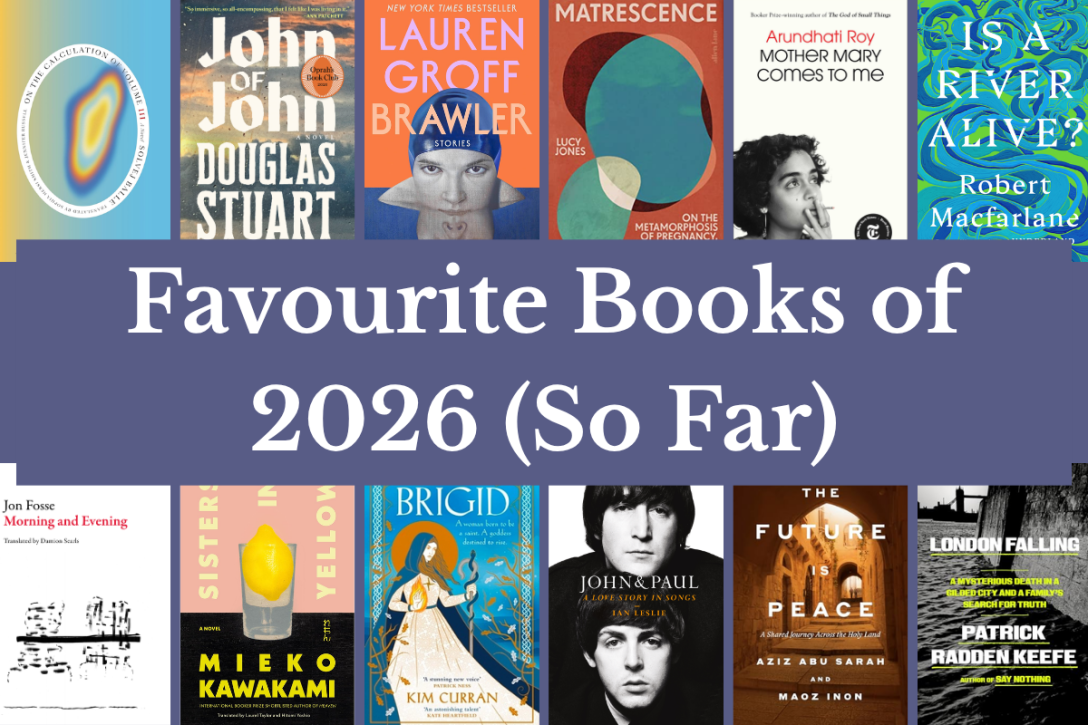
It is wild that we’re halfway through the year already. Despite my new year’s resolution to read fewer books, I have somehow still read a ton of books. Luckily I have some big ones on the TBR to take up my second half of the year (#lonesomedovesummer), but in the meantime here are some favorites read in 2026 so far.
I do have to say that I would normally have a section specifically for horror since I read so much in that genre, but surprisingly I haven’t read a horror novel, published this year or otherwise, that has really blown me away yet (apart from rereading a couple of Stephen King classics). But I do have a few on the docket that I have high hopes for, so fingers crossed.
Fiction:
On the Calculation of Volume III (& IV) by Solvej Balle
If volume II of On the Calculation of Volume is about what we owe the world, then volume III is about what we owe each other. Tara is no longer a solo traveller but now part of a small coterie of other folks who are also reliving November 18th again and again, and they begin to discuss their responsibilities as stewards of the day.
And in contrast to the earlier volumes in which Tara travels in search of answers and seasons, in book IV she mostly stays in place and it is others who enter and leave her orbit. And with them these fellow travelers bring a multitude more questions to consider in these endless November 18ths (along with varying perspectives on the nature of this day-in-stasis, the likelihood of its conclusion or the ability to escape it, and their place within it comparative to those who do not seem aware that they are reliving the day again and again).
There was a moment that dragged for me a bit near the start of book IV and I wondered if this was the volume that would start to lose its lustre — they are necessarily repetitive, after all. But soon enough I was thoroughly drawn back in, and by the end I knew I will once again be eagerly waiting the publication of the next volume’s English translation.
John of John by Douglas Stuart
Brawler: Stories by Lauren Groff
I was ambivalent on Lauren Groff’s Fates and Furies but loved Matrix and The Vaster Wilds, so I thought that maybe I was just more drawn to her historical fiction than her work set in the modern day. But the stories in Brawler have certainly set me straight.
Groff’s writing is perfectly balanced; it never feels like too much even when it is lush or too little even when it is sparse. And both the writing itself and the themes and the characters it explores feel simple yet deep, contemporary yet timeless, destined to take their place alongside other pinnacles of the craft. “The Wind,” “Between the Shadow and the Soul,” and “To Sunland” were my favorites, but all were wonderful and devastating.
Also the collection had one of my favorite formats in that one of the stories was novella length where the others were much shorter. I don’t know what it is about this inclusion of a longer tale that always tickles me but even though the novella, “What’s the Time, Mr. Wolf?” wasn’t near the top of my rankings, I delighted in its presence.
Morning and Evening by Jon Fosse
This book is one hundred pages long and manages to say more in those hundred pages than many books do in five times the number. I wept through the last three pages (from “everything you love is there, everything you don’t love is not there”). A beautiful, beautiful, philosophical meditation on the meaning of a simple human life.
Sisters in Yellow by Mieko Kawakami
Brigid by Kim Curran
This an exemplary retelling of Irish myth and history. I would nearly put this work on par with Madeline Miller’s novels in terms of how well it captures the spirit of its subject and influence and transforms it into a rich retelling that brings something new to the text while staying true to the heart of the original mythos.
While I enjoyed Kim Curran’s other Irish mythology retelling, The Morrigan, I did find some faults with it in terms of the tightness of the plot, but here the vast amount of history and mythology (the protagonist of the novel is the historical figure Saint Brigid, but the narrator is the pagan goddess who shares her name, which I loved) is so artfully transposed into the story that the pacing is perfectly balanced.
The writing is gorgeous, bold and modern while still capturing the elegance of a classic tale and infusing the story with poetry without falling into purple prose or overwriting in an attempt to emulate the style of an earlier time.
Nonfiction:
Matrescence by Lucy Jones
Well, this floored me. This kind of nonfiction book, the pop-science/psychology blended with memoir, is probably my favorite style but can a tricky balance to pull off — often it feels as though it relies too much on anecdata, extrapolating the author’s own experience into a would-be universality, or it goes the other direction and holds the reader at too much of a distance with the focus on figures and studies rather than the lived experience it purports to share.
In Matrescence, the two elements blend and balance perfectly, with Jones utilizing both her experience as a science writer and as a mother to create a grounded and yet deeply personal exploration of a time in life that is often discussed in romanticized, abstract terms rather than in the genuine, life-altering way it should be.
Mother Mary Comes to Me by Arundhati Roy
The story begins and ends with the death of Roy’s mother, Mary, and the complicated relationship Roy has with her — a towering figure that Roy writes of with admiration and love, but equally with discomfort and fear. While this relationship creates a through line across the memoir, the book covers so much.
Roy’s time as an actor and filmmaker, her writing, her politics and activism, wider Indian politics and society, her childhood, her relationships… this book is so full that it could easily feel overwhelming were it not for the fact that Roy’s writing is so exceptionally good that she weaves the tapestry with such artistry and deftness that it becomes perfectly balanced.
I loved listening to Roy narrate her memoir on audiobook, and reading Mother Mary Comes To Me has certainly made me want to go back and revisit her fiction and read more of her nonfiction. What an incredible life Roy has led, and what a brilliant writer she is.
Is a River Alive? by Robert Macfarlane
The question asked in the title of and throughout Robert Macfarlane’s latest exquisite book is one both ancient and contemporary: is a river alive?
Ancient in that animist cultures of centuries and millennia past have believed in the souls of theoretically-inanimate objects such as rivers, trees, and mountains. Contemporary in that a growing number of social movements and court cases have argued for the legal rights of these objects/beings as part of conservation efforts against logging, mining, polluting, and other environmental destruction.
Macfarlane’s journeys are part-travelogue, part-memoir, all full of care and love for the natural beings he visits and . There are elements of spirituality here, and elements of poetry. The writing is as rich and lush and beautiful as its subject.
If everyone read this book, and could feel nature’s heartbeat the way Macfarlane does, there would be no one who could argue with the answer to the book’s titular question being a resounding yes.
John & Paul: A Love Story in Songs by Ian Leslie
I could read a million books about the Beatles (and probably have, at this point) and still find something new in each one, even as they retread the same stories from their first Quarrymen days to their last solo moments, and all of the epic highs and fraught lows in between. And Ian Leslie’s book is firmly taking a place as one of my favorites.
Each chapter of this magnificent book takes a song performed (as in the case of their early covers) or written by Lennon, McCartney, or in most cases both (or at least credited that way) and ties it in to a stage in their songwriting, business, and personal relationships in such an insightful and emotional way.
What really works about this book is that Leslie truly captures what makes the Lennon/McCartney relationship so compellingly indelible. The subtitle, A Love Story in Songs, is truly so accurate in that it understands that the relationship was one so unique in both nature and circumstances. Apart from George and Ringo, there was nobody else who had the experiences that John and Paul had, and even within the Beatles they shared a unique bond both with each other and in terms of their personal and professional circumstances.
Leslie captures this so well, as well as the complexities of the two parties involved, going beyond their public personas and their musical notabilities to more closely examine their songwriting partnership and the way they influenced and were influenced in their music. Even people who aren’t huge fans of the Beatles but who are interested in the joys and pains of creative work and the creative process will appreciate this book.
The Future is Peace by Aziz Abu Sarah and Maoz Inon
Israeli Maoz Inon and Palestinian Aziz Abu Sarah are peace activists, but it would be easy, understandable even, for these two men to be among the most sectarian of anyone. Not only do they have their ethnic and religious differences but their families have suffered directly at the hands of the other’s “tribe.” And yet, they have instead dedicated their lives to the opposite. “It is not easy to feel empathy when you are suffering,” Aziz explains in the introduction, “but it’s an endeavor worth fighting for.”
The introduction also explains the title of the book, saying that the future *is* peace, that peace will come eventually, but that it is a question of how much bloodshed will be allowed before it gets there. Aziz and Maoz, both working in the tourism industry, hope that showcasing their own cultures and history in the hopes of greater education and understanding will help to reduce that bloodshed on the road to peace.
The book takes the form of a weeklong tour through the region, with each author sharing about their chosen locations through their eyes, talking about both national and personal history, before ending each chapter with a shared reflection and a reiterated call for peace. This sort of repetition could get tiring in a less important book, but here the emphasis is essential. “This book, in your hands, is a hammer,” they say.
While the authors do not lay out their own roadmap for exactly how peace could be achieved (although they say their ultimate vision is a single nation in which everyone has equal safety and status, and in the interim they hope for a lasting cessation of violence in which people of all faith have the security and freedom to visit their holy sites), they say that the process logistics are, for now, secondary to rooting the belief that the process is possible at all. And I think that anyone who reads The Future is Peace will close the book convinced.
London Falling by Patrick Radden Keefe
The story begins with the mysterious death of 19-year-old Zac Brettler, but Radden Keefe takes us on a tour of the intersection and overlap between London’s elite population and its criminal underbelly.
Every digression — the history of immigration to the UK by Ugandans of South Asian descent, the prevalence of Russian oligarchs in the city — only serves to create an even more compelling picture. Any time you think he might be going off on a bit of a tangent, you can rest assured that it will tie back into the story in ways you may never expect.
At the same time, Radden Keefe maintains an empathy in the narrative with his focus on Brettler’s parents and their search for answers, our understanding of the story unfolding in Radden Keefe’s narrative along the same timeline as it did for them.
Like all of Patrick Radden Keefe’s writing, London Falling is brilliant, the work of a stellar journalist at the top of his investigative prowess and skillful craft.


