Foraging for mindfulness


Hi friends, long time no type.

This is always what happens around this time of year. As much as I say that summer is my least favorite season, as soon as the sun comes out and the weather warms up, I want to spend all of my time outside and none of it writing blog posts. I think it helps that it doesn’t get as ungodly hot and humid in Ireland as it does other places I’ve lived (and the sun and warmth aren’t givens either, so I always want to make the most of it).
Then autumn rolls around, and I start feeling like, well, I suppose a bit like hibernating animals feel as they get ready for the cold, dark days of winter. I get productive and motivated, preparing things and getting things done. Although I obviously don’t need to eat my weight in salmon or lay in a supply of acorns, I do get that “end of year” feeling around September where I start to wrap up some summer projects, start winter ones, and look ahead to my little New Year routines like setting up my bullet journal. 

I know that I fall victim to SAD, particularly with Ireland’s extremely short, usually rainy days, so having routines and hobbies and things to look forward to helps. But I love this transitional time, when the air gets crisp and the days are shorter but not too short, and when I can take my summer activities into autumn. 

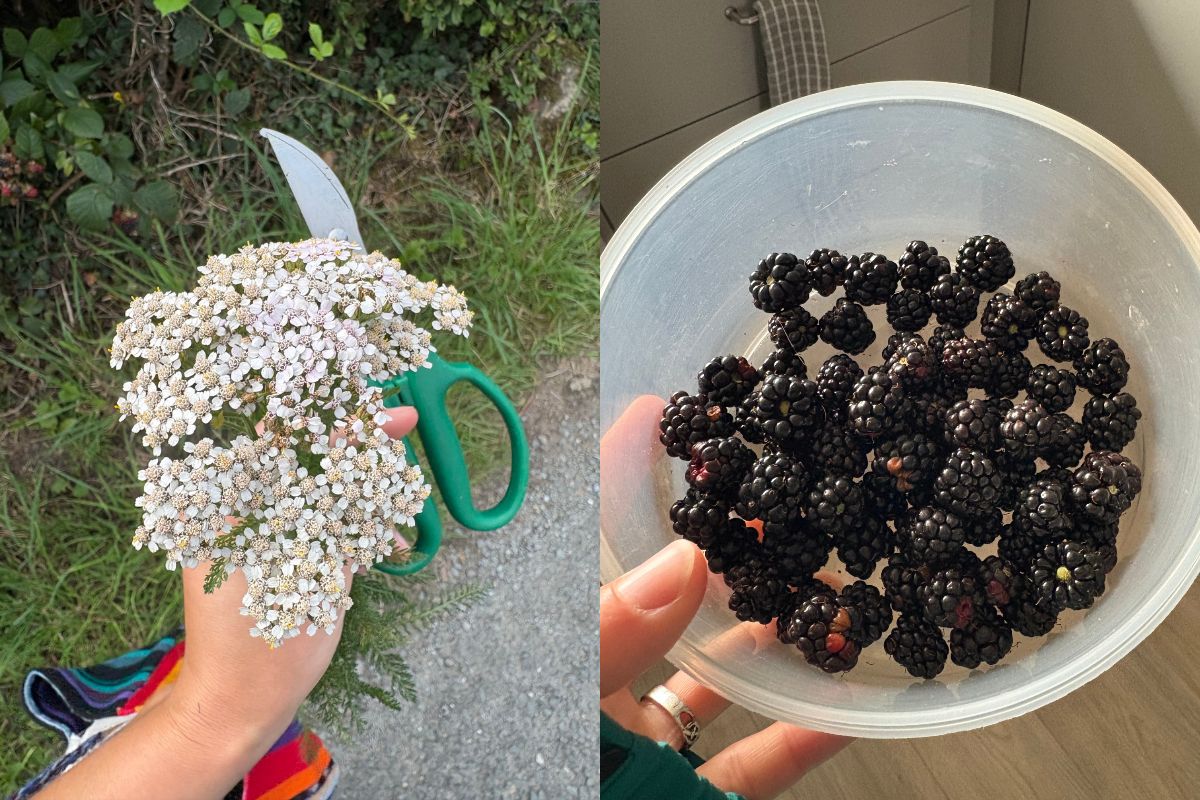
I’ve gotten into foraging in the past couple of years, the fullness of the hedgerows and the lack of poison ivy in Ireland combining to create a good environment for it. I began with picking blackberries on all of my walks, sometimes coming back with a kilogram in only the half hour or hour I’d spend outside at lunch. 

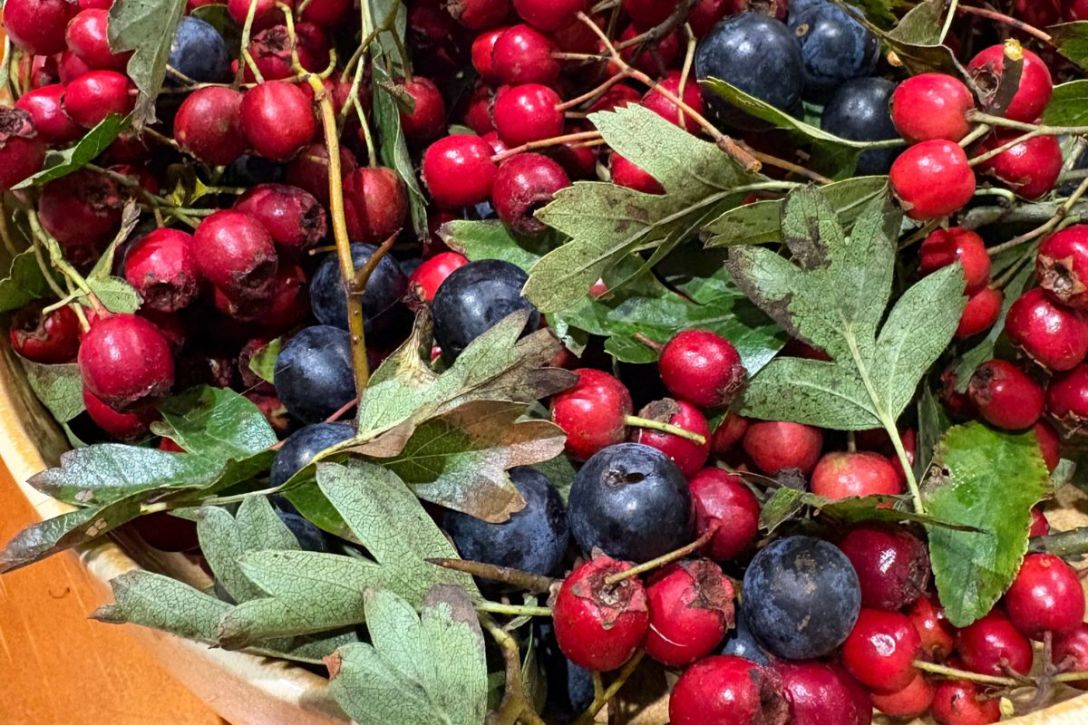
I’ve since branched (ha) out to hawthorns, sloes, elderberries, yarrow, meadowsweet. Basically anything that is easily recognizable and not potentially lethal. Like, I’d love to start foraging mushrooms, but I’d definitely want to get some expert training first; I’m not about to start just eating fungi out of the ground (cue “dumb ways to die” jingle). 

I took my last foraging walk over the weekend, just before they cut the hedgerows back along the rows, in order to grab one last haul of sloes. Then, outdoor adventures completed, I turned to my indoor activity of processing my harvest. Some of the things I’ve made so far: 
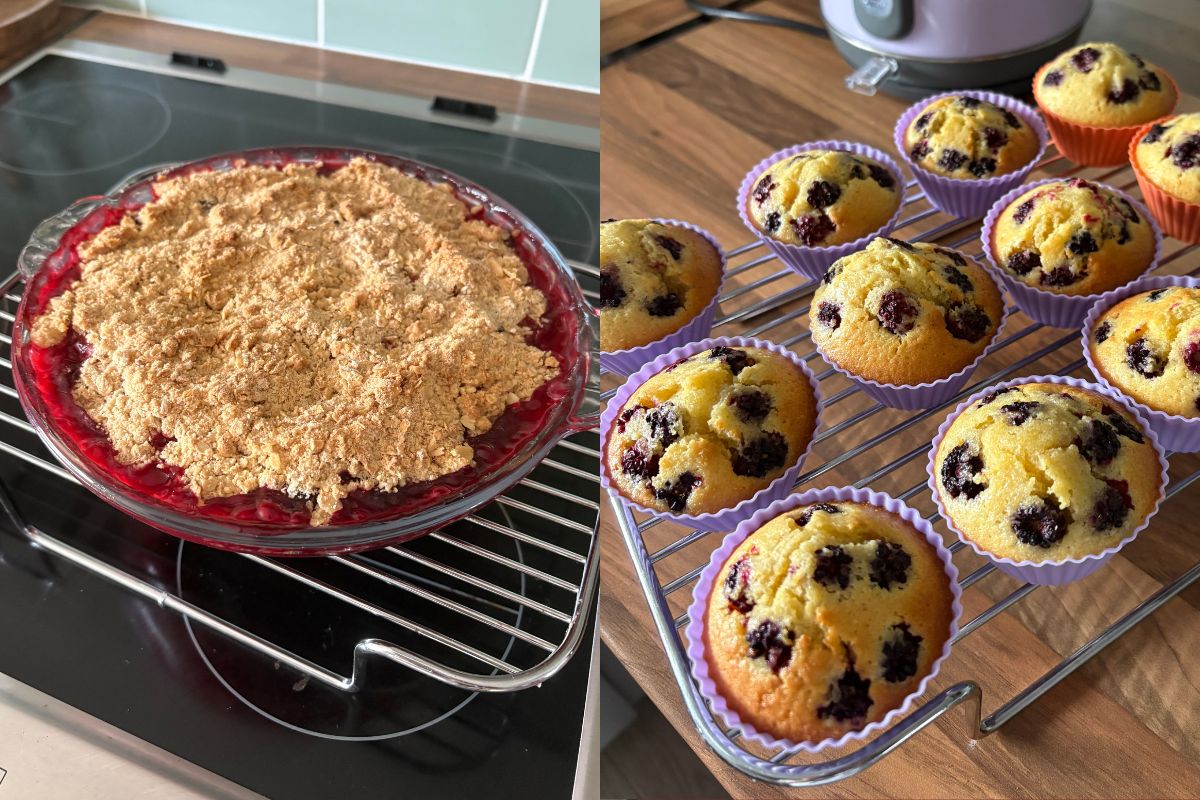
  • Blackberry wine
  • Blackberry jam
  • Blackberry and apple crumble
  • Blackberry muffins
  • Blackberry cheesecake bars
  • Blackberry Bakewell 
  • Blackberry syrup
  • Elderberry syrup
  • Elderberry tincture
  • Elderberry powder
  • Yarrow powder
  • Yarrow tea
  • Yarrow oil
  • Meadowsweet tea
  • Sloe gin 
  • Hawthorn jam

And I’m still planning to try some oxymels and ketchups and a few other recipes with what I’ve got left. 

One thing I really enjoy about the process is how it almost feels like a ritual. I’ve been trying to get back into a yoga routine lately, and it feels similar, the journey of slowing down and making deliberate movements. 

There are a dozen hacks online for the easiest and quickest way to remove tiny elderberries from their bushy stems, but why do we always need the easiest and quickest options? Why would I freeze the branches for faster removable or scrape the berries away with a fork to take them off in clusters rather than individually when I could sit cross-legged on the floor, listening to music and separating the berries from their stems one by one. It’s meditative.  

Anyway, my goal for this year was to write at least 20 blog posts and this is number 19, so you’ll be hearing from me at least once more in the next few months. But as the temperatures drop and the days get shorter and I’m spending more time inside, I hope to spend more time writing as well, so I’d like to think there’ll be more than one more blog post coming along. 

I have been reading an ungodly amount of books, so there’ll at least be a few book reviews on the horizon. The kind of thing you could read over blackberry jam on toast and a cup of mint tea. 
Bagging a big Munro: hiking Ben Nevis (1345m)

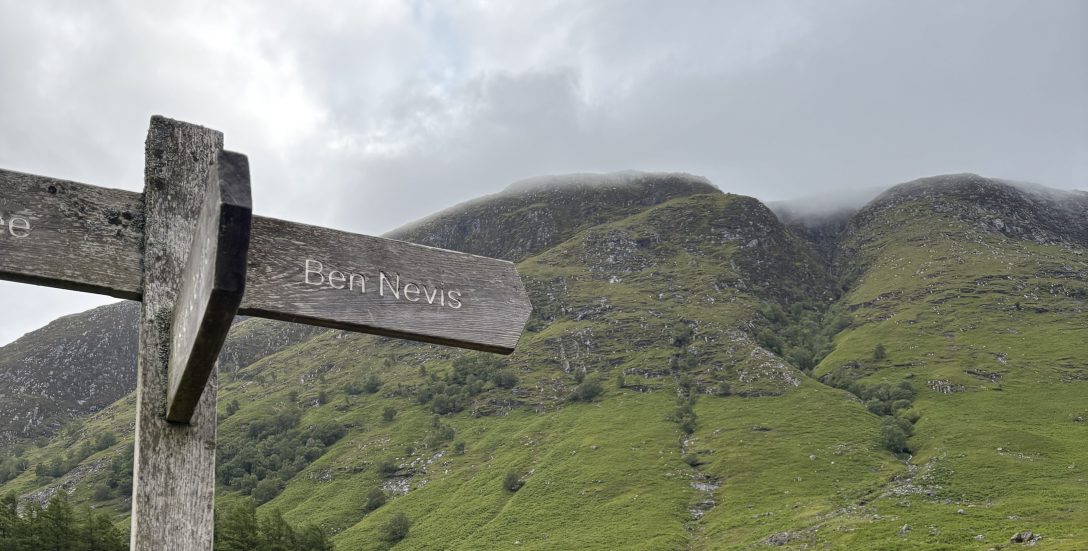
A couple of weeks ago Steve and I met up with our friend Tom for a long weekend in Scotland. We were supposed to be seeing Billy Joel (or, if you’re Irish, Billy Jo-el for some reason) but with the gig cancelled and our flights were already booked, we turned our attention from Bill to Ben and set out to take a hike up Scotland’s highest mountain.

Scotland’s mountains over 3,000 ft (914.4 m) are called Munros, after the man who made the first list of these hills and mountains, and Ben Nevis (Beinn Nibheis) is the tallest at 4411 ft or 1345 m. Side note: this is 306.4 metres higher than Ireland’s highest, Carrauntoohil, but who’s counting?

Hiking up one of these mountains is called “bagging” a Munro, and there plenty of folks that have made it their mission to bag the whole lot (all 282 of them). We’ll start with this one, anyway, but given how much I absolutely loved my short time in the Highlands (I’d only ever been to Scotland once before, on a brief weekend trip to Edinburgh when I was studying in London years ago), I’m sure it won’t be the last.

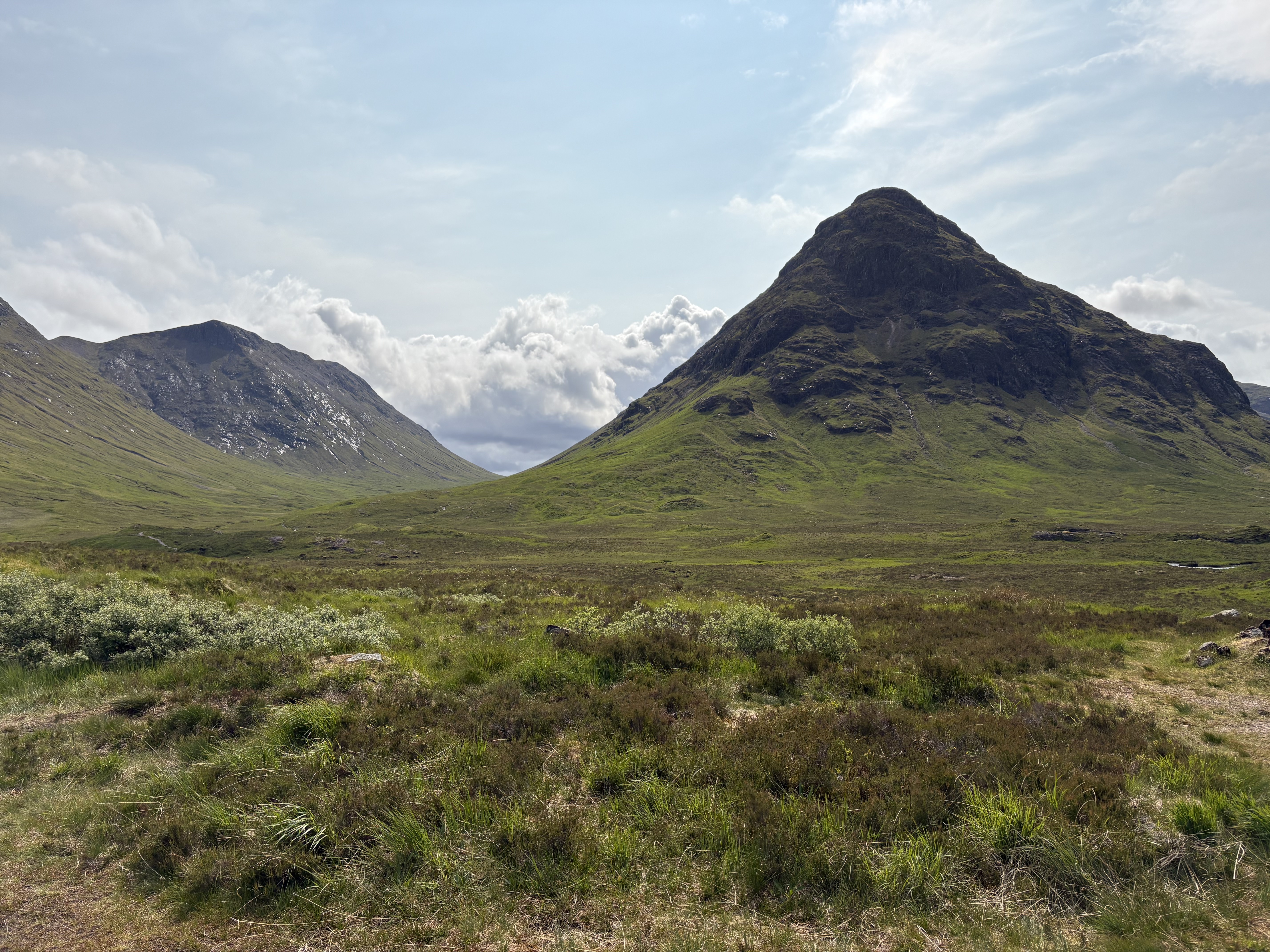
After picking up our rental car at Edinburgh airport, we started on the drive up to our base of Fort William. Although google maps will tell you that this should take three hours, if you’re following this route you’ll want to give yourself an entire day, as we did, for stops at the lovely Ben Lomond, the gorgeous Glencoe, and every random beautiful pull-off and viewing point in between.

The next morning we started bright and early on our trek, driving a quick ten minutes from our accommodation to the visitor’s centre and trailhead (parking £6 for the day — there’s space for about 80 cars but it was already filling up quickly when we arrived just before 9am on a Friday morning).

The path is wide and well-marked throughout; while it’s always important to be well prepared and it’s good to have some orienteering skills in case of low visibility, it’d be a difficult one to get lost on, especially given that there were a decent number of fellow hikers throughout the journey.

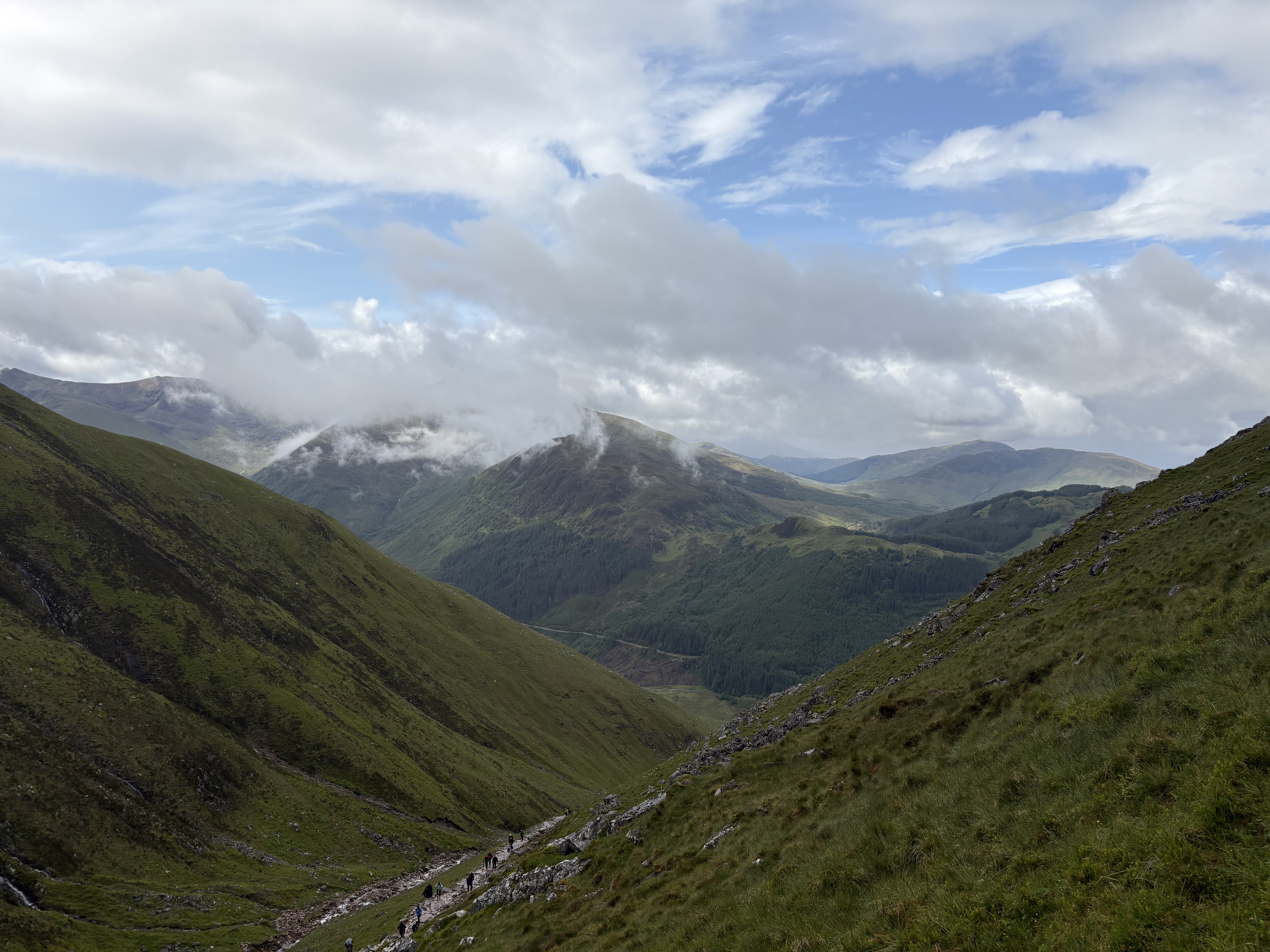
The hike is fairly cruisey at the start, taking you up past some farmers’ fields and a few turnoffs to hostels and guesthouses for those who want to stay super close to the mountain the night before. But after a kilometer it starts snaking its way up the side of neighboring mountain Meall an t-Suidhe. The weather was beautiful for us at this point, a mix of clouds and sun but dry and with a light breeze that kept things cool even as we began to climb.

I’d read prior that Ben Nevis only gets an average of 14 clear days on the summit per year, though, so I kept my expectations low. Similar to Carrauntoohil, I figured the top of the mountain would likely have its own little microclimate, meaning you could have clear skies and sun on the way up, and the complete opposite as you reached the top.

Around 3.5 km in, we passed a small and beautiful lake and then turned up on to Ben Nevis proper. Another kilometer took us to the halfway point, according to the map at the trailhead that said however long it took you to reach the stream crossing at Red Burn you’d spend the same time again reaching the summit (and then approximately 3/4ths of that time descending).

From here it started to get tougher, with a series of switchbacks heading up through the rocks and scree. And the weather started to change as well, with the clouds thickening into a misty fog and the visibility ahead lessening into a haze of grey and white. We spotted the first patches of snow on the ground as well, apparently leftover from a heavier fall a few nights before. This was only a few weeks ago, in June, remember.

Around 7.5 kms, near the summit, when the snowfall on the ground was thicker and the hikers ahead of and behind us quickly disappeared into the whiteout conditions, we passed a couple of steep gullies — slightly unsettling given the low visibility. You wouldn’t want to stray too far off the path here. But a series of rock cairns built up along the route kept us in check, and just past 8 kms we reached the summit!

The trek back down takes you the same way, and as we descended the skies began to clear and the air began to warm again. True to the trailhead map’s guidance, the hike that took just over 3 hours on the way up took about three-quarters of that on the way down, and we found ourselves back at the trailhead in a bit under 6 hours total.

In terms of strenuousness, I would put Ben Nevis as being comparable to Carrauntoohil, despite being a bit higher. It was longer (~16km compared to ~14km) but there were a few flat(-ish) stretches near the top that gave a bit of a break compared to Carrauntoohil’s final push through a steep field of scree. While it was definitely tough on the knees and I wished that I had been able to bring my hiking poles (we were traveling carry-on only so it wasn’t an option), Steve and I did manage to shuffle through a slow 5km jog the next morning at Fort William parkrun, if that tells you anything.

After another night in Fort William, toasting our achievement over a few pints at Black Isle Brewing, we left for a drive up along Loch Ness to Inverness the next day, and then headed back to Edinburgh to fly out on the Sunday.

I’d been dreaming of visiting the Highlands since my small trip to Edinburgh 14 years ago, and between the things we knew we wouldn’t have time to do (namely the Isle of Skye) and the things I heard about while we were there or looked up since we’ve come home, I am eager to return again. Maybe to bag a few more Munros!

Run Killarney 2025

This past weekend I ran the 10k at Run Killarney. First of all, I want to say that this is a fantastic event. It’s probably the most well-organised of any of the Irish races I’ve done, the course is a gorgeous loop that takes you through the national park, and the weather always seems to cooperate. They also have the nicest medals!

My only complaint is that I think it’s weird there are no bananas at the finish line, but at least as of this year there are vegetarian and gluten free options for the post-run snack of a breakfast sandwich. 

My time was 51:17, which is pretty much in line with my recent running. 51:17 works out to about 5.08 per kilometre, and I ran the Streets of Killarney 5 Mile a month ago in 41.28 (5.15 pace, in fairly heavy rain), and my last couple parkruns have all been in the range of a 4:58-5:10 pace. 

It’s not my 10km personal best – that would go to a flukey 48:49 at Run Killarney a few years ago – but it was a solid effort. Before the race, I told Steve that I’d love to get between 50 and 52 minutes, although I thought 55 minutes might be more realistic. So not only was I much faster than my “realistic” 55 minutes, but I was right in the middle of the range I was hoping for. 

I didn’t train too hard for Run Killarney, and one of the main reasons why is pretty silly. I have thick hair, and a lot if it, and it’s extremely slow to dry (and I hate using blow dryer). So the harder I run, and the more often, the more frequently I have to wash my hair. I just wasn’t in the mood for that the last few weeks. If my hair-washing laziness is more of a priority to me than my running speed, then it’s no surprise that I wasn’t breaking any personal records over the weekend. 

And look, that’s part of life. I’m not an elite athlete; I’m not being paid to run (or to wash my hair). I’m just trying to stay fit and healthy, and not feel like crap when I go out for a jog. My big goal when I ran my last marathon was to maintain my running routine afterward – it’s so easy to “take a few weeks off” which somehow spirals into months and months. I managed to keep up a more-or-less twice-a-week habit of a Wednesday evening jog with my running group and a Saturday morning parkrun that felt like enough. 

That said, even if I’m fairly content with my current running fitness, there are some elements I still struggle with. One thing is the natural peaking and dipping of my athletic performance. The women in my running group were talking about this the other week – how one week you might be flying effortlessly, while the next you’re huffing and puffing while going slower or for a shorter distance. 

Sometimes it’s obvious why – tiredness or dehydration or spending hours walking around the Berlin Zoo the day before you run a marathon like I did – but sometimes the reason isn’t so clear. And while anyone can have an off day, women can be particularly affected due to our hormonal changes over the course of the month. And the annoying thing is, the points where your energy is likely to be the lowest are also the times when your emotions are likely to be the most sensitive, a double whammy of poorer performance + letting it get to you. 

Now, I’ll be frank, I don’t track my menstrual cycle (and I haven’t gotten a period in years thanks to my IUD) so I couldn’t actually tell you when it’s the cause of my faster or slower runs. But sometimes you just know when, no matter how hard you push yourself, you’re not going to be getting any of those cute little medals when you upload your activity to Strava. Sometimes you know that you’re not running as fast as you can, but paradoxically you know that you can’t run any faster, at least not on that particular occasion. 

I’ve digressed here, because I did feel pretty good during my Run Killarney 10k, and although I didn’t feel as though I was running as fast as I could, it also felt clear to me that the reasons were the overall lack of training and the hot, sunny day, rather than anything internal and undefinable. 

But it’s a good reminder that these good and bad days will come and go, and you can’t always predict or explain why. And regardless of the result (which again, I was mostly happy with), it was a great day out on a gorgeous sunny day. And the pints afterward went down well, too!

A parkrun for everyone

Killarney parkrun

This week I hit a milestone and ran my 50th parkrun. For those who don’t know, parkrun is a free, community/volunteer-run weekly 5k event that takes place every Saturday morning. Since the first event took place in London in 2004, parkrun has grown to encompass over 2000 locations in 23 countries.

I first started parkrunning at an event in Australia in 2019, and since then I’ve run at 10 different locations in three different countries. But most of my parkruns (38 out of the 50) have been at my local parkrun, Killarney House, a beautiful 3-and-a-bit lap looped run in the national park, and that’s where I ran my 50th on Saturday.

I’m a bit of a parkrun evangelist — if you mention that you’re thinking of getting into running, or that you’d like to get a bit more exercise, I’ll probably start singing parkrun’s praises. And I figure that my 50th parkrun means that it’s good timing to do that here as well. So here’s why I love parkrun and why you could, too.

fun fact: i have never looked good running in a photo ever 🙂

Anyone can join, anytime

Parkrun is completely free for participants and doesn’t require advance registration for any individual event — once you sign up once, you can run at any parkrun, anywhere. All you need to do is go to the parkrun website and register. Once you register, you’ll receive a barcode that you can print out or show on your phone to be scanned after you cross the finish line. That’s how your attendance at an event and your time are tracked.

It’s a great way to get involved

If you’re not a runner or walker, you can also get involved by volunteering! Parkrun depends on volunteers, so you can register to be a marshal, a barcode scanner, a timekeeper, or a number of other roles and become a part of this great and welcoming community. It’s definitely encouraged for runners to volunteer occasionally as well! I like to do the first timer’s briefing, where I explain the route to new participants or visitors and welcome them to our parkrun. As a bonus, it’s one of the volunteer roles where you still get to run as well.

Parkrun meets you where you are

One constant refrain at parkrun is that it’s an event, not a race. Whether you’re an Olympian or a couch-to-5k-er, you’re equally welcome and your participation is celebrated. At Killarney House, for example, finisher times usually range from just over 16 minutes to just under an hour. One of the most valued roles at parkrun is the tailwalker, whose job it is to be the final finisher, so you don’t have to worry that you’re “too slow” for parkrun. There’s also no pressure to maintain a certain pace; some weeks you might run, some you might walk, and sometimes you might do both.

You can meet parkrun where it is, too

There’s a whole group of people who are avid parkrun tourists, travelling to events around the world, whether just for the fun of it or to try to complete unofficial “challenges” like running a parkrun that starts with every letter of the alphabet. While one of the great things about parkrun for me is that I don’t have to travel far to reach my local event, which is convenient and better for my carbon footprint, I definitely like to check out the local parkrun if I’m visiting a new place anyway. Even if I’m not around on a Saturday morning, looking at the parkrun’s event page can be a nice way to find a fun, safe 5k route in a new town or city.

The stats are so satisfying

Because each individual parkrun event takes place on the same route, it can be fun to look back over your personal results and see how they change over time. If you’re on a fitness journey, you might enjoy seeing the times getting quicker as you go, or if you’re the kind of person who parkruns in all conditions (internal and external), it’s interesting to see the numbers go up and down week to week depending on the weather, how you’re feeling, etc. Less than a month ago, I ran my fastest parkrun in two years. This weekend, after two days of hiking, I was over a minute and a half slower. That’s the way it goes!

If you want to get involved, find your local parkrun HERE and sign up to run, jog, walk, or volunteer! As a note, there definitely are far fewer parkruns in the United States than in other countries that have the event, but numbers are growing all the time. And if you’re looking for an event that’s local to you, maybe it’s time to consider starting one!

Hiking Mount Errigal in Donegal

Note: Hi, hello, sorry, it’s been a while. I’ve been blogging 2-3x per week for work and writing some of my own personal projects, and it hasn’t left a lot of time for updating this. Apologies, I’m trying to work it into the schedule going forward.

Over the St. Patrick’s Day bank holiday weekend, Steve and I took a trip up to Donegal, which may be the only county in Ireland that can rival Kerry for beauty. From the rugged cliffs of Sliabh Liag to the lovely bike trail that runs along the lake in Glenveagh National Park, it’s a stunning and off-the-beaten-track part of Ireland that is well worth a visit.

Hiking Mount Errigal was one of our main goals in visiting Donegal, and we were lucky to have absolutely fantastic weather throughout the whole weekend. The highest point in the country, Errigal stands at 751 metres (although the trailhead starts fairly high up so your actual ascent is only about two-thirds of that) and has great prominence, making it a short but impressive hike to undertake.

Continue reading “Hiking Mount Errigal in Donegal”

Wowed by Waterford

When you look at a list of the top things to do in Ireland, Waterford doesn’t often get a mention. It appears nowhere on this list, nowhere on this one, and even on a list of hidden gems rates only a single mention. And while it’s true that if I were recommending essential spots to someone coming to Ireland for only a few days Waterford probably wouldn’t make the list, after visiting a couple of weeks ago I would say that if you have a bit more time to explore, it’s definitely worth a visit.

Continue reading “Wowed by Waterford”