Read Banned Books

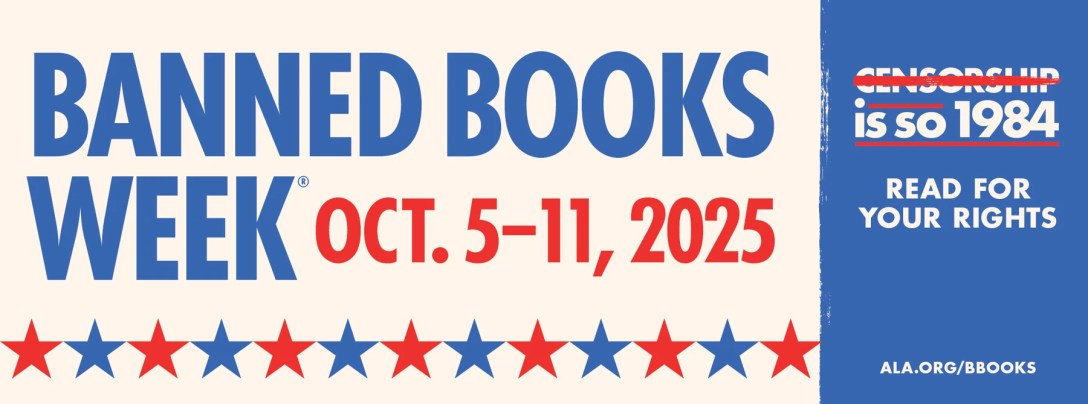
Banned Books banner from ALA

It’s Banned Books Week, and with books, authors, and libraries under more pressure than ever (usually from the people who claim to be champions of free speech…), there’s no better time to celebrate the challenged, banned, and censored literature we love.

With reasons for challenges as nebulous (and as bullshit) as DEI content (aka “there was a Black person in it”) and indecent material (aka anything the complainant doesn’t like…), we must continue to fight hard for books and the people who write, share, and read them. 

Some people are going to pretend that their reasons for wanting this or that book taken off the shelves are in good faith rather than based in their bigotry. 

“I’m all for free speech,” say the so-called free speech warriors while they try to stifle free speech. “I just don’t think this is appropriate for kids,” they say, of books they haven’t read but have heard second hand that something in them conflicts with their personal beliefs (which obviously need to be foisted upon everyone else, because everyone knows that’s what free speech is all about). 

And look, it’s true that not everything is appropriate for all ages. Even if it is a time-honored tradition for every kid to read a book (usually by Stephen King) that is extremely age-inappropriate for them. Mine was King’s The Dark Half when I was probably 12, although I’m sure others didn’t come long after. 

But for folks who claim they want small governments and people to mind their own businesses, they sure don’t want to take responsibility for their own kids. 

When I had to do an elementary school project on an aspect of colonial America, I had to get a permission note from my parents to be allowed to research the Salem Witch Trials (another formative event for me, I’d say). I wasn’t barred from it, and the books wouldn’t have been taken off the shelves if my parents had objected to my reading them; the school just wanted to be sure they were aware (aware of what? That they had a weird kid, probably). 

With thousands of books challenged every year, you can be sure that almost every possible topic has been deemed offensive and inappropriate by someone out there (and I thought we were the snowflakes?). It’s particularly ironic to see classics like Fahrenheit 451, 1984, and The Handmaid’s Tale on the lists of most-banned books year after year, but we can’t forget about the many new and emerging authors for whom book bans and challenges can really damage.

And while reading is not activism (and let’s be real, neither is posting), I think it’s still good to stand in opposition to the folks trying to ban these books, who often admit to not having read them when they’re pressured to provide evidence of their claims, by reading and promoting banned books (and buying them to support those authors!) 

Or, as the author that PEN America reports is the most banned in US schools, Stephen King, puts it: 

“When books are banned from school libraries, run to your public library, or the nearest bookstore, and read what it is your elders don’t want you to know”
What I Read in April

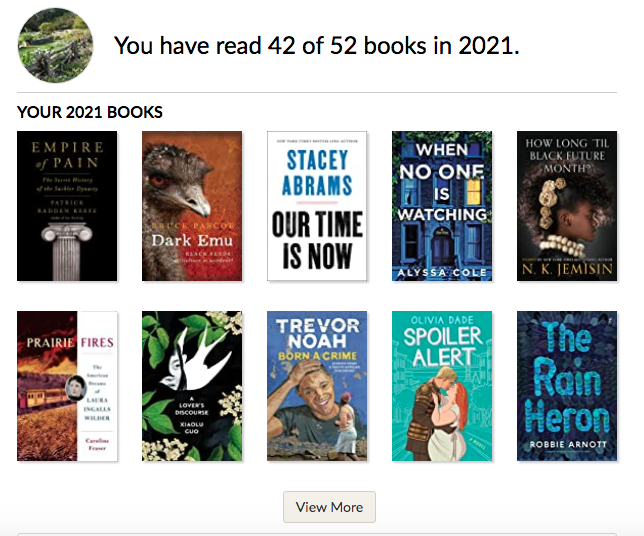
Okay, so after all my big talk last month about how I might have to split up this month post’s into two because of all the books I was going to read, I actually had a pretty slow reading month. I got a just a wee small little bit obsessively hooked on a podcast (The Magnus Archives) and so instead of listening to audiobooks I found myself listening to the podcast, and instead of reading… I also found myself listening to the podcast. 90 episodes in means it was a quieter reading month than the last couple (and I still have half the podcast to go so May might have fewer than usual books in it as well). That said, I still got through a good few excellent books; read on for my reviews or check them all out on Goodreads.

Continue reading “What I Read in April”

A better world is possible

It looks like a suburb.

I’m not sure five words have ever given me such a radical mindset shift. Like so many of us, the ongoing murders of Black people at the hands of the police, and the police response to peaceful protesting in the wake of yet another unjust death, has cemented the idea that we cannot just put our faith in law enforcement to do the right thing and uphold justice and fairness in our country. This is something that I’ve already known, but do to my privilege, I’ve never had to sit down and think about how that would look.

Continue reading “A better world is possible”

500 days of twenties

I’ve got this great app called Countdown Star on my phone that I love. You input an event and it how many days there are until the date (or from the date, if you’re counting up from the day of your birth or whatever past occasion you want to celebrate or remember). 19 days until Steve and I go to Japan. 59 until we go to Tasmania to hike the Overland Track, 11 days since we got engaged (oh yes, did I not mention? …more on that next week), 10,457 days since I was born, and so on. And today it is exactly 500 days until I turn 30. Because I’m me and I love a good list, of course that called for one. A short-term bucket list of sorts, 30 things I want to do between now and 500 days from now, when I leave my twenties and join the world of thirty, flirty, and thriving.

I won’t share the whole list as some things are quite personal, but here are some of the items I plan to check off:

Continue reading “500 days of twenties”

Heartbeats, holidays, hopefulness, helplessness

When I was in grad school in Ireland, my friends and I made an agreement that if one of us should find ourselves with an unwanted pregnancy, we would rearrange our schedules for an immediate “girls’ holiday” to the UK—cocktails, spa visits, shopping, all that fun, female stuff. And an abortion.

It’s something that I had never had to think about in the United States. Roe v. Wade had been settled by the Supreme Court almost two decades before I was born, and while another Supreme Court ruling from my own home state, Planned Parenthood of Southeastern Pennsylvania v. Casey, allowed for more restrictions and guidelines, abortion would have been generally accessible to me had I needed it.

Continue reading “Heartbeats, holidays, hopefulness, helplessness”

Kia kaha, Christchurch

It is a privilege to feel safe in the places you call home. It shouldn’t be, because what is home if it is not a place that is known and that is safe, but again and again we see places that should be known made unsafe by hate. Like the rest of the world, I was shocked and saddened to hear the news of the mass murder of Muslims at a mosque in Christchurch. New Zealand is the safest and most peaceful country I have ever been to or lived in, and yet a group of people decided that shouldn’t be the case for their victims.

New Zealanders haven’t had to grapple with a tragedy like this, whereas in America we are nearly desensitized to news of yet another mass shooting. Politicians send their thoughts and prayers, outraged is silenced with cries of “too soon,” The Onion reposts that too-accurate headline, and nothing changes. I was surprised and gladdened to hear that the New Zealand government’s immediate response was to promise a ban on semi-automatic weapons; imagine if our politicians had ever acted so quickly and decisively? How many schoolchildren, churchgoers, and others would still be with us?

The outpouring of support for the Muslim community in the wake of the tragedy is also heartening. Flowers cover mosques around the country. Vigil attendances number in the thousands. A givealittle page (New Zealand’s answer to Go Fund Me) for victim support has topped $5 million in donations. Kiwis and the world are coming together to echo Prime Minister Jacinda Ardern’s words about the victims: “They are us.”

At the same time, although for many New Zealand seemed like a utopia between its stunning natural beauty and its peaceful, unified society, the sad truth is that New Zealand is not immune from the influence of intolerance, white supremacy, and an environment where “casual” discrimination is given a blind eye rather than spotlighted and called out (and what does “casual” discrimination even mean? Is it a hobby? A side-hustle? Part-time racism?). Where alt-righters like Stefan Molyneux, Jordan Peterson, and Lauren Southern have eager audiences. Where stereotypes about Maori and other islanders flourish as “jokes.”

I am certainly not writing this as a sanctimonious outsider pointing out the flaws of another country; I, too, am certainly often guilty of not doing enough to call out intolerance when I see it. It’s particularly tragic to think that the murderers were likely inspired by the political climate of my own nation. And New Zealand is certainly a lot more welcoming than the United States (or Australia, by the way; wow, there is a lot of racism here, and not just from the Senator who made that awful statement after the mosque shooting, although you should enjoy this video of him getting egged by a teenager).

However, it is tempting to dismiss the murderers’ terrible actions as unrelated to anything else in New Zealand society, to identify solely with the victims. But without changing our own actions and stepping up every time to speak out against racism, discrimination, Islamophobia, intolerance, we are dishonouring the victims by allowing the murderers and those who think like them to find something to identify with in us (please read this powerful comic by Spinoff journalist Toby Morris for more).

It is important to carry the feelings of love and solidarity for the Muslim community, the immigrant community, the community as a whole, that are strongest and most present now in wake of this tragedy, and let them be a guideline going forward. We must cultivate an environment in which seeds of hate can not plant roots. And that means asking ourselves difficult questions, and being willing to ask difficult questions to others. Kia kaha, New Zealand. Stay strong and show your strength by protecting your whānau—Maori, pakeha, Muslim, and everyone else who is lucky enough to live in such a kind and beautiful country. Come together in love and action to ensure that everyone is safe in the places they call home.