First time in Asia, we went to Malaysia

Kia ora! As usual, I haven’t been updating this blog, so last you heard I was hanging out at my parents’ house in Pennsylvania, and now here I am on the other side of the world in Wellington, New Zealand. Steve and I arrived about three weeks ago to begin our 12-month working holiday visas here in New Zealand, and it’s been nothing short of amazing so far. I promise, promise, promise (but I always say that, don’t I?) I’ll give you some NZ details soon, but first I want to talk about the journey over and our stop along the way.

Before heading off to New Zealand, I went over to Ireland for a month. It was the first time i’d been back since finishing my MA and leaving three years ago, so I was so excited to return to Killarney, Galway, and see some new places like Wicklow and the Ring of Kerry. More on that later, but I want to jump ahead to leaving Ireland on November 21st.

The longest flight I’d ever taken before November was about nine and a half hours from Philadelphia to Madrid. We were looking about 30 from Dublin to Auckland. Obviously there are no direct options, so when we were deciding which route to take we started discussing stopping over somewhere for a few days to hopefully lessen the jet lag and take the opportunity to see somewhere new. And that’s how we ended up on a flight from Dublin to Heathrow before heading on to Kuala Lumpur, Malaysia.

OLYMPUS DIGITAL CAMERA

We picked KL for a few reasons. It’s not Dubai, one of the most common spots for layovers between the east and west but someplace neither of us have much desire to see. The combination of Asian cultures that KL promised interested and appealed to us. It’s also meant to be far less expensive than other cities we considered like Hong Kong and Singapore. And so we booked a hostel and were off to Malaysia.

We arrived in Malaysia after almost 24 hours of traveling (counting layovers and time spent driving to the airport), hungry and tired and completely unprepared for the heat and humidity, coming from Ireland’s already wintery conditions. After checking into our hotel we only made it around the corner for some (delicious) indian food before returning to our room and collapsing to sleep.

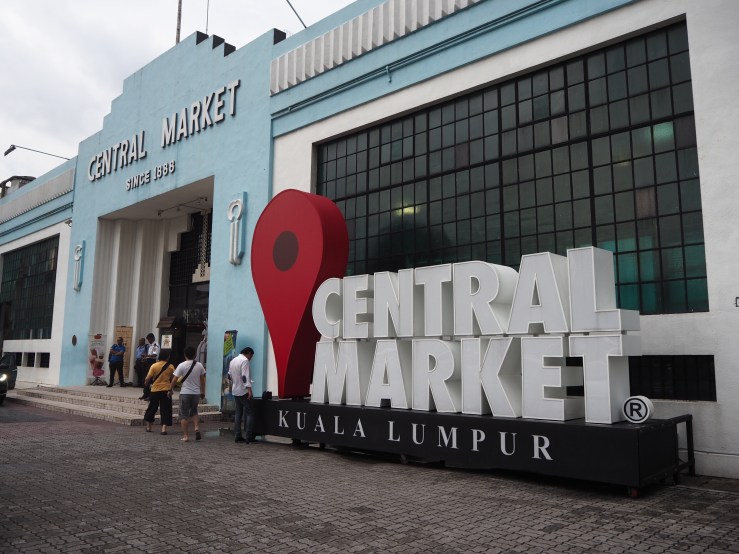
Luckily, our flight was scheduled that we got to KL in the evening, so by morning we were fairly refreshed and our sleeping schedules weren’t too horribly screwed up. We ventured out to explore the city. Our first stop was the famous Central Market, where hawkers and vendors sold their wares to hordes of tourists. We were immediately tempted by any number of items but, having been told that KL is a shopping mecca, we used our willpower to hold off in anticipation for having plenty more options over the course of our stay.
OLYMPUS DIGITAL CAMERA

As it turned out, our shopping trip would soon continue as we left the market to find a torrential downpour. Wanting to stay inside as much as possible until the rain let up, we headed for Bukit Bintang and a seemingly endless parade of malls. Usually I get equal parts bored and overwhelmed in massive shopping malls, but the bright lights, bustling crowds, and array of brands and shops I had never heard of combined to create an experience more like the Vegas Strip or New York City than a typical trip to the mall.

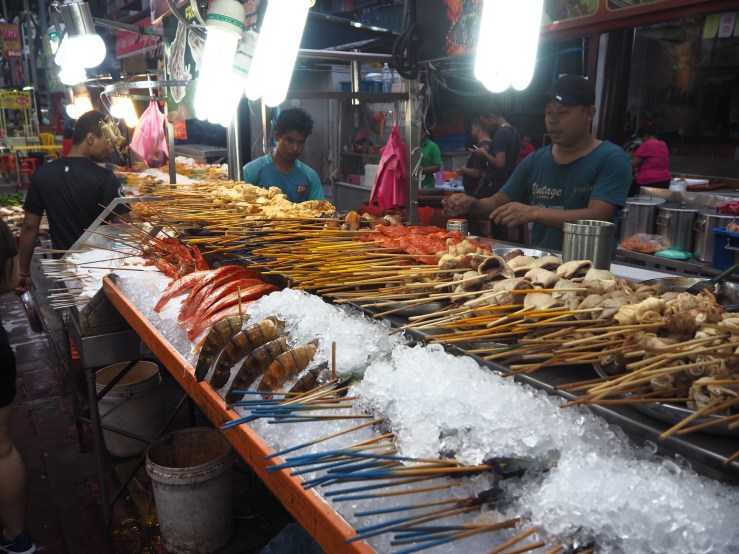
We cheerfully spent the rest of the afternoon going from shop to shop, mall to mall, and when the rain had let up we took a friend’s advice and made our way to Jalan Alor, the famous outdoor street food market.
OLYMPUS DIGITAL CAMERA

I would be remiss if I didn’t tell you how amazing the food in KL is. For as little as three US dollars, you can stuff your face with incredible mee goreng (fried noodles), nasi goreng (fried rice), or my favourite, hokkien mee. This last we ate twice in Lot 10, a food court with an offshoot kiosk of the original restaurant that created this smokey, savoury noodle dish. I could have eaten it half a dozen times more if it hadn’t been for my desire to try as many different dishes as I could.

OLYMPUS DIGITAL CAMERA

On days two and three of our trip, we visited the two most famous attractions in KL. The morning of the second day took us to the Petronas Towers, one of the tallest structures in the world (it’s the tallest twin tower, and the 12th tallest building overall). First we took the lift up to the skywalk on the 41st floor, where we stepped out onto the (enclosed) bridge between the two towers and got what we thought was an impressive view of the city.

OLYMPUS DIGITAL CAMERA

And it was, but it was nothing compared to being sent up to the 83rd floor and walking around the observation room, taking in the 360-degree views of the city and surrounding area. One of the most striking things about KL is the contrast of old and new. Skyscrapers sit next to temples and down the street from aging villages. In the distance, the mountains and hills encase the city, impressing their own power on the imposing newness of the vibrant billboards and rushing traffic.

OLYMPUS DIGITAL CAMERA

In the afternoon, we ventured south through Brickfields (also known as Little India due to its cultural make-up) and to the Royal Palace. Unfortunately we were not allowed to take pictures inside of the lavish rooms where the King and his family live when they are in the city, but it was still an interesting introduction to some of the political culture of Malaysia. I have to admit, I knew (and still know) very little about Malaysia, and on this trip we focused more on having fun and eating a lot of food than really learning, for fear of taking in too much information and arriving to New Zealand exhausted rather than refreshed, but I was glad to get a little break from the bustle of the city and see a bit of Malaysia’s history at the same time.

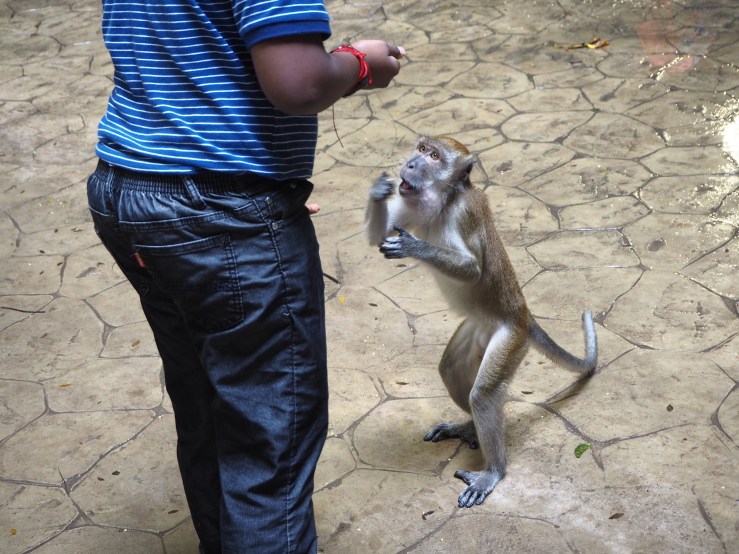
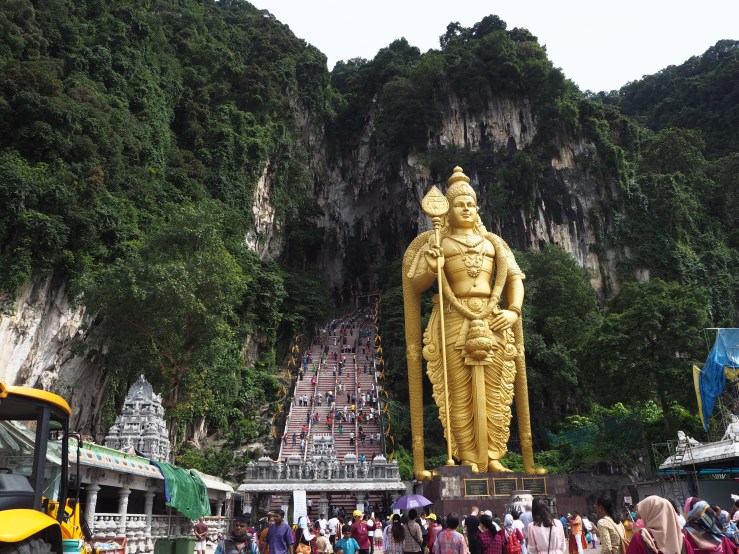
The next day, we visited KL’s other most famous attraction: the Batu Caves. Having heard advice from friends who had visited, we came prepared. We made sure to cover our knees and shoulders for modesty (although judging by the amount of skin most other tourist were showing, this wasn’t strictly enforced unless you were actually entering a temple) and, more importantly, we didn’t carry anything that the monkeys might try to steal.
OLYMPUS DIGITAL CAMERA

We had been advised to visit the caves early in the day, when it wouldn’t be so hot to climb the steps up, and apparently everyone else had received the same advice as the steps were crowded with locals and tourists. Monkeys leapt around, not caring if they got in the way, happily stealing from unsuspecting people who stopped to take photos or look back at the city. The caves itself were cool to see, although heavily scaffolded from restoration construction work.
OLYMPUS DIGITAL CAMERA

However, it was the cave just around the corner from the main entrance that was one of the highlights of my trip. The Dark Cave is an eco-reserve that traverses deep into the mountain and features an array of bat species, cave-dwelling insects, and one of the rarest spiders in the world. We took the 45-minute tour and were led by our excellent guide, Ain, into the cave.

Dark Cave is aptly named. For most of the tour, light from outside is visible. However, as you go deeper into the cave, it fades away until you turn the corner and find only illumination from the torchlights provided. Then, the tour guide asks you to switch off your lights before she switches off her own, leaving you in darkness so complete that opening and closing your eyes looks exactly the same. It’s an intense experience.

Throughout the tour you can hear the chirps of bats and the dripping of water. In one area, openings in the cave create an eerie wind. In another, the falling water creates a beautiful calcite waterfall, seemingly frozen in time as the moving water flows over it. I didn’t hear anything about this tour before we went, but if you are ever in KL I highly recommend it.

OLYMPUS DIGITAL CAMERA

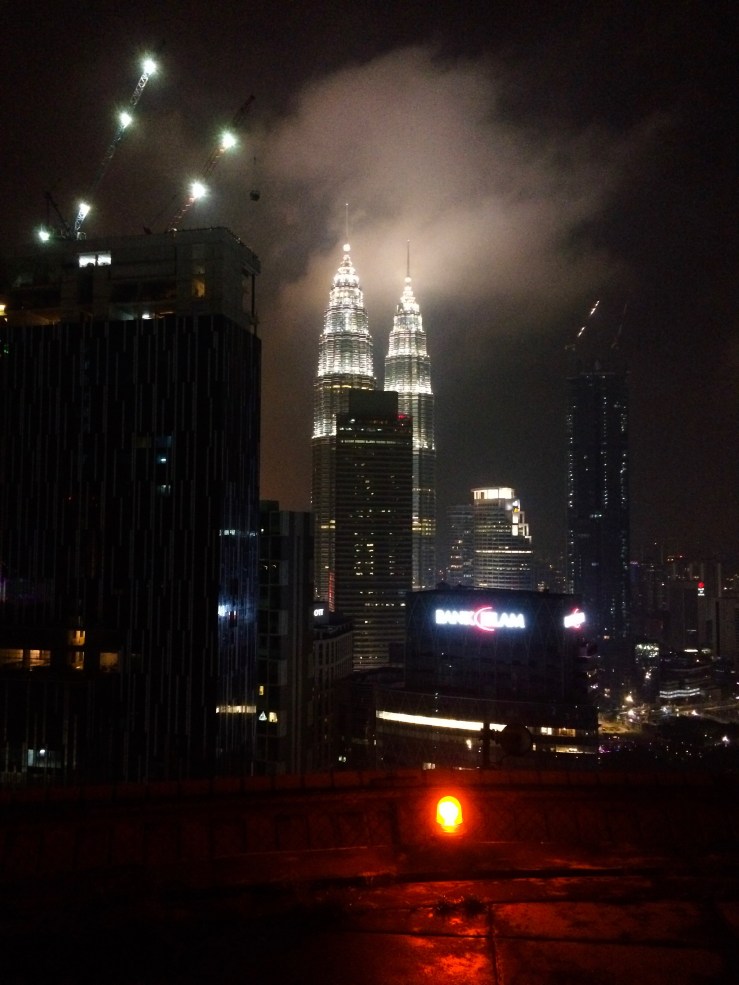
In the evening, it was back to the bright lights of the city and up to the top of a local hotel where a helipad-by-day, bar-by-night offers incredible views of the city. We stayed for two cocktails and then went exploring along the main tourist/bar street. A ladies’ night deal saw me drinking free gin & tonics—don’t worry, Steve wasn’t completely left out; he got 2-for-1 Long Islands. As you might expect, we weren’t up for doing much the following day.
IMG_6501

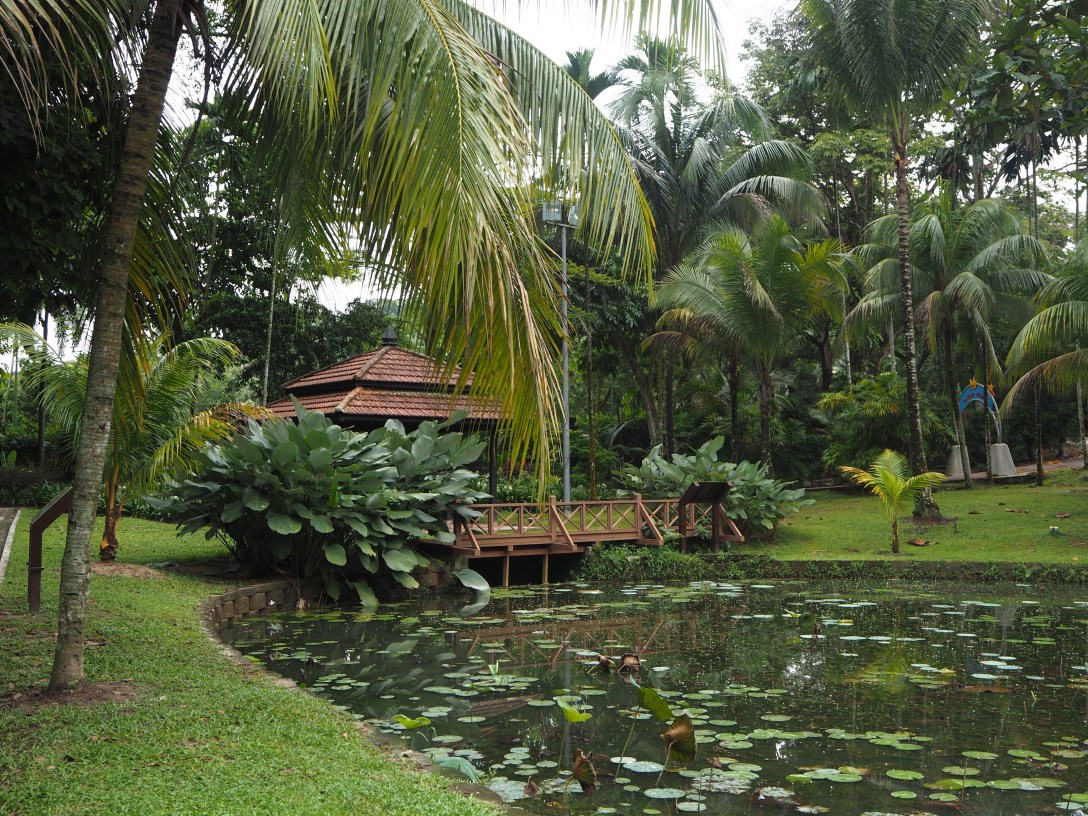
Our flight on the day we left wasn’t until nearly midnight, and we were determined to cram as much into our last day as possible. In part, it was because we wanted to experience all of KL that we could, but it was also an effort to tire ourselves out in the hopes of catching a few minutes of shuteye on the flight to Auckland. We explored the botanical gardens in the morning. seeing a variety of local trees and flowers.

Afterward, we headed to the central market once more, where I tried something that I had been curious about since Steve had done it on our first day: a massage of sorts by small, toothless fish who got their sustenance by eating the dead skin cells of your feet. It was an incredibly weird but oddly nice feeling, and I have to admit my feet felt pretty good afterward, despite the number of miles I had put on them over the course of our trip.

OLYMPUS DIGITAL CAMERA

Finally, a quick stop back at Jal Alor for one last dose of delicious Asian street food saw us off before we returned to our hotel, collected our luggage, and hopped in a taxi off to the airport. Onward to New Zealand!
Being a Writer When You’re a Writer

“Being a writer” has a low bar to entry. It’s not like “being an engineer”—you don’t have to work as a writer or be trained as a writer or ever publish a word of your writing. You just have to write. Being a writer as a career obviously takes a little more effort. I am a writer by nature and by trade—for the last two years I’ve spent somewhere between two and ten hours a day, five days a week, writing. It’s not what people would consider “glamorous” writing, creating product copy for ecommerce websites; it’s not being a novelist or a features writer or any of my “dream” writing jobs, but it’s nice to be able to say that I pay my bills as a writer.

Plenty of writers have no interest or ability to write as a profession, and simply write in their free time as a hobby. Sometimes I envy that. Too often, after a full day of writing for work the last thing I want to do in my free time is open up Scrivener and start on my own projects. Even on weekends when I haven’t been writing all day, I feel as though I want a day off from this thing that I supposedly love and feel endlessly passionate about. This is where I admit that I haven’t finished so much as a short story in nearly a year. Heck, I’ve barely even started so much as a short story in that time. And you, dear readers, have seen how infrequently I manage to even update this blog.

Sometimes the self-doubt creeps in and I think that perhaps I’m not a writer. Maybe I’m a non-writer who just happens to write for a living. I know this is the kind of self-doubt that nearly every writer struggles with; twitter is full of jokes from amateur and professional writers about the trials and tribulations of putting words on the page.

The recipe is simple: to be a writer, you must write. You must write when you’re tired, or sad, or after you’ve written all day for work. You must especially write when you feel like every word that spews out is pure shit. Thriller writer Harlan Coben said, “You can alway fix bad pages. You can’t fix no pages.”

Stephen King said that he writes 2000 words each and every day. I know from several years’ experience participating in NaNoWriMo, where the daily average goal is 1667, words that writing 2000 words can take an hour or twelve, depending on the day. Obviously, that’s not feasible for everyone, whether they write for their job or not. But what I must learn to better remind myself is that ending a day having written a single word on a personal project leaves me with one more word than I started with, and sometimes that’s enough.

I won’t be participating in NaNo* this year—for most of November I’ll be visiting Ireland and toward the end Steve and I will be moving across the world to New Zealand where I’ll almost certainly be too preoccupied searching for housing and a job. I can’t commit to writing 2000 words a day, or maybe even 200. But I’m a writer, and so I must write.

* For the uninitiated: November is National Novel Writing Month, where thousands around the world attempt to write a 50,000 word novel in 30 days. Published novels that began as NaNo projects include The Night Circus by Erin Morganstern, Water for Elephants by Sara Gruen, and Fangirl by Rainbow Rowell. 

My Self-Improvement Summer

As most of you know, I’m back at my parents’ house for a few months between Steve and my epic three-month, cross-country road trip and reuniting with him in Ireland again before we head on to a working holiday in New Zealand. As my town is quite small and uneventful and my work doesn’t take up too much of my time, I decided that for the summer I would work on setting some habits, reaching some goals, and making it a summer of self-improvement.

I know that summer isn’t technically over, but I’m wearing a hoodie and drinking hot tea during the day for the first time in ages, so it definitely feels like fall and therefore I’m going to check in as I move into My Self-Improvement September. The eight things I wanted to work on this summer were: yoga, meditation, piano, guitar, Duolingo’s German course, running, dance and this blog. Let’s see how I did:

Continue reading “My Self-Improvement Summer”

Buying Happiness: The Internet and Self Care Materialism

I read an interesting article on Buzzfeed yesterday discussing the way youtubers and influencers use the idea of “self care” to sell sponsored content. The article discusses influencers who shill products that allegedly help them when they’re feeling low, as well as influencers who post sponsored (i.e. paid to mention certain brands) videos with a self-care focus. It’s a good article and it got me thinking about the way we use and, yes, commodify self care.

“Self care” is of course not a new concept, but it seems like there’s a definite uptick in talking about it as of late (especially, for obvious reasons, after the 2016 election). From blog posts to YouTube videos talking about “10 things I do for Daily Self-Care,” “My Favourite Beauty-Related Self-Care Products,” and so on. There’s also been a lot of discussion about the concept of self-care in positive and critical ways, ranging from an acceptance for the need for self-care being beneficial in fighting the stigma surrounding mental health to the inequality of “self-care” being limited to those who have the time and resources to achieve it. 

The materialism often underlying self-care talk that’s examined in the Buzzfeed article is something that’s come up before, and I think it’s an interesting discussion. Part of this comes from the fact that some youtubers and bloggers who frequently talk about their self-care routines also gain emotional credibility from their audience through their openness about their struggles with mental health. While their efforts to work against the stigma of mental illness is admirable, there’s also a definite backlash against people equating “self-care” with a treatment for mental illness. There’s this whole history of people saying, “Oh you’re depressed? Just do something that makes you happy” that doesn’t acknowledge that mental health treatment often requires medical treatment because it’s a medical condition, not just a bad feeling, so the ire is understandable. 

Continue reading “Buying Happiness: The Internet and Self Care Materialism”

The Museum of the American Revolution and other essential Philadelphia-area Revolutionary War historic sites

As a kid, it took me some time to realise that everyone in America didn’t grow up within minutes of important historical locations. I grew up in the suburbs of Philadelphia, so I would always say I was from “outside Philly” but whenever I need to give more specificity to people familiar with the area but who didn’t know my small town, I described it as “near Washington Crossing… as in Washington crossing the Delaware.” In addition to being just a few minutes’ drive from this historic location, the towns around mine are full of houses and buildings that date back to the colonial era, I used to work at a school that was owned by a doctor during the Revolutionary War (and is allegedly haunted by a Hessian soldier he operated on there), and, of course, the city of Philadelphia is only 40 minutes away.

603790_10153168766615960_3753087677858423150_n
The Artillery park at Valley Forge National Historic Parka

Yesterday I visited Philadelphia’s new Museum of the American Revolution. A few blocks away from Independence Hall and the Liberty Bell, the museum is the perfect addition to the area. Tracing the events leading up to, during, and through the aftermath of the Revolutionary War, this well-curated exhibit features artifacts from the time period and thorough explanations of significant happenings and people. Highlights include the excellent orientation video, the original tent Washington used as his personal office during the war, and one of the oldest preserved Revolutionary-era flags of the soon-to-be United States. Most of us are already familiar with the basic history due to years of primary education (is it just me, or did we learn about the Revolutionary War pretty much every year?) but the museum does a great job of providing a comprehensive overview while also delving deeper into lesser-known moments, people, and things.

Continue reading “The Museum of the American Revolution and other essential Philadelphia-area Revolutionary War historic sites”

Long Listens for Long Drives

Everyone always talks about making the perfect “road trip playlist.” There are two reasons I don’t think this as important as millions of Spotify users make it out to be. One: you don’t need to make the perfect road trip playlist because it already exists and it’s called Born to Run by Bruce Springsteen. Two: while it’s true that driving down an empty highway with the windows down and the radio at full volume is a freeing, exciting feeling, listening to something that really grabs your attention is a better way to keep you alert and pass the time.

Some people enjoy listening to an audiobook while on the road; personally, I prefer podcasts. Steve and I started listening to podcasts on our road trip after we decided to check out NPR’s deservedly-hyped hit S-Town. We binged on all of the episodes over the course of several days, and then I learned that he had never listened to the first season of Serial. After that, it was the latest episodes of The Men in Blazers Show, the back episodes of Reply All, and more. Here are a few of my picks for longform listens to make the long hours on the road fly by in entertaining style.

Continue reading “Long Listens for Long Drives”